
Priming, or pre-practice, is an effective intervention for individuals . Priming involves familiarizing the student with materials, activities, and interactions before an event occurs. An instructor previews information or practices responses with the student before he actually engages in that activity. Thus, priming orients the student to the upcoming event or activity to support familiarity and predictability. In other words, you are preparing the student for what is to come and increasing the likelihood for successful performance. This manipulation of antecedents and readjustment of orientation has proven effective in reducing confusion, anxiety, and frustration with the individual .
Antecedents: Any events that come prior to a behavior / response and have some effect on the occurrence of that behavior / response.
Orientation: Readiness, attention to the relevant cues, focus
Here are three examples that depict relatively simple yet important priming procedures:
 |
 |
 |
| You are working with a student who is a very picky eater. The cafeteria today is serving two main dishes, neither of which make her very happy. She sometimes cries when she arrives at the cafeteria and is surprised by these non-preferred options. Therefore, to better prepare her for the fact that today’s lunch options are not her favorites, you show her the lunch schedule and also show her images of those dishes from the internet. Before she goes to the cafeteria, she indicates which of the two she will select and you provide heavy reinforcement for making an appropriate choice. You have primed her, or prepared her, for an upcoming event. | You are working with a student who will encounter a small group activity in his next class period. When he sits with a small group, he sometimes turns his chair around so he is facing away from the group. Before he transitions to that class, you engage him in several practice opportunities to come over to a table, sit down, and face towards a small group. By engaging him in these practice opportunities, you have primed him for the upcoming situation. | You are a job coach working with an employee at a grocery store. The grocery store has decided to change from the use of plastic bags to only a new type of paper bag. To better prepare this employee for this change in materials, you meet with him before his shift starts to show him these new bags. By exposing him to these bags before he starts working, you have engaged in priming that will likely reduce this employee’s confusion and anxiety as he works with new materials during his work shift. |
Because priming, or pre-practice, orients and focuses the student on expected behavior in the instructional setting, it may involve the use of a number of visual supports. Often, the use of a visual support tool is a crucial component of the priming process.
Making a commitment to change a behavior is often quite difficult for all of us. It is human nature to keep doing the same thing one has always done. Breaking a pattern requires motivation, determination, and effort. The challenge of learning a new behavior can be problematic for any individual . Additionally, changing social behavior patterns can be overwhelming for a student . Repeated failure and consistent lack of success in social situations can lead to an expectation of future failure. Negative experience in interaction can lead to denial and avoidance. When one expects to fail, why bother making an effort to learn a new skill?
Priming involves the process of getting agreement with the student when he is resistant to change. The priming process requires intervention to get agreement that there is a different way of looking at the problem and that ‘trying a new way’ is worth the effort. The priming process involves:
- Getting agreement on the problem
- Getting agreement on the solution
- Creating the motivation for change
We prime to assure both mutual understanding of the present and the value of doing things differently. Getting agreement is often a major hurdle in the process of behavior change, so priming with a focus on what can motivate behavior change is crucial.
- First, the student may not admit or understand that the behavior needs changing. Though ineffective, denial is a coping strategy. Recognition of the problem is only one underlying cause of resistance to change, however.
- Second, anxiety or confusion in social situations may interfere with the individual’s capacity to act in a new way.
- Third, in the midst of the social situation, the individual may forget to use the new behavior. He may not remember the concept of what to do or the value of acting in a new way.
- The instructor must define if/when one of these issues interferes with behavior change and must define in priming how to help the individual understand the new behavior and its value.
Priming is a form of negotiation that can reframe and sharpen a student’s assessment of self. Can I make it visually clear to the student that the student’s assumption is only one way of looking at things? Can I make it visually clear to the student that they need to change their behavior in order to achieve better outcomes? Getting agreement involves providing information that adjusts the student’s perspective in a way that is meaningful to him.
Let’s examine two examples where a priming process is essential to effective intervention:
Example 1 of Priming Process: A student named Marcus does not ask for help in class because he believes that it means he is stupid.
Adjust perspective to get agreement on the problem:
The instructor recognizes that Marcus sometimes does not understand material discussed in class. However, Marcus does not ask questions to resolve his confusion. Then, when he completes an assignment or performs on a test, it becomes evident that he did not understand material covered in class. As a result of discussion or priming, the instructor or a designated ‘social interpreter’ finds that Marcus believes that asking for help or asking questions in class means he is stupid.
The instructor first acknowledges Marcus’ opinion, stating it in terms that assure that Marcus feels understood. Often, using the student’s words here is a key.
Then it is necessary to ‘map out’ a plan to help Marcus see the situation in a new way. Priming often involves the use of one or more visual supports to assist a change of perspective. Priming involves defining the problem or situation in a way that is meaningful to the student.
The instructor may ask Marcus who are the smart kids in English class. Once Marcus identifies the “smart” students, the instructor notes which of those students ask questions in class.
The instructor must then determine his next step:
- Should he ask those students to write down some reasons why asking for help or clarification is important, and then present those responses to Marcus?
- Does the instructor make a video of the students asking questions in class and then present that to Marcus?
- Can the instructor create a graphic organizer or list of “smart” students and the questions they ask to get the student to “see” a different assumption (that is, smart kids ask questions to be smart)?
- Will a thought story (social narrative) connect the key details in such a way that the student sees that asking questions is a way to be smart?
If a graphic organizer, social narrative, or video helps Marcus see that smart kids ask questions in class, only one part of the priming process has been addressed.
There is more work to do:
- Has the instructor helped him to see that asking questions is a valuable skill that can help him?
- Has the instructor helped him determine what he needs to do instead?
- There is still a need to make a plan and negotiate the motivation to learn the new behavior.
- Is the student sufficiently motivated to act like the ‘smart kids’?
- Is there a need for additional and hopefully natural reinforcement of the new behavior?
Get agreement on the solution & provide motivation:
Now the instructor and the student work together to create a social narrative, a video model, or a coping card with which the student is comfortable. This visual support is crucial to the student’s practice and development of the new behavior. It must be something that belongs to him. The student may be anxious about changing his behavior. He may feel that it is impossible for him to do what the instructor expects. As a result, the instructor must carefully attend to what the student can perform, in which environments and with what supports.
In this case, the student and instructor write a social narrative together:
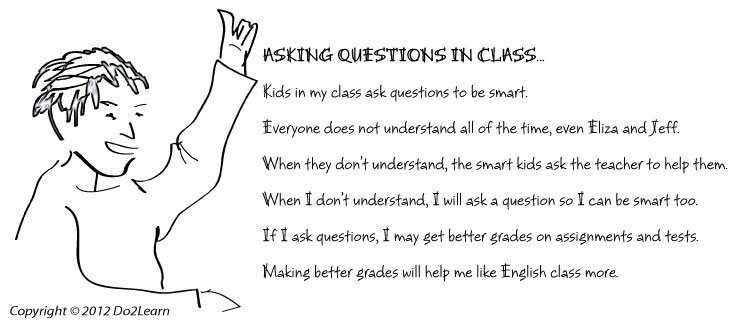
The instructor and the student then continue their plan by finding a place in the student’s notebook to keep the story. They make a plan that the English teacher will remind the student quietly at the beginning of class to flip in his notebook to the story and to read it.
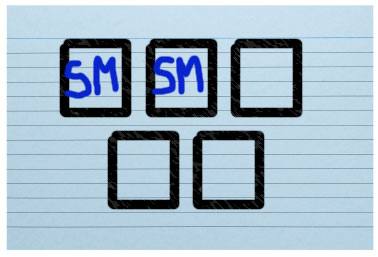
Since it is still difficult for the student to ask questions, the instructor negotiates a plan to provide an index card on the student’s desk in English class. On this card will be 5 check boxes or squares. When the student reads the story silently at the beginning of class, the English teacher will write her initials in one box on the student’s card. When the student then asks a question in English class, the English teacher will quietly go over to that student’s desk, make a statement about the question (“Great question! That helps you be on top of this!”), and write her initials in one of the boxes on the card. At study hall at the end of the day, the student gets to turn in the card for additional minutes of a favored activity.
 Note that within this example, the instructor first worked to clarify or adjust perspective, worked to find a plan that the student could call his own, and added motivation as needed. Working with other teachers and personnel was essential in the example and is often a crucial part of the priming process.
Finally, as part of the priming process, the instructor and student must determine in which environments the student will practice the new behavior. In the example, English class was determined to be the place to practice. Because the English teacher was willing to support the student, because the English class was where the student noted that he wanted to be “smart like Eliza,” and because the student agreed to use the card in this setting, agreement was reached and a plan was developed.
In summary, this instructor used priming to:
- Determine the student’s perspective on a social situation,
- Visually clarify an alternative perspective or explanation for the social situation,
- Visually represent a mutually agreeable plan,
- Identify the motivation necessary for the student to carry out the plan and
- Identify how and when this plan will be practiced or used so that the student is successful as quickly as possible.
Example 2 of Priming Process: A student named Jeffrey often becomes upset when he receives corrective feedback or when he makes a mistake in class.
Jeffrey enjoys his teachers and clearly wants social praise. He responds to good grades, to check marks on his work, and to graphs that show him his progress with the content of instruction (i.e., the math teacher had him graph his correct responses to problems on timed tests and he was very focused on seeing his progress).
The resource teacher serves as Jeffrey’s ‘social interpreter’ at school. During his 5th period class, he goes to her class for instruction. The resource teacher decides to use a simple graphic organizer in a priming session with Jeffrey. She has a 15-minute one-to-one session with Jeffrey during 5th period one day, and they fill out the chart with concrete examples of Jeffrey’s ‘expected’ and ‘unexpected’ behaviors together in class.
During their discussion, the teacher negotiates agreement with Jeffrey on the specific behaviors that are ‘expected’ and ‘unexpected’ in class. These terms were understandable to Jeffrey but not weighted down with judgmental overtones that would embarrass him or interfere with his understanding.
The completed chart looks like this:
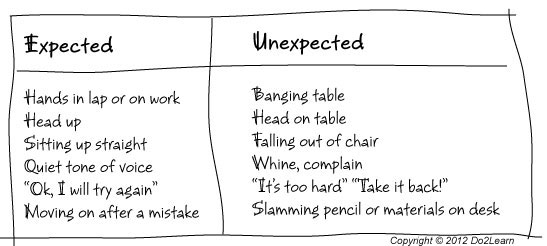
After they create the graphic organizer, Jeffrey’s resource teacher talks to Jeffrey about how he can get checks on a check card in each class for ‘expected’ behaviors. He agrees that he will have this chart on his desk and a card on which the teacher will place a check when she sees him engaging in ‘expected’ behaviors. He and his resource teacher then practice (see Modeling, Practice & Role-Playing section) using the graphic organizer and the check card with several problems where he makes mistakes.
During classes the next day, when a teacher in one of his 3 classes (Science, Math, and English) sees him engaging in an ‘unexpected’ behavior, she will go over and point to the behavior on his graphic organizer and say nothing to him. When he calms and refocuses on his work, the teacher may give him a check mark on his ‘check card’ and may praise him for his work. All teachers will give him checks throughout class when they catch him engaging in ‘expected behaviors.’ They may point out verbally what he is doing well while giving him a check. Also, each teacher will ‘prime’ Jeffrey in class before correcting him in class. All teachers met with the resource teacher and agreed to prime him by saying, “Jeffrey, I need to point something out to you that I want you to fix for me.” The teacher will point to the column of ‘expected’ behavior while saying this. Then the teacher points out his mistake. When he engages in expected behaviors following this, the teacher gives him two checks and quietly says, “Nice job fixing that. That makes me proud that you are learning.”
He will keep the cards each day in his notebook pocket and bring them to the resource room at 5th period. At that time, he will plot the number of checks in each class on a line graph and get 5 minutes of social praise time with his resource teacher. This 5-minute period is also an opportunity for review of the rules, for practice and role-play, and for any adjustment needed to the visual supports.
In many priming situations, there may be a necessity to role-play the new behavior in a “safe” setting in order to build student confidence and willingness to attempt the behavior in other settings. Over time and with successful practice, the strategy will be systematically used in other environments as well.
In summary, this instructor used priming to:
- Determine the student’s perspective on a social situation,
- Visually clarify an alternative perspective or explanation for the social situation,
- Visually represent a mutually agreeable plan,
- Identify the motivation necessary for the student to carry out the plan and
- Identify how and when this plan will be practiced or used so that the student is successful as quickly as possible.