
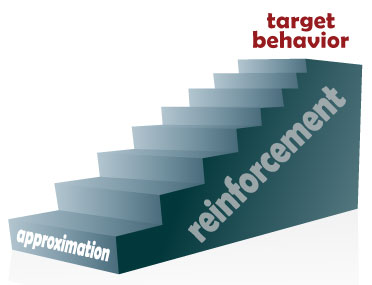
 Shaping is the reinforcement of progressively closer steps towards a target behavior. These steps are also called “approximations.” An approximation is a behavior that resembles the target behavior and can be molded over time into that target behavior. In other words, an approximation is an earlier “version” of a target behavior, with your end goal being the target behavior. The first approximation (or starting behavior) must be one that the student can do now.
The shaping process involves immediately reinforcing the approximation multiple times within a series of trials or opportunities. Precise timing and immediacy of reinforcement is essential in good reinforcement practice, and thus in shaping.
Reinforcement:
Reinforcement is a procedure used to increase a behavior. A reinforcer is a specific event (consequence) that follows a behavior which increases the future frequency of that behavior under similar circumstances.
As the student becomes consistent in his use of the approximation across repeated opportunities, the instructor expects a closer approximation of the target. The instructor shapes an approximation that is closer to the target by differentially reinforcing a slight improvement in the skill across multiple opportunities. Though this process may feel slow or tedious to the instructor, the student is receiving a high rate of reinforcement with the approximations as teacher and student move together toward the performance of the target skill. Frequent reinforcement of attempts in a systematic manner that moves the individual toward a desired target behavior is crucial in good instruction. Note that the elements of good direct instruction often require combining shaping with modeling, repeated practice, reinforcement, prompt-fading and chaining.
Why is shaping relevant to you?
Can any of us perform every single skill accurately on the very first try? No. In many cases, one needs multiple attempts in order to perform a skill to target criterion. Each attempt might be a closer and closer approximation of the targeted skill. When we want our students to perform a certain skill, we may need to shape that skill over time. Shaping involves waiting and timing in the reinforcement of a sequence of approximations of a target skill across multiple trials.
Guiding questions to consider: |
|
Shaping
|

What do you want the student to be able to do?
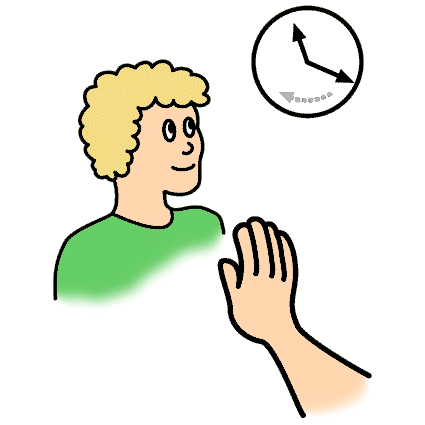
“I want the student to tolerate being told to wait without escalating.”
 Why does the student need this skill?
“Because there will be many situations in school, at home, and on job where he will have to wait for something that he wants without yelling.”
- What can he or she do now that might serve as a basic, first form of the behavior you ultimately want to see?
“He can wait for about 30 seconds after being told “wait” before he gets really upset.”
- How can I shape this behavior?
“I can start by using a visual ‘wait’ signal that shows my student that he has to wait for 35 seconds before he can access what he wants. When he waits appropriately for this length of time, I will give him access to the desired item or activity and I will verbally praise his behavior.
I select this interval because I want to make sure I am targeting an approximation that he can successfully achieve. If I set the bar too high too early and jump from 30 seconds to 1 minute, my student might experience failure again. Then, once he is tolerating a 35-second wait time, I will increase the targeted length to 45 seconds. When he waits appropriately for this length of time, I will give him access to the desired item or activity and I will verbally praise his behavior.
I will continue to systematically increase the amount of time that he has to wait for access to a desired item or activity. To promote generalization of this skill, I will target it in a number of different settings and help other professionals who work with him to also shape this skill. - How will I reinforce this behavior during shaping? How will I assure that the student understands what is expected?
I will reinforce the student by giving him the desired item at exactly the designated wait time point, and I will assure that he understands what is expected by showing a visual wait signal (a card) that I then immediately remove when he has waited for the designated duration.
What do you want the student to be able to do?
“I want the student to look at a conversational partner’s face when he is speaking or listening.”
 Why does the student need this skill?
“It is okay if this student cannot make eye contact, but looking towards the person in a conversation is an important social communication skill that impacts his interactions with his peers, potential employers, and co-workers.”- What can he or she do now that might serve as a basic, first form of the behavior you ultimately want to see?
“He will position his body towards the person, but he will direct his head far off to the left or right.” - How can I shape this behavior?
“I can start by reinforcing the approximation of looking just beyond the left or right shoulder of the conversational partner.
I select this first form of the behavior because I want to make sure I am targeting an approximation that he can successfully achieve. If I set the bar too high too rapidly, my student might experience failure again.
Then, once that initial response is consistent, I can reinforce the approximation of looking at the left or right shoulder of the conversational partner. Then, once that response is consistent, I can reinforce the approximation of looking towards the neck of the conversational partner.
Then, once that response is consistent, I can reinforce the approximation of looking at the chin or mouth area of the conversational partner….”
- How will I reinforce this behavior during shaping? How will I assure that the student understands what is expected?
I will reinforce this behavior during shaping by immediately providing the student with the opportunity to select the next topic of conversation related to one of his special interest areas. I will assure that the student understands what is expected at each step by providing modeling and gestural prompts that I then fade out before moving to the next approximation of the behavior.
What do you want the student to be able to do?
“I want the student to signal that he needs a break instead of getting up and walking away from tasks.”
 Why does the student need this skill?
“This student needs to know how to request breaks in an appropriate manner. Otherwise, he will continue to struggle with his tasks at school and at home, and he will struggle to cope with the demands of a job.”- What can he or she do now that might serve as a basic, first form (approximation) of the behavior you ultimately want to see?
“This student will push work materials towards me and away from himself.” - How can I shape this behavior?
“First, I can develop and introduce a break card (a visual signal). Then, I can start by reinforcing the approximation of him touching the break card on the table to indicate that he needs a break.
I select this first form of the behavior because I want to make sure I am targeting an approximation that he can successfully achieve. If I set the bar too high too rapidly, my student might experience failure again.
Then, once that response is consistent, I can reinforce the approximation of pushing the break card towards me to indicate that he needs a break.Then, once that response is consistent, I can reinforce the approximation of picking up the break card and giving it to me to indicate that he needs a break.
Then, once that response is consistent, I can reinforce the approximation of raising the break card up in the air to indicate that he needs a break.
Then, once that response is consistent, I can reinforce the approximation of raising the break card up in the air when I am not in his immediate proximity…”
- How will I reinforce this behavior during shaping? How will I assure that the student understands what is expected?
I will reinforce this behavior during shaping by providing a break to the student immediately after he displays the approximation. I will assure that the student understands what is expected at each step by using gestural and modeling prompts that I then fade before moving on to the next approximation.
How long does it take to shape a behavior? The answer to that question depends on several things:
- The specific learning needs of the student
- Multiple opportunities to practice the target behavior, the frequency of direct instruction
- The relative complexity of the targeted response, which determines the “distance” between your starting point (the first approximation) and your ending point (the goal behavior)
- The student’s intrinsic motivation level, his engagement in the learning task
- The effectiveness and timing of your reinforcement
Keep in mind that when shaping a behavior, there are times where you might need to take a step back (to an earlier approximation) if your student is struggling with next approximation.