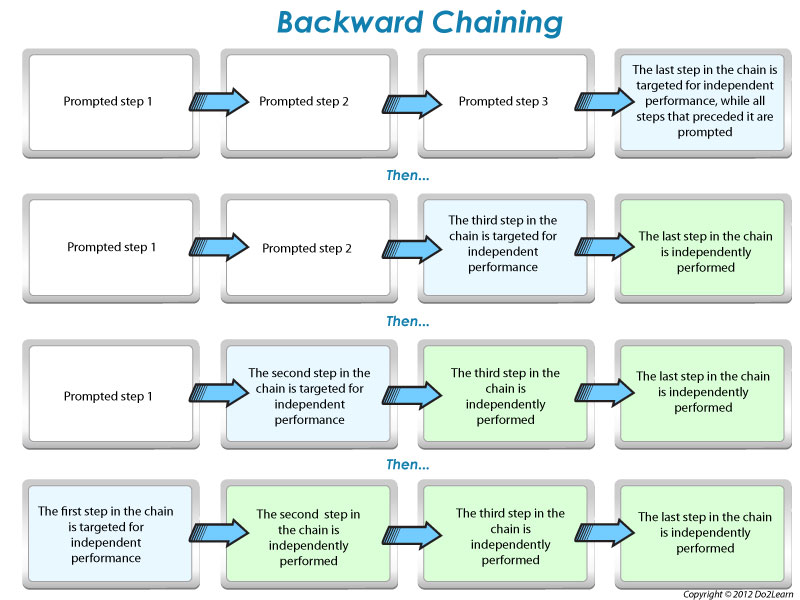
Backward chaining is a procedure in which the last sub-skill or step within a total skill is targeted for independent performance, while the steps that preceded it are prompted through. When the last step in the chain is performed with independence and accuracy across learning trials, the second to last step is targeted for independent performance, and so on.
When might you use a backward chaining procedure? There are two main considerations:
- For some students, it might be important to consider that they need immediate reinforcement (end of the task, removal of demand, in this case) when they are learning a skill that involves chaining. For example, if you are targeting the skill of loading the dishwasher, and you have prompted the student through the earlier steps and then he performs the last step independently, the reinforcement for the independent response is immediate – the task is over. If you use a forward chaining procedure, the student is expected to perform earlier steps independently before later steps, and thus there is (in the early stages of chaining) a longer delay between targeted performance and reinforcing consequence (the task ending).
- By seeing all of the steps that come before the last step (the one targeted first for independent performance), this might better prepare or “prime” the student for independent responding.
*This is not intended to convey that backward chaining is better than forward chaining! You base this decision on the needs of the student, the nature of the skill (and its subcomponents), and the overall environment in which the student is learning the skill.