
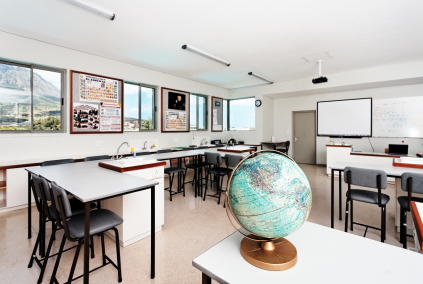
 The physical environment of the work space or classroom can have a profound effect on the student’s success. Learning materials and visual supports must be readily available and easy to access. Specific visual supports include environmental design, the schedule, the to-do list, and various visual tools or task structures that support independent performance in the specific work space. Our colleagues at Division TEACCH, along with a host of other professionals including Andy Bondy, Carol Gray, Kari Dunn Buron, and others, have developed a vast toolbox of visual supports for use in community-based instruction. Their work has created an exciting educational world in which systematic visual structure supports independent student performance.
Most individuals, especially those with social communication differences, benefit from visual supports in their classroom, work, and home environments. Visual supports are effective in making materials and environments more meaningful. Providing visual supports or structure is a way of organizing or directing one’s activities so that the person can live and work as independently as possible.
Why do my students with ASD need visual supports?
For some individuals who do not communicate verbally (or do not do so proficiently), it is critical that they have a communication system in place. This individually tailored system gives the individual the power to express their wants and needs, their choices, their feelings, and their ideas. For some individuals, those communication systems might come in the form of basic or advanced scripts that identify key verbal and non-verbal components within a social exchange.
Nearly all students benefit from visual supports because they may have trouble initiating activities, organizing tasks, staying focused, completing tasks, understanding verbally issued multi-step instructions, and shifting focus between one activity and the next. Visual supports also help students to keep their end goals in sight while they are working on parts of the tasks and enable them to complete activities in a timely manner.
Some forms of visual support also help students visually represent and organize social, perspective-taking, conversational, and emotional concepts that are more abstract. These supports typically come in the form of social narratives, role-play scripts, graphic organizers, and video modeling. When students understand and can refer back to these visual representations, they are more able to respond appropriately.
The crucial integration of direct instruction strategies and visual supports
Providing quality in instruction requires the ability to apply behavioral strategies and visual supports in a coordinated manner that leads to student ability to apply skills in various, new situations. It is not possible to apply visual supports for proficiency without using behavioral principles. Generally, a process of instruction that systematically fades any prompts (gestural, verbal) to the visual support is required to assure that the student acts independently. Teaching may also require a priming process to get agreement from the student that the visual support can help him function independently; and in many cases, effective priming involves the use of a visual support to promote understanding and to shift perspective. Thus, both “technologies” should be blended to create quality in instruction and generalized skill development in students.
Are visual supports and prompts the same thing?
No! The visual supports (i.e. communication systems, schedules, to-do lists, instructions, social narratives, etc.) that provide structure are not prompts.
The difference is that visual supports are long-term strategies or cues that often remain in place to sustain independence and autonomy. Teaching students to independently access and use visual supports is critical. Prompts are the temporary assistance that someone provides to help a student learn how to perform a skill. For example, when teaching a student to use a visual schedule, the instructor temporarily applies and systematically fades prompts.
Do visual supports make a student less independent?
No! In fact, the purpose of visual supports is to make individuals more independent. Most of us tend to rely on calendars, written lists, visual instructions, visual reminders, coping mantras, and cell phones to organize and regulate ourselves. Visual supports serve the same purpose. They allow an individual to work, communicate, and cope without the help (prompting) of another person. Some forms of visual support can also serve as classroom or workplace accommodations (hyperlink to the classroom and workplace accommodations document) that promote access and independence in these contexts.
Types of visual support |
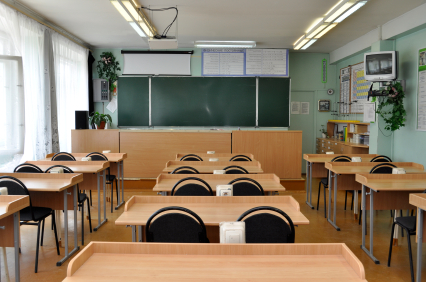 Environmental design sets the stage for learning and performance in any classroom or workplace. Adjusting the environment to support focus on expected work skills and behaviors is essential in successful teaching. Modifying the environment to address social, sensory, cognitive, and self-management characteristics of the student can enhance skill development and improve instructional outcomes. Environmental design sets the stage for learning and performance in any classroom or workplace. Adjusting the environment to support focus on expected work skills and behaviors is essential in successful teaching. Modifying the environment to address social, sensory, cognitive, and self-management characteristics of the student can enhance skill development and improve instructional outcomes. |
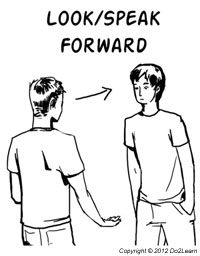 An individually tailored communication system is vital for some individuals with social-communication differences. Having the power to communicate choices and needs across all environments is perhaps the most crucial element of self-determination. If an individual does not verbalize at all, has only emergent verbal language, or does not verbalize under certain conditions (high stress, anxiety), then the instructor must identify and design an appropriate visual system that will enable the student to initiate requests, make choices, express ideas, respond to social overtures, etc. For some individuals, visual scripts provide a powerful tool to support practice and role-play opportunities within instruction. Such scripts can be carried beyond the instructional context however, also providing a quick visual reference for the individual as they prepare to interact with others in their community. An individually tailored communication system is vital for some individuals with social-communication differences. Having the power to communicate choices and needs across all environments is perhaps the most crucial element of self-determination. If an individual does not verbalize at all, has only emergent verbal language, or does not verbalize under certain conditions (high stress, anxiety), then the instructor must identify and design an appropriate visual system that will enable the student to initiate requests, make choices, express ideas, respond to social overtures, etc. For some individuals, visual scripts provide a powerful tool to support practice and role-play opportunities within instruction. Such scripts can be carried beyond the instructional context however, also providing a quick visual reference for the individual as they prepare to interact with others in their community. |
An individually designed schedule must show a sequence of places to go so that the student is independently mobile within and between settings. Providing a means for the student to identify where to be and where to go next is crucial. Many students also benefit when provided with the knowledge of when they are able to engage in a preferred activity, a component easily integrated within the schedule. The schedule helps the student predict the sequence of places (and activities) within the day. 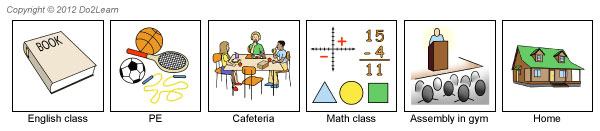 |
Once the student reaches a specific space, visual elements within the ‘to do list’ clarify four elements: What work is to be done? How much work? When is it finished? What comes next?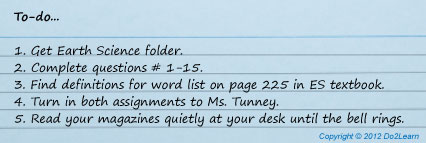 The ‘to do list’ (also referred to as a ‘work system’) prevents confusion and provides predictability to the student about the sequence and amount of activities he will do in that space. Students need to know the sequence of activities, need to see progress within and between activities, need to understand when a task is finished and need to know what activity will follow the completion of those activities in the ‘to do list.’ The ‘to do list’ is an effective tool, when individually designed, in supporting a host of academic and vocational behaviors, including stamina, sustained on-task behavior, independence in movement within and between tasks, and potentially in reducing errors in performance. The ‘to do list’ (also referred to as a ‘work system’) prevents confusion and provides predictability to the student about the sequence and amount of activities he will do in that space. Students need to know the sequence of activities, need to see progress within and between activities, need to understand when a task is finished and need to know what activity will follow the completion of those activities in the ‘to do list.’ The ‘to do list’ is an effective tool, when individually designed, in supporting a host of academic and vocational behaviors, including stamina, sustained on-task behavior, independence in movement within and between tasks, and potentially in reducing errors in performance. |
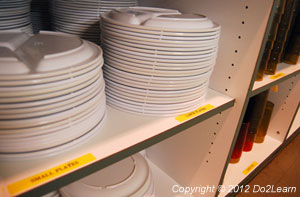 Visual cues structure the content of the tasks and activities that will be completed within a setting. These tools help the instructor design the learning materials that will support the targeted skill. The task or activity may be academic (e.g. instructions on solving quadratic equations), vocational (e.g. instructions on mixing cleaning solution), social (e.g., responding to an introduction) or self-regulatory (e.g., following a set of relaxation exercises). Visual cues include: 1) visual instructions that define the sequence of steps in a task, 2) visual organization that segments, contains, and stabilizes materials to support performance, and 3) visual clarity that ‘turns up the visual volume’ by highlighting or emphasizing key details within the materials or the task. Visual cues structure the content of the tasks and activities that will be completed within a setting. These tools help the instructor design the learning materials that will support the targeted skill. The task or activity may be academic (e.g. instructions on solving quadratic equations), vocational (e.g. instructions on mixing cleaning solution), social (e.g., responding to an introduction) or self-regulatory (e.g., following a set of relaxation exercises). Visual cues include: 1) visual instructions that define the sequence of steps in a task, 2) visual organization that segments, contains, and stabilizes materials to support performance, and 3) visual clarity that ‘turns up the visual volume’ by highlighting or emphasizing key details within the materials or the task. |
Other visual supports are designed to promote the acquisition and maintenance of social communication and self-regulation skills that the individual needs in order to appropriately engage in conversations, recognize the perspectives of others, cope with anxiety and frustration, and understand the rationale behind unwritten social communication and behavioral expectations.
These supports include:
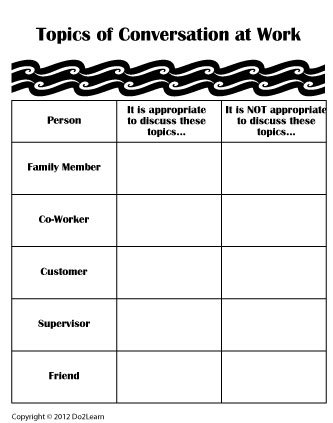
Graphic organizers help an individual visually represent and sort their thoughts, feelings, and behaviors. When designed appropriately to meet the specific needs of the student, the graphic organizer can provide a more concrete framework in which the individual can recognize and label how they are feeling and to what intensity, how to compare responses, how to reflect on events and evaluate outcomes, and more.
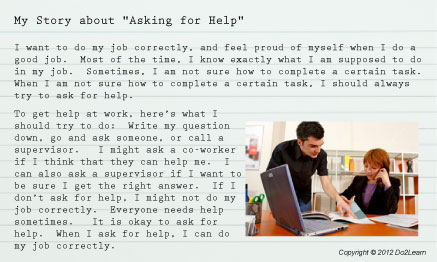
The social narrative is an individually tailored story (in written and/or picture form) to help the student understand and use the key details or the “why?” within a common event or social situation.
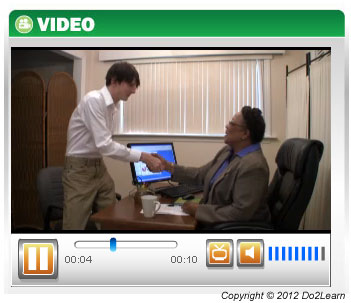
Video modeling is a powerful tool both in priming and in practice during skill development and maintenance. The video model has elements of a video social narrative, illustrating the completion of the positive target skill within the expected environment. Evidence is clear that if an individual watches a video of either himself or someone else engaging in the expected behavior, he is more likely to perform the expected behavior after watching. The video model shows someone performing the expected behavior and may include an audio narrative over the video that defines the expected behavior.
Each Visual Supports subsection offers detailed and practical information on how to design that visual support in a way that meets the needs of your student.