
The concept of environmental design is sometimes also referred to as "physical structure," "environmental modifications," or "environmental arrangements."
Modifying the environment to support focus on expected work skills and behaviors is essential in successful teaching of students with an autism spectrum disorder. Adjusting the environment to address social, sensory, cognitive, and self-management characteristics of the student can enhance skill development and improve instructional outcomes. Environmental design can set the stage for learning and performance in any classroom or workplace.
Designing the work environment can serve multiple purposes. Redesign can reduce distractions, remove sensory stimuli that agitate the individual, help the student identify where and when to focus on special interests, and provide physical/furniture cues for what to do when anxious, among other skills. Environmental design can help the student stay focused on the expected work skills and behaviors. Employers often welcome any design features that can improve employee productivity. As a result, this element of the intervention process is an important first step.
In general, the questions that often drive environmental design are:
- When the student walks into a space, does he see the tasks he has to perform, or does he have to visually discriminate (pick out) where he will be and what he will do?
- When the student is working, how is furniture and space used to reduce or remove distractions that will adversely affect performance?
- When the student is moving from space to space, are paths defined and distractions reduced along those paths?
- Are there clear separate spaces for different contexts or sets of activities (i.e., place to take a break vs. work spaces vs. place for belongings, etc.)?
Environmental design provides the answer to the question "Where am I supposed to be?" It clarifies where specific activities take place and offers specific, visual information on where the individual is to sit, stand, or move to complete activities.
How to design the environment:
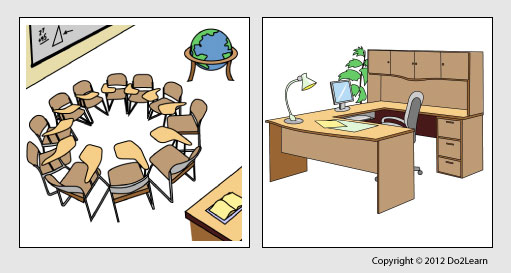 Clarify and organize classroom and vocational materials in locations that support independent retrieval and use by the individual during activities.
Make sure boundaries are visually clear to indicate expected school or work behaviors within a clearly defined space. Specifically, the boundaries should make it clear where the student is supposed to work and where their materials are supposed to be placed. If space arrangement is ambiguous, use tape, labels, or other materials to designate specifically where one student’s space ends and another student’s area begins.- Provide adequate space to address either sensory needs or conceptual understanding of the individual .
Does the individual need space to prevent feeling agitated because of proximity to others? Does the individual need space to prevent bumping into people or objects? Does the individual have difficulty understanding my work space vs. your work space, or my materials vs. your materials? Will a larger work table help the individual succeed with expected work behaviors?
- Use preferential seating in the classroom.
In most cases, this involves placing the student in a desk up front, near you, and away from distracting peers. In other cases, this might involve placing the student towards the back of the classroom, near an exit door, or next to a conscientious and friendly peer.
- When possible, design classroom and employment spaces to create proximity to needed materials.
How far does the individual have to travel to obtain needed materials before he can start working? If possible, place materials near the classroom or workspace entry point so he can begin working as soon as he arrives.
- Use large bookshelves, room separators, curtains, cubicles, or other furniture to reduce distractibility when needed while maintaining the instructor’s capacity to see all activity within a room. Face the student away from the larger room if necessary.
- Make sure it is clear where materials are supposed to be placed after work is completed. Are we designing the space so that the individual can clearly see where it goes when finished?
- Control for sensory stimulation that might bother the student and therefore interfere with work. Light, noise, heat, and visual distractions are especially important!
Examples of accommodations to control sensory stimulation might include:
- Ear phones or ear plugs to help eliminate difficult noises
- Sunglasses, tinted lenses, or transition lenses to mitigate light sensitivity
- Curtains, carrels, partitions and furniture placement to section off the individual’s work area
- A quiet, separate location for a break
- A fan or white noise machine in an independent work area
- If sharing a large work space with several students, it can be important to establish a designated place where she can go for breaks. Additionally, a clear space for break materials should be accessible to the individual.