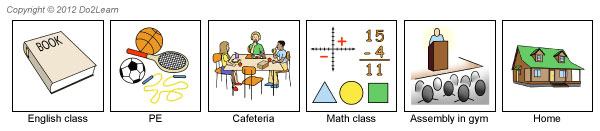
What type of schedule is best for my student?
Determining whether to use a written, picture, or object format when creating a schedule can be tougher than you may think. Using an inappropriate modality can be confusing and overwhelming to an individual , and the schedule will not be effective. Most often, people tend to use a higher level modality than appropriate for the individual. The error is often in expecting the individual to use the schedule to learn what pictures, photos, icons or words represent. The purpose of the schedule is simply to help the individual make independent transitions from place to place and to use the schedule to understand the order of events in a day.
The type of schedule you use should cater to the individual’s toughest day. This means, in the middle of (or at least after) a meltdown, the schedule should be easy for the individual to understand. If the individual is a reader, but reading is not entirely automatic, having to read during the middle of a stressful time is not productive. Thus, pictures should be used for that individual. Again note that you can add words to the picture cues of the schedule. The size of the word attached to the picture cue should be considered to assure that the format is neither too busy nor distracting.
To determine what type of schedule to use for your student or employee, you will likely need to assess the individual’s level of functioning. You can assess the individual’s level of understanding by seeing if they are able to do specific tasks independently.
Specific tasks include:
- Matching objects to the same object
- Sorting objects (silverware, or other materials by color and shape)
- Matching objects to a photographs
- Matching pictures (color? black and white?)
- Matching icons
- Pointing to pictures in a book (Where’s the cow? Where’s the circle?)
- Matching a picture to an object (If given a picture of a cereal box, can the individual go to where the cereal box and match the card to the box?)
- Reading single words with ease
- Reading short phrases with ease
- Reading sentences with ease
- Understanding intervals of time (Does the student understand if you write “Band practice at 3:30” on a schedule?)
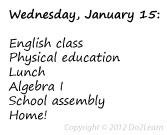
Present the schedule in written form if the individual is an automatic reader. The amount of written information should vary based on the reading ability of the individual.
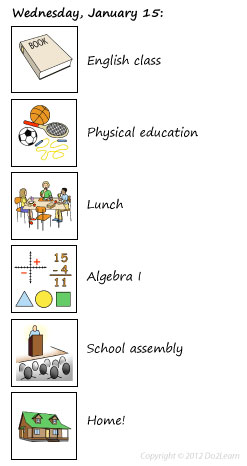
Use combination of pictures and words to depict the schedule if the individual has some reading skills, but obtains meaning more readily from pictures. This is a very common schedule format and is a good match for many students .
Use pictures to depict the schedule if the individual:
- Can match objects to pictures or photos
- Understands that photos represent spaces or activities
- Can match pictures to other pictures with ease
- Attends to pictures with ease
- Labels pictures
- Easily understands the meaning of pictures