
The written schedule is the most appropriate format of a schedule for an individual who reads automatically and fluidly. If reading is an emerging skill, the written schedule will not support independence in movement. In that case, use pictures alone or add them to a simple written schedule. Remember, the schedule should cater to the individual’s hardest day, so if reading is not automatic, pictures will be more meaningful and appropriate.
For more information about how to decide whether a written schedule is most appropriate for your student, click here.
Creating a written schedule:
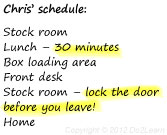
- Written schedules are generally considered the easiest schedule to set up and create. A simple written schedule involves a sequenced list of the places to which the individual will go in a day.

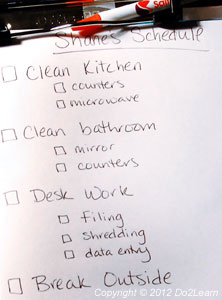 The amount of information on the schedule will vary depending on the individual. Some individuals respond better to simple single word schedules, others can use short phrases, while others can handle more detailed information.
A natural urge of instructors is to provide as much information as possible on the schedule. However, it is important to pay attention to the needs of the individual. For many individuals , adding details of daily activity to the schedule is overwhelming.
For other individuals , it is a helpful and more efficient presentation of information. Having one place (the schedule) to find information needed for the day can be appropriate. In other words, depending on the individual, you may add the list of activities that would occur in each area / location. Thus, you may build the ‘to do list’ into the schedule so that the activities, the progression of activities, when they are finished and what comes next are all represented within the body of the ‘schedule.’
While the schedule tells the student where to go and in what order, and the to-do list clarifies what to do once they get there. The to-do list answers the following four questions:
What to do? How much to do? When finished? What next?
Also, written work or school rules or important reminders may be added to a schedule so that the schedule becomes one place where the individual can find a variety of important information. However, it is critical that the instructor carefully consider whether the individual can process and use additional information that is provided through the schedule.
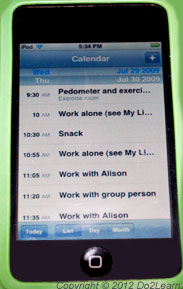 For some individuals , it may be appropriate to have their schedule presented on a cellular phone or device, such as an iPhone, Blackberry, an iPad, or other portable electronic device. Using technology can come across as less stigmatizing and more motivating. Frequently, electronics are inherently motivating to the individual and they are appreciated by peers. In other cases, using an appointment book or a daily calendar may fit the individual.
- Consider the portability and location of the schedule. Some individuals remain in the same general location while working. These individuals will likely prefer to keep their schedule in the same place all the time, returning to their schedule after the completion of a task to check what is next. Other individuals may move around to different locations during the school or work day. In such instances, the individual will need to carry their schedule with them from location to location. The instructor should carefully consider the environmental design of those spaces to support the student in keeping up with his schedule. Remember, to promote attention and stamina, and to reduce anxiety, the individual needs to be able to see their schedule at any point across the work or school day.
In school, the student may carry their schedule in their backpack, on their smart phone, or in their pocket. In the work place or within certain school settings, their schedule could be placed on a clipboard with a pencil attached to mark off items as they are completed. Identifying and teaching the individual to always place his schedule on a hook or designated spot at each site is one key to success.
The instructor must support two routines for the individual . One routine is always placing his schedule in the designated spot at the beginning of an activity. The second routine is always picking up the schedule and taking it with him to the next space.
- Some individuals will develop skills necessary to create their own daily schedules or weekly and monthly calendars. The instructor may need to help the individual find and use materials (calendar, appointment book, iPad, smart phone, etc.) to more independently choose the sequence and content of activities. Setting up a schedule is a complex cognitive process involving prioritizing, time concepts, and problem solving skills. Because this cognitive process can be overwhelming, the instructor must decide how to present choice in making a schedule, how to support the student in listing and prioritizing, and how to support the student in estimation of time needed for activities. This may also involve priming to help the student shift their perspective and recognize that this form of visual support is necessary.
Guiding questions to consider: |
|
Written Schedules
|
