
Coping cards are a practical and extremely useful visual support to help individuals cope with stressful, overwhelming, confusing, or frustrating situations. Coping cards present brief information about what to do in these situations. While the coping card is taught and practiced beforehand, it is generally a tool to be used in the moment.
An advantage to using coping cards is that they are small, portable, and fairly inconspicuous. Coping cards are typically about the size of an index card, and the student can keep the coping card on the desk, in their wallet, bag, daily planner, or front desk drawer for easy reference.
Coping cards should be individually tailored to meet the needs of the student and their level of functioning. The topic of the coping card will, of course, vary depending on the issue for your particular student. Some coping cards may contain all written information, while others will be heavily based on images.
You can obtain images from a variety of sources including View2do, Google images, photographs, or hand-drawings by you or the student. View2do also offers samples of coping cards.
In some cases, it might be appropriate to incorporate the student’s favorite character, theme, or mantra (e.g. from anime, video games, movies, sports, tv, books, music, etc.) onto this card. The incorporation of such high interest features may further motivate the student to review his coping card and display the targeted skill.
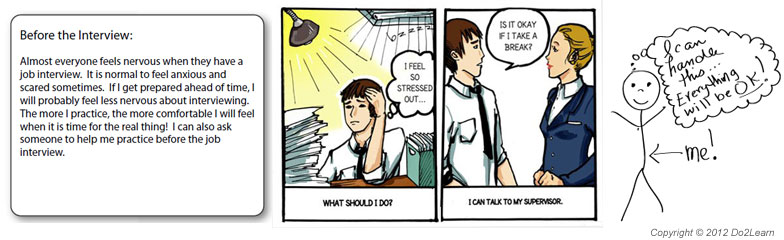
Using coping cards within the direct instruction framework:
- Teach and repeatedly practice the skill on the coping card during a time when the individual is calm. Stressful situations are not the time to utilize an unfamiliar strategy. Practice the use of the card under increasingly generalized conditions.
- The coping card is often a great tool to use in conjunction with a situational story. While the situational story may go into more detail about what to do and why to do that, a coping card can provide a brief visual reminder of this. Teach the skill using a full situational story, and then using the coping card as a visual reminder on the go.
- It makes the most sense to have the student review the coping card shortly before he is expected to encounter a potentially stressful situation. Priming may reduce anxiety while supporting performance. For example, review a coping card about meeting new people just before the student encounters that situation.
- When your student becomes anxious or stressed, he can pull out the coping card, read it, and hopefully calm down because he has experienced numerous practice opportunities in preparation for this stressful event.
- Arrange for a convenient place for the coping card to be stored, such as in the student’s wallet, purse, daily planner, or desk drawer.