
Coping comics are a fun visual strategy to teach how to appropriately handle a social situation through comics or drawings. The drawings or comics depict a quick conversation or interchange that is either already written, or left blank for the student to generate responses. The comic can portray details within a setting or interaction that are important to remember when interacting.
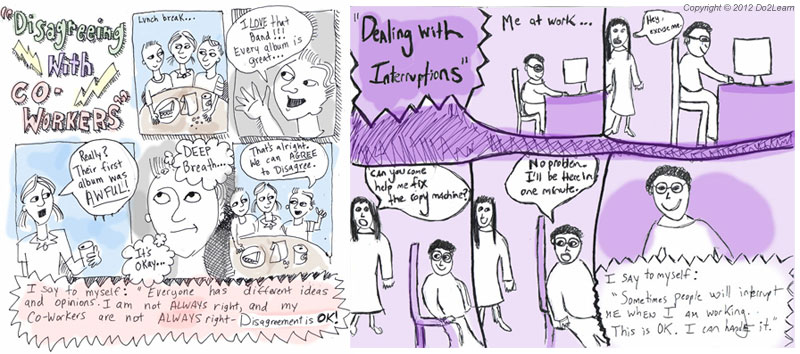
Coping comics are an effective strategy because they are often appealing to individuals . Not only do they draw on the visual strengths of many individuals , but comics often are of interest to individuals .
Coping comics can cover a wide range of topics. Any issue that is confusing, frustrating, or stressful to your student can be illustrated through a coping comic. Coping comics can provide a script of what to say or think in certain situations.
How to design and use coping comics:
- Focus on one skill at time. Do not overwhelm your student by teaching too many concepts or skills in one coping comic.
- Create the coping comic with your student. You can draw coping comics for your student, or you can have them draw their own. A collaborative process will promote student involvement and motivation, but also allow you to guide them in appropriate responses.
- Neither you nor the student needs to be a good artist in order to develop an effective coping comic. Stick figures are perfectly acceptable. As another option, you or your student could also cut and paste people (or preferred characters) from magazines, printed Google images, and more. If you select this route, you would need to write in speech and thought bubbles to accompany the characters.
- Ask your student questions about the coping comic to check for understanding. Or, write down questions for them to respond to in writing if they have trouble responding aloud. Answers could be circled if your student has trouble with open-ended responses.
- The coping comic should be reviewed frequently for it to be most effective. Store the coping comic in a convenient place, such as a notebook, binder, or taped to the top of their agenda. As stated previously, take care to work on very few of these at one time (preferably one at a time).
- Practice and repeated role-play opportunities to address the targeted skill. With any social narrative strategy, it is also necessary for the student to experience opportunities to rehearse the skill across multiple contexts.
- Priming with the comic may support resulting performance. It makes the most sense to have the student read the coping comic shortly before she is expected to apply that skill. For example, review a coping comic about dealing with noisy social gatherings just before the event occurs.