
Situational stories are brief stories that describe and explain a certain behavior for individuals .
Situational stories:
- Often tell the student what the appropriate behavior is, when the behavior should be displayed, how to respond/react appropriately, and why this is the appropriate response
- Are individualized to contain the information that a student can use
- Are presented visually and concretely
- Are individualized to the student’s level of understanding (e.g. a fluent reader may learn best from a pure text story while a non-reader will likely learn best from a story that utilizes pictures in addition to text)
- Are personalized in that they use the student’s name or are written in the first person
- Can be used for an endless number of different topics
Although numerous examples are provided in the Transition Toolbox curriculum units, you may need to write your own situational story to tailor it to your student’s needs and level of functioning. Use View2do to modify our examples of situational stories, or to create your own versions that combine text with visual icons.
Guidelines for creating situational stories:
Focus on one skill at time. Do not overwhelm your student by teaching too many concepts or skills in one situational story.
Possible components to include in a situational story:
- Description of the situation
- What the individual thinks, feels, does, or says in this situation
- What others may think, feel, do, or say in this situation
- Description of appropriate response or behavior in that situation
- Explanation of why that response or behavior is appropriate
- Tailor the number and complexity of details to the individual!
Provide additional visual cues as needed. Some individuals read and retain written information easily; for those individuals, simply writing out (or typing) the story is enough. For many others, pictures supporting written text can be very useful. Supplement the written text with pictures of important information. You can obtain images from View2do, Google images, your photographs, hand-drawings, and more.
For those with limited reading skills, include both written information and pictures. The written information will allow you to read the story to your student/employee consistently each time, providing her with the same information so she retains it. The pictures will be crucial in helping the student understand what you are reading, follow along with you, keep her attention, and provide meaning. Have your student look at the story and pictures with you as you read it so that she is involved.
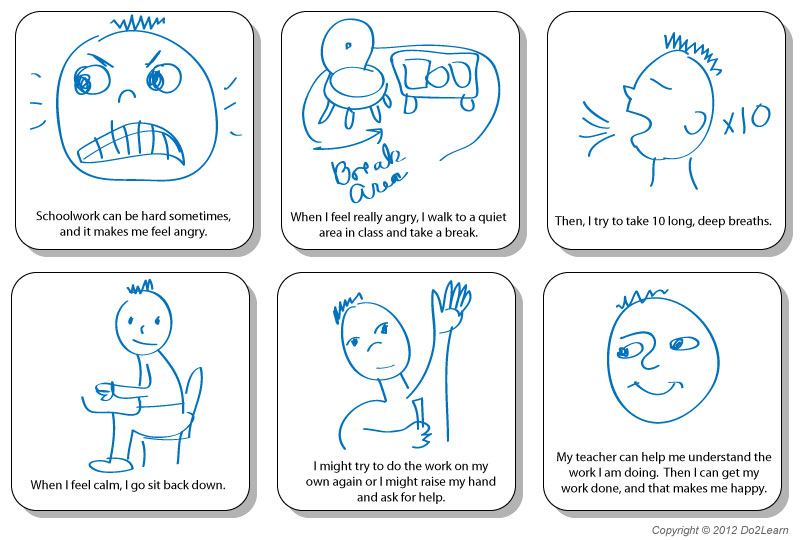
Make your story positive. Instead of emphasizing what not to do, emphasize what to do. Describe the appropriate behavior (rather than harboring on the inappropriate) and explain why it is appropriate. Situational stories should be fun and informative, rather than preachy or negative.
Personalize the story. Use your student’s name or photograph in the story, or write the story in first person. If there are certain artistic styles, favorite characters, or visual themes that your student is interested in, then incorporate those images into the story. If your student enjoys drawing, he or she could add his or her own relevant images into the story as well. For typed stories, allow the student to select their favorite font if they are so inclined.
Using situational stories within the direct instruction framework:
- Situational stories should be read with the student to teach them the target skill, or you may have your student read the story aloud if they are a fluent reader. The first time you read your student the situational story, ask a few questions to make sure they understand the content. Or, write down a few questions if they are better able to answer questions through writing. Questions could be presented in multiple-choice form if your student struggles with open-ended responses.
- In order for a situational story to be most effective, it should be reviewed on a consistent basis. Reading the story once will not be enough. Also remember that reading should be followed by practice.
- Direct instruction and repeated role-play opportunities should also be used to address the targeted skill. While the social narrative may define the what, when, how, and why behind the skill, it is also necessary for the student to experience opportunities to rehearse the how across multiple contexts.
- It makes the most sense to have the student read the situational story shortly before she is expected to apply that skill. Priming with the story prior to being in a context where the skill is required may improve the performance of the skill. For example, review a story about crossing the street safely just before the student goes on an outing.
- Finally, because many individuals have difficulty with organization, devising a plan for storage will be very important. If there are multiple stories, you could create a situational stories notebook. This can be used for periodic review of well-learned strategies. For a single story, keep it in the front of a notebook or day planner.
- When you devise a storage system for situational stories, be sure that the system is portable and accessible to the individual across their school or workday. Be extremely careful to avoid practicing and using too many social narratives at one time. The social narrative ties together social details to clarify a social concept. Therefore, this is challenging to individuals . In general, a social narrative is not placed into a stories notebook until it is used in multiple settings independently.