
Should you use a written to-do list, picture matching to-do list, or an object-based to-do list?
As with schedules, determining what type of to-do list to use with your student can be challenging. Using the inappropriate type of to-do list will be confusing and overwhelming to your student and less effective. Thus, it is important to find the right system for your student.
Most often, people tend to use a higher level system than appropriate for the individual. For instance, a common mistake is using too much written information when a combination of writing and pictures would be more appropriate. The to-do list should not be used as a tool to teach what pictures, photos, icons, or words represent.
Instead, the to-do list should be an easy-to-use, familiar tool that tells the student what activities they are to engage in. The type of to-do list you use should cater to the individual’s toughest day. This means, in the middle of (or at least after) a meltdown, the to-do list should be easy for the individual to understand rather than something that requires effort.
Whatever modality you use for the schedule should remain consistent with the to-do list as well. For example, if you use written information for the schedule, use written information for the to-do list. However, this means you have to get the modality right for both the schedule and the to-do list!
To determine what type of to-do list to use for your student, you will likely need to assess the individual’s level of functioning. You can assess the individual’s level of understanding by determining if they are able to do specific tasks independently.
Specific tasks include:
- Matching objects to the same object
- Sorting objects (silverware, or other materials by color and shape)
- Matching objects to a photographs
- Matching pictures (color? black and white?)
- Matching icons
- Pointing to pictures in a book (Where’s the cow? Where’s the circle?)
- Matching a picture to an object (If given a picture of a cereal box, can the individual go to where the cereal box and match the card to the box?)
- Matching photos to activities or places
- Reading single words with ease
- Reading short phrases with ease
- Reading sentences with ease
- Understanding intervals of time (Does the student understand if you write “Band practice at 3:30” on a schedule?)
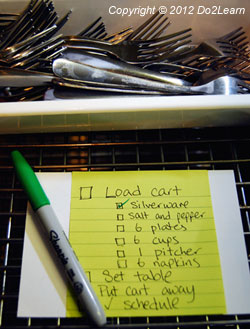 |
Present the to-do list in written form if the individual is an automatic reader. The individual needs to not only be able to decode written text, but also to comprehend it. The amount of information will vary based on the reading ability of the individual. | 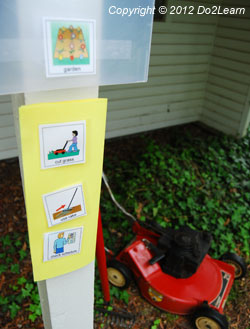 |
Use a combination of pictures and words if the individual has some reading skills, but obtains meaning more readily from pictures. This is a very common modality and is used often for students . |
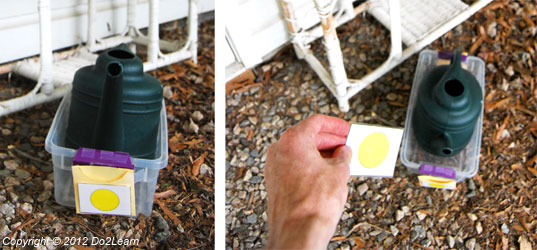 |
Use a picture matching system if the individual:
|
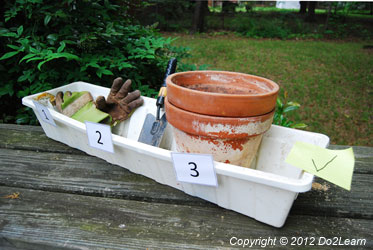 |
Use an object-based system (often described as a left-to-right work system) if the individual:
|