Idioms & Sarcasm
Talking with others can be a minefield of figures of speech, but an employee must learn the ropes of idioms and sarcasm to avoid getting off on the wrong foot with co-workers and supervisors. If we interpreted everything people say literally, we might think that cats and dogs fall from the sky during a rainstorm and a sarcastic “Good job” is intended as a compliment. Parsing out idiomatic and ironic speech can be a challenge, so the instructor should work with the student to identify common turns of phrase. Using the speaker’s body language to help understand their intentions is also a critical skill. As the student becomes more confident interpreting idioms and sarcasm, they can also work on refining their own use of these linguistic peculiarities. Learning these social skills is no cakewalk, but it is worth the sacrifice and will help the student put their best foot forward in any conversation.

Teaching Ideas
Click on the icons below for detailed information on how to teach this skill.





 Guiding Questions
- Does the student’s misinterpretation of statements tend to result in confusion, frustration, or anxiety?
- Can the student identify when a phrase is not meant to be taken literally? Can the student label the actual meaning behind the phrase?
- Is the student able to decipher how tone of voice and facial expressions might change the meaning of or intention behind what is said?
- If the student is unclear about the speaker’s intention or the meaning of the words, does he seek clarification?
- Does the student use sarcasm in a way that is perceived as awkward, poorly timed, or as caustic and rude?
Visual Supports
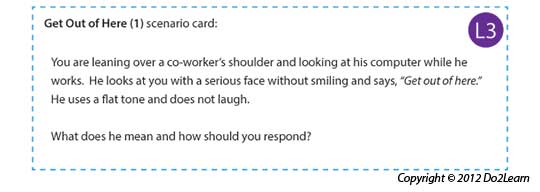
Communication systems and scripts provide the student with a means to initiate communication. Use these cards to practice different scenarios with your students.
|
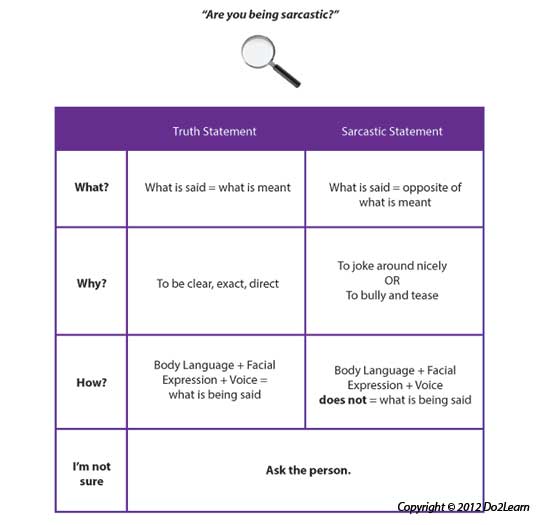
Graphic organizers can provide a student with a way to represent and organize concepts, thoughts, feelings, behaviors, and potential outcomes.
|
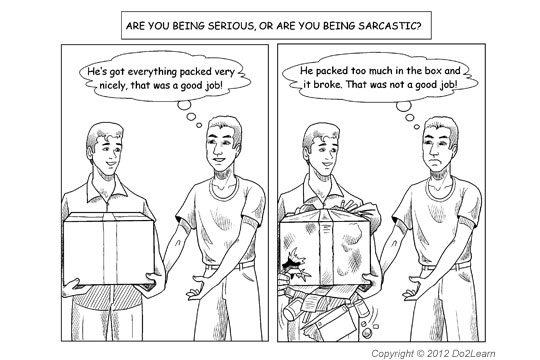
Social narratives are a set of tools that visually represent social situations and appropriate social behaviors. The social narrative connects the important details of a setting or social situation to support the student in understanding the social context and in developing a new social skill.
|
|
Visual Cues are learning materials that students can keep with them to help guide them through real life situations.
|