
Where is the student now? Where do you want him to be? Given the sub-skill you selected within your task analysis (your starting point for instruction), how can you shape this behavior into a practical skill for the future?
In breaking down skills for use of a copy machine, for instance, you can set up simple copying jobs first for the student. Then you can systematically add new functions to the sequence of steps (possibly written instructions). Initially you may need to provide support such that repair needs are addressed by another attentive office worker or job coach. As the student shows skill in using the keypad, consider what steps of the process in fixing a paper jam are within the capacity of the student.
What visual supports (scripts, instructions, reminder cues, etc.) will you use to help the student perform the expected skills?
The schedule and to-do list are often critical to student independence on the job. Carefully prepare these materials so that actual practice of the hard skill occurs around the use of the visual supports. You are teaching the student to use the schedule, the to-do lists and the organization of these tools so that he performs the hard skills independently. Refer to the sections on Schedules, To-Do Lists and Visual Cues for specific ideas.
It may be necessary to devise a set of sequenced visual instructions for tasks that are complex for the student. Consider that multi-step tasks may sometimes become disorganized so help the student to consistently refer to a set of visual instructions, possibly checking off each step as completed to assure 100% success in performance.
The student will need repeated opportunities to practice responding to the visual cues that you arrange, as well as those cues that exist naturally in the work area. For example, as the student learns to re-shelve books in the library, direct his attention to the section labels at the top of each bookshelf. Over time, your directives to those visual cues must fade out.
What type of prompting might you need to provide in the initial learning phase?
Initially, it is likely that you will model the steps of the hard skill. Also model how you reference and adhere to the visual support that is in place (the to-do list that will eventually facilitate independent task completion). You might narrate your actions for the student – “I open the tray. I put the sheets in, up to the gray line. Close the tray gently. What’s next on my checklist?...”
As you fade these more intrusive modeling prompts, continue to provide less intrusive support with gestural prompts. You can direct the student’s attention to the visual supports and to the natural features of the task with gestural prompts. Be careful to not pair those gestures with verbal prompts, unless absolutely necessary.
What is your plan for systematically and quickly fading out your prompting? How do you time and fade the prompt to support the student in initiating the target behavior?
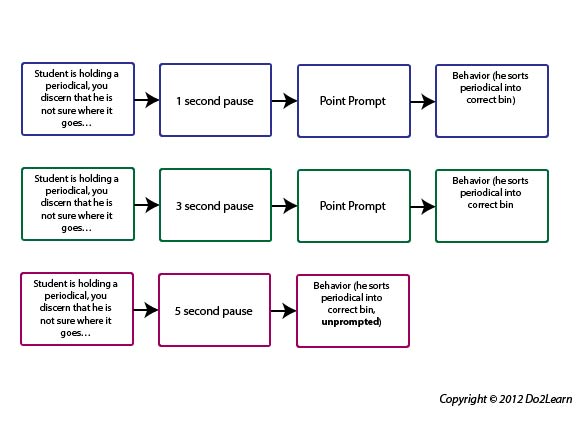
As the student demonstrates increasing independence with a skill, delay your gestural prompt to allow time for the student to respond without prompting. Below is a basic example to illustrate how you might increasingly delay prompting across practice opportunities:
Are you arranging frequent practice opportunities to build fluency through repetition?
Initially, it is important to consistently expect the student to go to the visual support to find information rather than asking what to do next. As independent employees, we self-start and go about our workdays without asking constantly for guidance. How long would we keep our jobs if we did not self-start? Your goal is to build a routine of the student checking the list or schedule for what to do next. As noted above, you want to build reliance on the use of sequenced visual instructions to prevent mistakes that occur as a result of doing familiar tasks from memory. Thus, build a consistent pattern of using the visual instructions so that 100% success is more likely.
What steps do you need to take to ensure that everyone targeting that skill applies the same level of prompting and fades it out at the same rate to support initiation by the student?
Is everyone prompting the student to use the postage guide on the wall above the postage machine while you are working to fully fade your prompts? Is everyone prompting the student to use the laminated written instructions on the counter when processing returned books?