
What type of schedule does the student need (a written schedule, a picture-written schedule, a picture schedule, or an object-based schedule) to independently determine where to go for each event of the day and in what order?
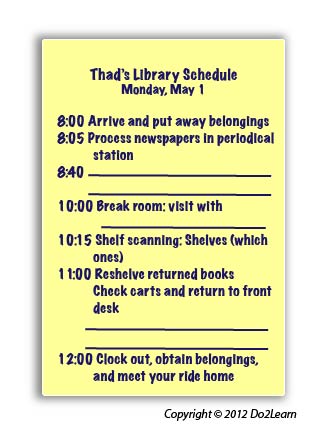
A template schedule can often be appropriate for offices and libraries since the volume and availability of certain tasks may vary from day to day. While some tasks do not shift from day to day, others may so they are not always present on the template. Mondays and Thursdays may be days that periodicals and magazines arrive in high volume and require processing for display, whereas newspapers may be heavy on Mondays. Because supervisors and co-workers are often willing to fill in the blanks on a list or schedule prior to the student’s shift, this is a natural support that can be used in the future:
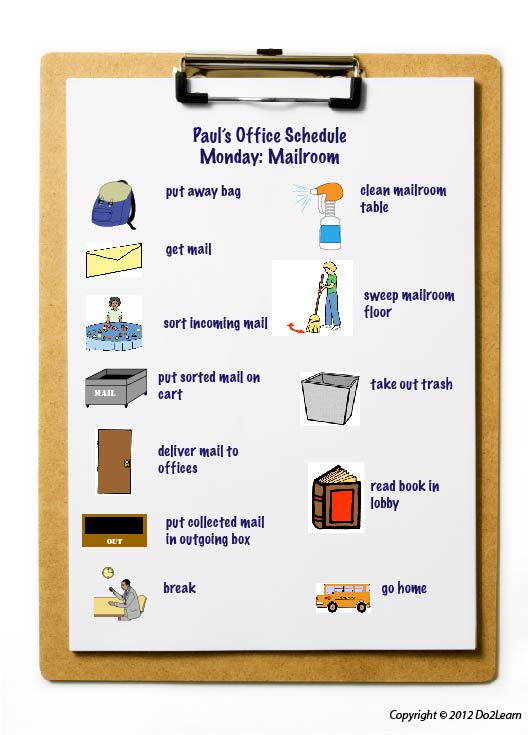
A schedule can be presented in a picture or object form as well. Design the schedule so that images or objects depicting the activities within that schedule can be re-sequenced or removed as needed. Laminated icons affixed to a strip or board with Velcro might be an option in some cases.
How will the student interact with his schedule to ensure that he is consistently using and referencing it? Will he check items off, delete items, place completed events in a folder, place items in a bin to represent completion of an activity, etc.?
Is the schedule available to the student at all times? If not, what adjustments should you make to ensure its accessibility?
The student’s schedule should be kept in a safe location so that no one else is likely to move it. The student will then know where to look for his schedule everyday when he arrives at the work site. It may be in his locker or at the specific place for his belongings. In this way, you can build a routine of putting up belongings and getting the schedule to determine where to go next. *Remember that a consistent daily routine that always stays the same is actually a mirage! Nothing stays the same for long in any work space, and job priorities and tasks do change. Do not expect the student to learn a routine and just follow that routine each day. How upset or disoriented will he be when the supervisor tells him that he needs to do something different one day? The schedule is a support that builds independence and assures predictability.
What additional cues (e.g. time durations, highlighting, reminders) might you add to the schedule to clarify expectations and activities?
Should there be a highlighted reminder to check with the supervisor first thing in the morning to check for any changes or additions to the schedule?
In order to align this intervention topic area with the unique needs of the student, do you need to create a schedule in the View2do program?