
What visual instructions or reminder cues should be present in each space to support sequenced and organized performance?
Visual instructions are likely to be crucial to success in childcare cleaning and in food preparation because of the number of steps in many of the tasks. Multi-step tasks lend themselves to either picture-written or written instructions. Creating a space for storing instruction lists will also be an important consideration. Will this storage space be a notebook in a drawer for the student’s recipes in food preparation? Will the storage space be an alphabetized file box with the student’s needed recipes or with cards that list various cleaning chores? Where can this structure be kept safely for consistent availability to the student?
If you refer back to the section on To-Do Lists, look at Marissa’s schedule that has a to-do list embedded in the schedule. Marissa will still need visual instructions for specific cleaning tasks. However, cleaning all stations and play areas may be addressed with one set of visual instructions for ALL stations. The Changing Area may have a specific set of visual instructions for proper cleaning and the Bathrooms may as well. For instance:
Cleaning Play Areas and Stations:
Remove all toys from shelves
Throw away trash
Wipe down shelves with Clorox wipe (1 wipe for 3 shelves)
Wipe off each toy with one clean Clorox wipe
Replace toys on shelf
Wipe off other furniture in play area or station
Vacuum rug in area
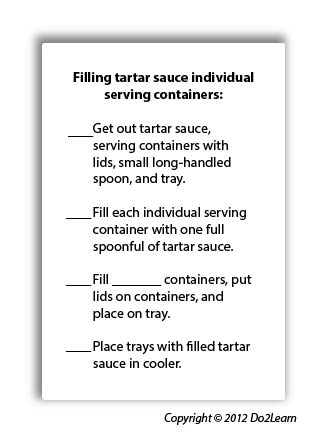
Food preparation tasks may need to-do lists that list specific instructions with spaces to fill in amounts as they could change on a daily basis. Below is one example:
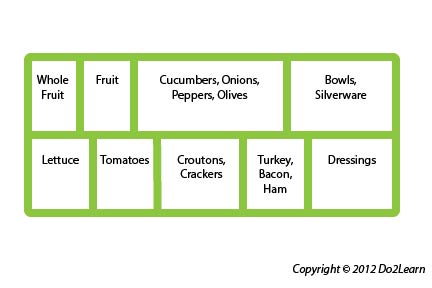
Consider that a map or photograph may prove helpful to the student in arranging items as expected. For example, a map of the layout of the salad bar may prove useful in helping the student prepare the bar:
As mentioned in the Social Narratives section, a reminder card may serve as a compact way of clarifying exactly what to say and do in customer service.
Where will these visual cues be placed?
Visual cues and reminders can be mobile tools kept in the student’s pocket. However, when possible, place cues so that the student sees them when he is engaged in a related task. For instance, the busing station may have written labels placed in different areas to assist the student in organizing the station efficiently. Boxes, cans and containers of food are dated and labeled for safe use. Serving trays or carts used to move food to a bar can have labels fixed to show what goes in each space. Make sure there is a consistent pattern for labeling these so that the student can attend to them.
How can I organize the materials (or help the student organize) to support independent performance? Where do materials go when they are finished?
The student may need a photo model to assist him in setting the table according to restaurant standards. Or, perhaps he can refer to one actual table that serves as an example for him. Would a photo model of the play station in a daycare center assist the student in placing toys and materials where they go?
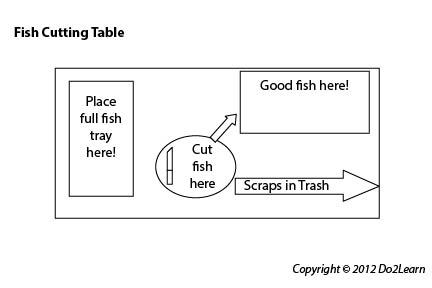
Silhouettes or diagrams on workstations can support organization. The diagram uses shapes and labels to assist the student in placement of materials in his workspace so that they are organized for efficiency. This example shows how a fish-processing table may be labeled with markings (e.g. tape or other options to meet health code requirements) that illustrate how to move through the process of cleaning fish:
In my design of each visual support, have I considered whether the student may need visual clarity cues (added to the environmental design, communication script or scenario, schedule, to-do list, graphic organizer, social narrative, and/or video model) to highlight (label) or emphasize key features or concepts?
In order to align this intervention topic area with the unique needs of the student, do you need to create visual instructions and reminder cues in the View2do program?
