
How can you break this skill down?
Commenting and questioning require the mutual interest of two parties in sustaining verbal contact. individuals may not see any value in making comments or asking questions. More than one individual has said, “Why would I want to talk with other people?” Wanting the contact is a core aspect to sustaining conversation.
Both require processing the verbal behavior of another and producing a response related to the same topic or concept. It requires generating a response based on grasping the main idea of what another person says. To comment I must: 1) process the words, 2) identify the topic (internally) and 3) make a related comment on the topic. To question I must: 1) process the words, 2) identify the topic (internally) and 3) ask the question with the intent to further the conversation.
Then consider the perspective-taking skills inherent in conversation. I gauge your interest as we talk and if you seem distracted or have little to say, I assume you are not interested in the topic. So I change the subject. On the other hand, if you say more, become more animated and have a lively expression, I recognize your interest and use that information to determine a response. Do I change the topic because you look stern? If you firmly state an opinion that I think of as ill-advised, do I share a different perspective or do I change the topic to avoid conflict?
The skill of reading body cues to determine interest level in a communication partner is a pivotal component of conversation, and using nonverbal cues to show interest is key in sustaining that exchange as well (see Showing and Deciphering Interest topic for overlapping elements). The conversation partner must read those cues while processing the words of the speaker. Evaluating the combination of body cues and words together requires advanced attribution skills that we describe as perspective-taking – reading and connecting the key details in a situation.
The skill of maintaining and adjusting conversation topics requires:
There is a sixth element here. All conversation partners miss cues or the meaning of words sometimes. And, all conversation partners dwell too long on a topic sometimes. When we do such things, we have 6) repair strategies available to us. We use words to acknowledge that we have digressed, we stop talking about that topic, and we initiate a shift. If we are unclear about the speaker’s meaning, we ask for information. We ask related questions to help us understand what we might be missing in a discussion. We ask for clarification on the other person’s thinking or perspective. Then we use that information to either sustain the conversation, or to end it (refer to Exiting Ongoing Conversations and Closing Conversations topic when this is your area of emphasis).
What sub-skill should you target first for the student to initiate? Given what the student can do presently, how will you present the task so that the student can perform steps within his capacity while learning a new step?
As with all intervention, careful assessment of each element is required. Choose the element that will respond quickest to your intervention. What motivation does the student need? Does he need practice in recognizing a topic? Does he have recognition yet needs practice in generating a response? Interest in conversation is often improved as a result of practice and success in limited and specific conversation.
Look at the student’s ability to recognize a topic. Can he generate a related response with specific topics of interest? If so, he can learn to generate a related response on other topics. How will you engage his attention on new topics? Motivation, concept recognition and generation will interact in early targeted efforts to build conversational competence.
If you are targeting the sub-skill of generating a response within a conversation, you might break it down as follows:
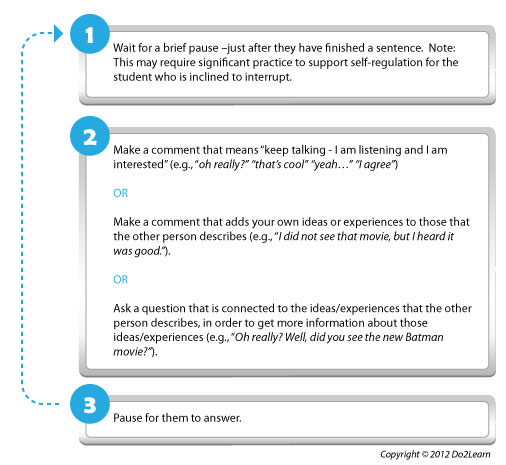
For some, this PAUSE to promote reciprocity is challenging. Some individuals might “monologue” about a topic that is of high interest to them, regardless of whether that topic is also of high interest to the person on the “receiving end” of this monologue. In such cases, it can be hard for the other person to fit even one word in, and even if they do, the individual might not even acknowledge that comment as he continues to talk. In this case, you will need to target strategies that support self-regulation within communication, while emphasizing how the failure to self-regulate (i.e., to monologue) is perceived by the person on the receiving end.
Repair strategies will need to be added to the mix of a sustained dialogue. After much practice, emphasis on attribution skills (reading and connecting the key details) can be layered into the dialogue practice.