
What type of graphic organizer(s) might the student require in order to visually represent and organize the concepts, feelings, or behaviors that relate to this particular topic?
Consider this graphic organizer for a student labeling and practicing skills in three categories:As discussed earlier in Communication Systems/Scripts, the use of scripts together with a graphic organizer can support the development of roles and expectations. Setting up a contrast of expected vs. unexpected behaviors with an organizer can support the student’s developing judgment around roles. The graphic organizer can be particularly important in helping the student understand a concept like respect or ‘interacting with co-workers’ or ‘good customer service.’ Acting on these concepts will require repeated practice, labeling and describing behaviors associated with the concept.
It may benefit some students to see where they “fit” in the larger structure of a school or workplace. Consider using words and names of people to fill in the organizer; some students may benefit from images (e.g. photos of the student, supervisor, co-workers, and generic photos of customers) inserted within each space:
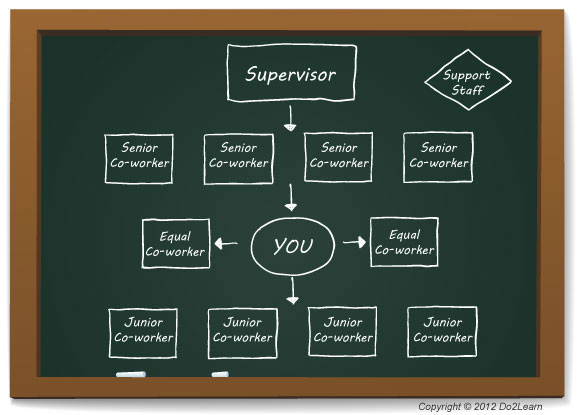
For some, you may need to create a graphic organizer for ‘respect with supervisors’ as a result of following scripts or repeated role-plays. As the organizer is developed, you will then have scenarios available where the student uses the organizer to practice appropriate responses.
"Labeling Roles And Expectations – Graphic Organizer 2 - Example"
The same approach can be used with the issue of ‘interacting with co-workers.’ In school contexts, consider how this relates to group work exercises that many students might encounter. Make sure that you word the rules so that the student can follow them. Some students may need extra instruction on Responding to Questions and Interruptions or several of the other basic conversational topics, Tolerating Interruptions, or Work Breaks.
As you target concepts related to roles and expectations within customer services positions, here is a graphic organizer, and a brief quiz that may be appropriate for some students (and answer key):
Is there a way to visually or thematically incorporate the student’s interests into this graphic organizer to increase motivation and engagement?
What additional visual clarity cues (e.g. icons, bolding, highlighting, color-coding) might you add to the graphic organizer to clarify concepts and to direct attention to key details?
Facial cues like a ‘smiley face,’ ‘eyes’ to note looking when talking, ‘nodding head,’ etc. may support the use of the rules in the organizer. Particularly difficult rules may require highlighting. Always consider how to re-word a rule so that the student can better use it.
In order to align this intervention topic area with the unique needs of the student, do you need to create a graphic organizer in the View2do program?