
What visual instructions or cues should be present in each space to support this behavior?
Visual instructions and cues will be very important in structuring the student’s downtime. Visual supports may be necessary in various situations. If the student has trouble initiating a downtime activity (meaning they finish their work and then have no idea what to do), you will need to create a visual cue or list to tell them what to do next. Visual reminders are also important because downtime can be unexpected and sometimes anxiety-provoking. The visual reminder takes away that element of the unexpected, but gives the student some preparation and guidance as to what to do. This reminder may be written as a reminder on their schedule or to-do list.
A choice board can be a visual support helpful for someone who comprehends information presented in picture form. A choice board offers picture cards of various activities that are appropriate to engage in during their downtime. Depending on the student’s needs, the choice board can be manipulated by the student in different ways. For example, the student can take the card and match it to a corresponding activity, cross off an item if they select it, or simply use the choice board as a list to scan and select from.
If you decide to use a choice board, you will need to clarify for the student when it is okay to use it. Specifically, you can indicate at the end of their schedule or to-do list that it is time to go to their choice board. This example is a choice board for school downtime.
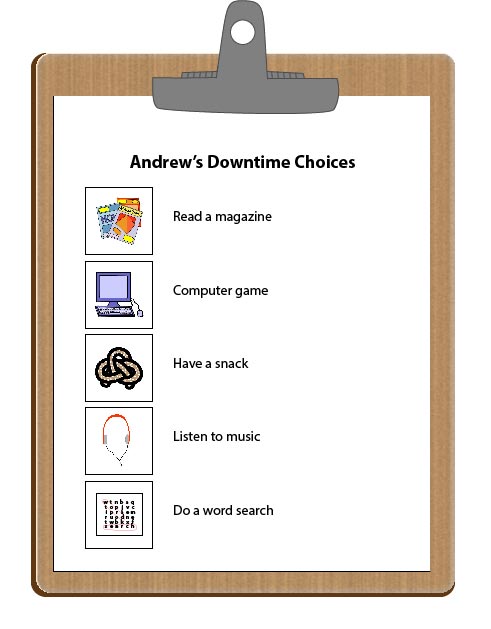
Here is another choice card to support the student in selecting appropriate activities during classroom downtime:
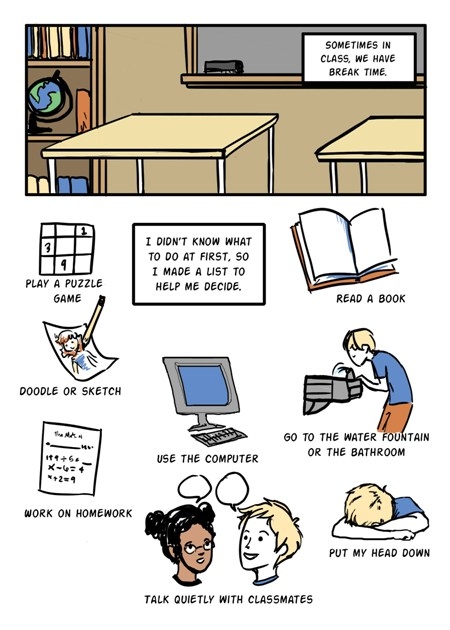
A student on the written-level may benefit from a reminder or list of acceptable activities to choose from to engage in during their downtime. The visual reminder may be posted near their workspace. It may include a reminder to go back to primary job tasks under specific circumstances.
How can I organize the materials (or help the student organize) to support independent performance? Where do materials go when they are finished?
In my design of each visual support, have I considered whether the student may need visual clarity cues (added to the environmental design, communication script or scenario, schedule, to-do list, graphic organizer, or social narrative) to highlight (label) or emphasize key features or concepts?
In order to align this intervention topic area with the unique needs of the student, do you need to create visual instructions and reminder cues in the View2do program?
