
How can you connect this new skill to the student’s priorities? How can you assure ownership by making the development of this skill the student’s goal rather than just your goal for the student?
What is the purpose of identifying your network? Help the student understand that networking goes beyond employment, that it is a key social structure that offers opportunities such as finding common interest clubs. If the student is part of a club, examine how he found out about it or who told him about it. If he is not, show him how to use his network to connect to others who share a common interest.
As you introduce this skill, how will you incorporate (visually, thematically) the student’s unique interests?
Undoubtedly, many students have a strong interest in and capacity for computers and internet technology. In this case, you might use visuals to illustrate how the internet is an interwoven network of connections. Connect this visual to a person’s network, showing the similarities of how a “server” that connects to a dozen computers to share information is similar to a person with a dozen contacts. Note that this analogy is not appropriate for all students, as many may not have an interest in computers, they may not possess strong knowledge in such areas, or they may not understand such comparisons.
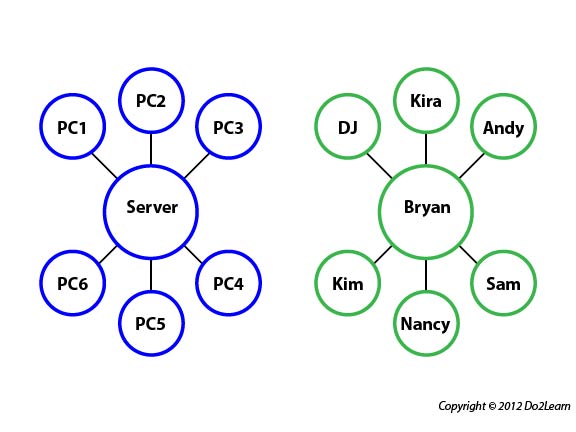
If the student is a fan of such online social networking sites as Facebook, emphasize that their Facebook “friends,” and the friends of those “friends,” comprise a type of network.
Can you make it visually clear to the student who is resistant to networking activities that his assumption is only one way of looking at things? Can your use of visual supports and self-assessments help get agreement that networking can be effective, get agreement on networking strategies, and create the motivation for change?
Using the internet analogy above, you can clearly show the importance of network “connections.” Show the student that by cutting established connections, or reducing the number of connections, the central server has fewer contacts and can therefore receive less information.
Here is a different activity that may be appropriate for group instruction contexts: A central person holds the end of several pieces of yarn. Around this student, others hold the other ends of the yarn pieces, forming a visible connection between them: “lifelines.” In a game show style, ask the central student questions (some easy, some hard), allowing him to get help from any of his connected lifelines. After each turn in which the student uses a lifeline, cut one piece of yarn, removing that lifeline. After all of the lifelines have been severed, discuss with the students if it was easier or harder answering questions with the help of the network or alone.
Finding jobs can be hard, but networking can make that process easier. People in your network might be able to identify jobs that are really good matches for you. What activities and visual supports (e.g. graphic organizers, social narratives) might you use to emphasize these points to the student?
Priming is a form of negotiation that can reframe and sharpen a student’s assessment of self. Below are the self-assessment tools that align with this intervention topic:
Looking for a Job - Networking
Interspersal is a proven technique involving the presentation of familiar, higher success tasks with the new, more challenging task. When it is appropriate, are you varying the activities to maintain the student’s confidence and focus?
For many who struggle to express themselves clearly and appropriately in writing, networking via email can be stressful and frustrating. Be sure to intersperse activities that do not demand writing with the networking activities that do. Clearly, rehearsals of phone-based and face-to- face networking can be challenging for many (e.g. I have to use the appropriate communication skills, say the “right” things, respond to questions I was not expecting, etc.). So as you engage the student in opportunities to practice these social communication exchanges, be sure he has the opportunity to watch others perform as well. Provide breaks as appropriate, and shift to other activities to sustain focus and motivation.
Before the student encounters a situation where he will need to perform this skill, how do you help the student prepare? How do you orient him to the materials he will use?
If the student is preparing to contact someone from his network by phone, he may use a checklist to make sure he has all of the necessary materials (e.g. contact information, script, pencil and paper, etc.). Additionally, he may review and rehearse out loud a rule card or script immediately before making the call. During the call, he might use the script to appropriately initiate the exchange, to remember to say “thank you,” etc. Similarly, orient him to the visual supports (a template, reminder cues) he might use before he drafts an email to a person in his network.