
How can you connect this new skill to the student’s priorities? How can you assure ownership by making the development of this skill the student’s goal rather than just your goal for the student?
This process requires negotiation with a clear knowledge of what is important and meaningful to the student. Always prepare a sequence that is within the student’s ability to see and comprehend. The simplest sequences are often 3-steps:

A more complex sequence might proceed with:

As you introduce this skill, how will you incorporate (visually, thematically) the student’s unique interests?
Can you make it visually clear to the student who is resistant to change that his assumption is only one way of looking at things? Can your use of visual supports and self-assessments help get agreement that there is a problem, get agreement on the solution, and create the motivation for change?
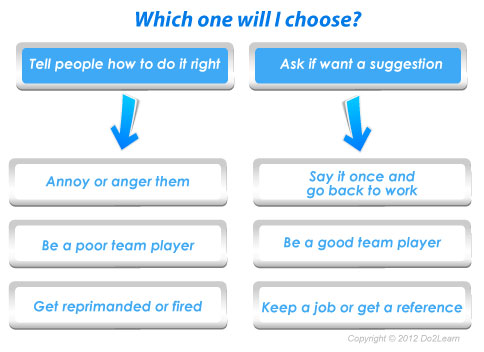
It is crucial in this negotiation to NOT argue with the student. Visually presenting the sequence in a connected fashion that is ‘in the student’s words’ is often a strong means of getting agreement. Flexibly following a student’s concerns within the visual support may support the student in ‘seeing things another way.’ Often a decision tree can help the student see (conceive of) two courses of action and thus come to a new point of view based on the connection to his motivation. (see Graphic Organizers)
Priming is a form of negotiation that can reframe and sharpen a student’s assessment of self. Below are the self-assessment tools that align with this intervention topic:
"Social Communication – Basic Skills 3"
Interspersal is a proven technique involving the presentation of familiar, higher success tasks with the new, more challenging task. When it is appropriate, are you varying the activities to maintain the student’s confidence and focus?
Consider natural, intermittently occurring daily activities in which you can ‘set up’ opportunities to practice offering help or suggestions.
Before the student encounters a situation where he will need to perform this skill, how do you help the student prepare? How do you orient the student to the upcoming situation?
Before encountering a situation, will the student need to review his social narrative or review an organizer that shows the sequence? Will he need to review an organizer that illustrates “what is happening” and “what is ____ doing with his body” so that the student can determine if help is wanted? Will he need to review a narrative or cue card that reminds him why the skill is important: “Helping too much can make people irritated. Then they do not want me as a teammate.” Or, “Helping when someone needs help means being a friend (a good teammate, a good member of the Justice League, etc.).” Just before the student encounters group work, it will be necessary to review the rule, the sequence or the key elements that have been discussed and practiced previously. A video model of helping prior to group work may increase frequency of appropriate helping behavior.