
Where is the student now? Where do you want him to be? Given the sub-skill you selected within your task analysis (your starting point for instruction), how can you shape this behavior into a practical skill for the future?
Since your goal is to help the student independently offer help or suggestions, create a map for yourself that may guide your instruction:
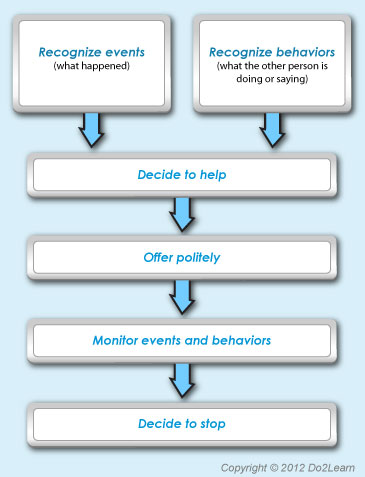
With this map, where is the student now? What step requires direct instruction and repeated practice?
What visual supports (scripts, instructions, reminder cues, etc.) will you use to help the student rehearse the expected behavior or skill?
What map, organizer or framework will help the student practice the specific skill that I have targeted? Will a script or cue card help the student focus on critical elements in the sequence?
What type of prompting might you need to provide in the initial learning phase?
Your role as a social interpreter is crucial in initial practice. You are labeling what you see. You are modeling the expected behavior. You are getting the student to imitate and practice the expected skill in small, concrete steps. You are getting the student to label what he sees in you and in his peers in initial practice sessions. Repeated practice is important. Initially you may have a reminder card that visually portrays the expected skill and you may point to it as you label, as you demonstrate, as the student labels and as the student demonstrates the expected skill. Over time, you may reduce your labeling and gesturally prompt to the reminder card to encourage the initiation and use of the skills by the student.
What is your plan for systematically and quickly fading out your prompting? How do you time and fade the prompt to support the student in initiating the target behavior?
Can the student discriminate between the more versus less appropriate response in a given role-play scenario? Are you arranging opportunities for the student to make such discriminations and to label when the instructor or someone else performs the behavior incorrectly?
After practicing the skill with a visual support, can I build in a set of scenarios or video examples that the student can sort into categories of ‘good help’ vs. ‘not so good help?’ Refer to Communication Systems, Scripts, and Scenarios for examples.
Are you arranging frequent practice opportunities to build fluency through repetition?
Do you design initial practice with ‘safe’ peers or friends, with the instructor? Is the practice interspersed with an engaging task?
What steps do you need to take to ensure that everyone targeting that skill applies the same level of prompting and fades it out at the same rate to support initiation by the student?