
What type of schedule does the student need (a written schedule, a picture-written schedule, a picture schedule, or an object-based schedule) to independently determine where to go for each event of the day and in what order?
The schedule is a primary tool that is intended to support independent transition. The form of the schedule should fit the student on his worst day. If he is agitated and can still process the information on the schedule, you have designed a good schedule. It must be understandable to the student, must fit his needs, and must be used as independently as possible.
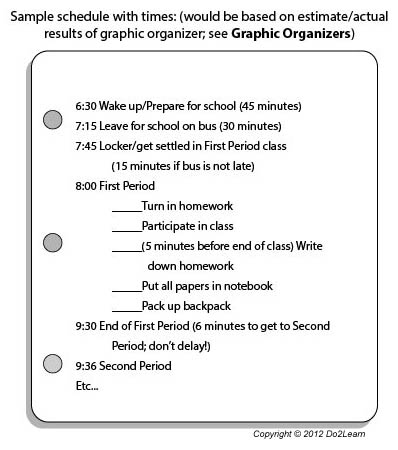
The student may need a daily agenda that includes the various bell schedules for the school. He may need a schedule divided by specific class period with times. Does he need a to-do list or checklist for each class? Maybe these could be created as one structure to decrease the amount of lists the student has to keep up with and increase his independence in using them.
The student may need a schedule that includes travel times or preparation at work or school, taking into account possible delays with traffic or distractions/interruptions. He might need a color coded calendar with routine times and dates highlighted. Both of these strategies could possibly be used for all environments.
How will the student interact with his schedule to ensure that he is consistently using and referencing it? Will he check items off, delete items, place completed events in a folder, place items in a bin to represent completion of an activity, etc.?
The student may need to use his schedule (agenda or planner) to write down specific times for activities, classes, or job sites. He may need sticky notes or visual reminders such as “start packing up your materials during the last five minutes of the class”, or “pack up and leave for your next class two minutes before the bell rings,” posted on the front of his binder or on his schedule. Determine if the reminder is best placed on the schedule since he already refers to that tool.
Is the schedule available to the student at all times? If not, what adjustments should you make to ensure its accessibility?
His agenda/planner will need to be available and kept in a routine place where he can always access it. If the student needs a daily bell schedule to help in transitioning to classes or work on time, this could be placed on the cover of his binder, or attached to the outside of his backpack where it can be referred to easily.
There may need to be a home schedule to assist in completing all home and daily living tasks. Is this on a clipboard on his dresser, or on a counter by the door? Note that the student may need a to-do list for hygiene and grooming. Is this a separate list that is in the bathroom or is the to-do list built into his home schedule?
A schedule for work could be kept on the student’s workspace, in a mobile device, or attached to a clipboard on a wall where it is easy to find and use.
What additional cues (e.g. time durations, highlighting, reminders) might you add to the schedule to clarify expectations and activities?
Highlighting may be used initially by the instructor for the times of day that are the focus of instruction in quick transitions. You can add extra time to specific spots on the schedule initially to adjust for distractions and likely delays. Some students may need specific times for each activity to see when exactly to transition. It might also be important to highlight important times with a reminder to ‘set the alarm on your watch”.
In order to align this intervention topic area with the unique needs of the student, do you need to create a schedule in the View2do program?
