
Where is the student now? Where do you want him to be? Given the sub-skill you selected within your task analysis (your starting point for instruction), how can you shape this behavior into a practical skill for the future?
Depending on the function of the behavior, and depending on the initial frequency and intensity of perseverative questioning, it may not be appropriate to expect an immediate drop down to zero perseverative questions. This is not a realistic initial goal. Instead, consider how you might identify an appropriate starting criterion (e.g. we will answer no more than 5 questions max. per day or per session). Then, successively reduce the number of questions that will be responded to (i.e. reinforced). Use a reminder cue/rule card to visually clarify your criterion for the student.
What visual supports (scripts, instructions, reminder cues, etc.) will you use to help the student rehearse the expected behavior or skill?
A visual support that indicates when it is okay and not okay to ask about the particular subject could be really helpful. For example, a card that indicates “it’s okay to talk about ___” on one side and “it’s not okay to talk about ___” on the other side can be used during teaching sessions. This allows the student to engage in a behavior that is enjoyable, or even relaxing to them, but puts appropriate boundaries around it.
Let’s say the student perseveratively asks questions about farming, as this is a narrow interest of his. Use a visual support to let him know that there is an appropriate time and place to ask about farming, as well as inappropriate times to talk about farming.
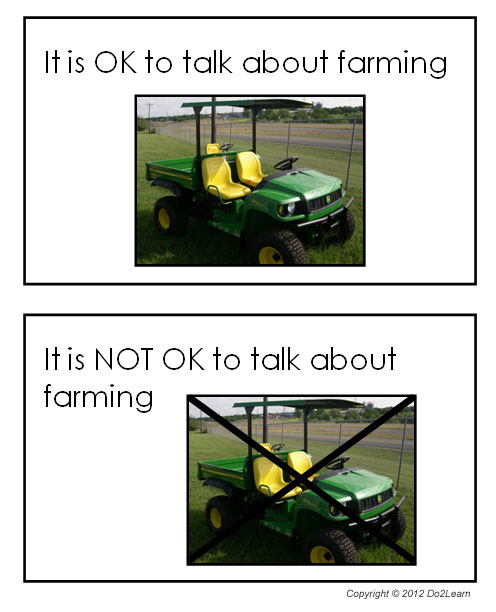
Additionally, including an opportunity to engage in their perseverative interest on the student’s schedule or to-do list can be a very helpful strategy. For example, at the end of their to-do list, you could write “Time for 2 questions about weather.” This indicates specifically when it is okay to ask about the weather, and may serve to motivate the student to complete their other tasks in anticipation of getting to ask about the weather.
If the student engages in perseverative questioning because of anxiety, it will be important to teach them an appropriate way to handle this anxiety. Video models, social narratives, visual relaxation cues, paired with initial modeling and practice of the coping strategies, will be necessary. Again, refer to the Self-Identify Anxiety topic for more on this.
What type of prompting might you need to provide in the initial learning phase?
If the perseverative questioning is driven by anxiety, you might point to or tap the visual support that provides a clear response to the question (e.g. “First Science, then lunch”); followed by a prompt that redirects the student to the task at hand. At first, modeling prompts would be necessary to support the student in the performance of coping exercises.
If the perseverative questioning is driven by the desire to initiate interaction, verbal modeling prompts may be necessary in the initial stage of instruction – you model the appropriate entry statement that would serve to replace the less appropriate perseverative question. It would also be necessary to provide gestural prompts to direct the student to any visual support that expresses a “rule” about when certain topics are off limits.
If the perseverative questioning serves a self-stimulatory function, your verbal and gestural prompts might serve to redirect the student to the task at hand, and to a visual support that signals when the student can take a break and engage in that behavior.
What is your plan for systematically and quickly fading out your prompting? How do you time and fade the prompt to support the student in initiating the target behavior?
The more discrete and brief the verbal and gestural prompts are, the easier it will be to fade them out. The visual support should be present as long as the student needs it. If the student is eventually able to be successful without the visual support, it can be removed. However, it should be re-introduced if the student begins having difficulty again.
Can the student discriminate between the more versus less appropriate response in a given role-play scenario? Are you arranging opportunities for the student to make such discriminations and to label when the instructor or someone else performs the behavior incorrectly?
Are you arranging frequent practice opportunities to build fluency through repetition?
What steps do you need to take to ensure that everyone targeting that skill applies the same level of prompting and fades it out at the same rate to support initiation by the student?
As discussed in the next section on Reinforcement, it is critical that everyone targeting the reduction of perseverative questioning (and the increase of an appropriate alternative behavior) responds in a consistent manner. Consider how over-used verbal prompts intended to redirect the student’s behavior might become social reinforcers. In other words, the student gets the social attention he wants when he uses perseverative questions in an effort to socially engage an instructor. His inappropriate behavior is reinforced, instead of reduced.