
Where is the student now? Where do you want him to be? Given the sub-skill you selected within your task analysis (your starting point for instruction), how can you shape this behavior into a practical skill for the future?
What visual supports (scripts, instructions, reminder cues, etc.) will you use to help the student rehearse the alternative behavior or coping strategy?
What is the alternative behavior or coping strategy that the student needs to practice repeatedly? Consider how you can depict that behavior (and the rules around that behavior) in visual form to support rehearsal. For students whose behaviors are driven by anxiety, a visual coping plan can support practice and performance of more appropriate soothing behaviors. For the student who uses particular phrases taken out of context (e.g. from films, TV) to initiate interactions with others, scripts can support practice of more appropriate entry statements and questions.
Schedules and to-do lists can be very effective in structuring when and where the student can engage in their repetitive behavior or a repetitive topic of interest. Finally, once strategies have been taught, visual reminders can play a key role in the maintenance and generalization processes. For example, write the student a note at his desk saying “You can fix one drawer at 10:00” or “You can fix your own stuff for 5 minutes, but you cannot touch anyone else’s.”
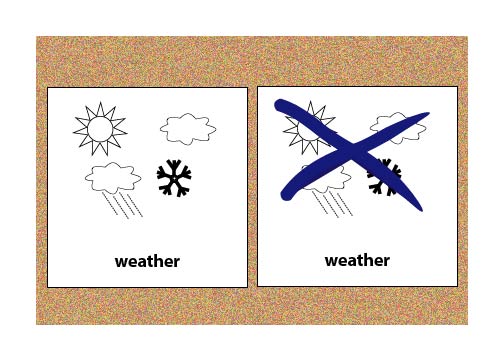
For a student who has perseverative interests that interfere with their work, use a visual support to indicate when it is okay and not okay to engage in conversation around that topic. A student who is a good reader may benefit from a written note saying “You can talk about politics online during your lunch break.” For a student who is at the picture level (or combined picture-written level), use a picture card (with words) that indicates on one side that it is okay to talk about their preferred topic and on the other side it is not okay to talk about their preferred interest. The instructor can flip the card to the appropriate side as needed. It is also a great way to re-direct a student who has become off-task talking about their perseverative interest. The following is an example of a flip-card for a student who likes to talk about weather:
What type of prompting might you need to provide in the initial learning phase?
Modeling prompts would be used to demonstrate the alternative response (e.g. fold hands together instead of flap) and to demonstrate any coping strategies (e.g. deep breaths and count when someone moves an item that I like to have in a certain place). In some cases, verbal prompts may be necessary at first to interrupt and redirect behavior. Keep verbal prompts short and simple.
In some cases you would use gestural prompts to direct the student to his schedule or to-do list to redirect him to the task he should be doing or to point out on the schedule when it is okay to engage in the behavior. For this to be effective, the schedule or to-do list should either be portable or contain picture cards that can be carried or handed to the student as a cue to go back to work. When re-directing the student to his schedule or to-do list, try not to use a verbal prompt as well, but if you do, make sure it is short and simple such as “Time to check schedule.”
What is your plan for systematically and quickly fading out your prompting? How do you time and fade the prompt to support the student in initiating the target behavior?
Are you arranging frequent practice opportunities to build fluency through repetition?
What steps do you need to take to ensure that everyone targeting that skill applies the same level of prompting and fades it out at the same rate to support initiation by the student?
This element is particularly important for addressing repetitive behaviors. If the behaviors are harmful or self-injurious, the student should be supported in preventing and avoiding engaging in the behaviors in all settings. But, if the repetitive behavior is only inappropriate in certain settings, such as at work with customers, you will need to work with the other instructors, co-workers and supervisors, and the parents to make sure the behavior is being addressed appropriately per location. For example, imagine a student who engages in hand-flapping with simultaneous full-body rocking when excited. This behavior may be unacceptable while working, but as it is not harmful and it brings pleasure and a sense of calm to the individual, he should be taught how to plan for times to engage in the stimulation during breaks, at home, or other personal times. For this type of situation, it is very important that everyone understands that the behavior is not targeted for extinction in all settings.