
What type of to-do list is most appropriate for the student: A written to-do list, a to-do list that combines words and pictures, a picture-matching to-do list, or an object-based system?
To-do lists provide structure and predictability for individuals. This type of predictability and structure often reduces anxiety as it informs the student what they are to do. If the student’s repetitive behaviors are related to anxiety, the presence of a to-do list is often helpful as it reduces anxiety about expectations of a specific task or activity.
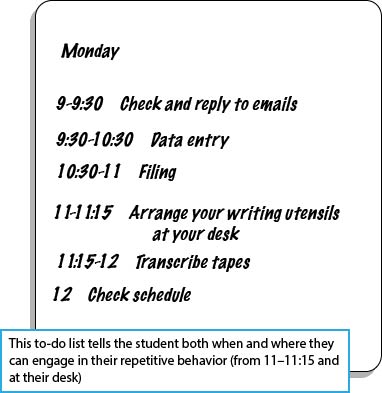
As with a schedule, you can also incorporate a time and place for the student to engage in their repetitive behavior within the to-do list. Thus, rather than eliminating the behavior all together, you are allowing the student to engage in it appropriately.
Here is a sample to-do list for a student who likes to repetitively sort and line up their pens and pencils:
Does the student’s to-do list answer these four questions:
How will the student interact with his to-do list to ensure that he is consistently using and referencing it? Will he check items off, delete items, place completed items in a folder, place items in a “finished” bin to represent completion of a task, etc.?
What additional cues (e.g. time durations, highlighting, instructions, reminders) might you add to the to-do list to clarify expectations and promote attention to key elements?
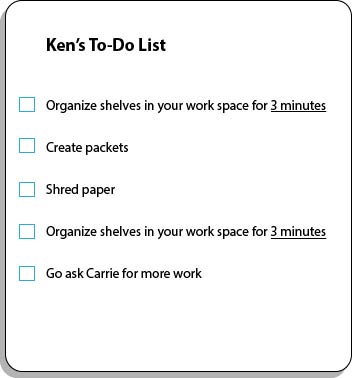
Including time duration can be important when handling repetitive behavior. Specify how long you are allowing the student to engage in these behaviors. It is also important to be clear about what to do after they are finished engaging in their repetitive or fixing behavior.
In order to align this intervention topic area with the unique needs of the student, do you need to create a to-do list in the View2do program?