
What type of graphic organizer(s) might the student require in order to visually represent and organize the concepts, feelings, or behaviors that relate to this particular topic?
The graphic organizer may be helpful in the priming process to assist the individual in understanding why following a set of rules will be beneficial to him. After all, he sees couples at school in social and sexual encounters that are outside of the bounds of professional behavior. Why should he follow your rules?
Does this organizer require adaptation to fit your specific student and his thinking? Do you need to add content on physical interactions in public settings?
"Managing Romantic Interests - Graphic Organizer - Outcome Map"
Consider the use of the graphic organizer that separates interactions with friends (those you spend time with OUTSIDE of work) vs. interactions with co-workers. There are topics that can be discussed with co-workers. There are topics that can be discussed with friends. In some cases, it may be appropriate to create an organizer that separates and defines public vs. private behavior. If this dichotomy is understood, consider one of the following options:
Then define a category for ‘romantic friend’ (or another label that the student can accept and embrace). What topics are ONLY discussed with those whom we wish to have a more intimate relationship? What behaviors are only displayed outside of the work setting?
These topics are tricky in that they must be ‘shared interests’ in a romantic relationship. Discussion of this fact while creating or reviewing the organizer is necessary. If the interests are not shared, it is likely to affect the relationship. If I want to hold hands and you don’t, how does that make you feel? Again, note that this list is created to clarify what not to talk about in work settings, even on break. You are not practicing how to share intimate details or intimate personal preferences. While this topic does not address the negotiation of ‘shared interests’ in a romantic relationship, it does define those topics and behaviors within the romantic category and thus are not discussed or shown at work.
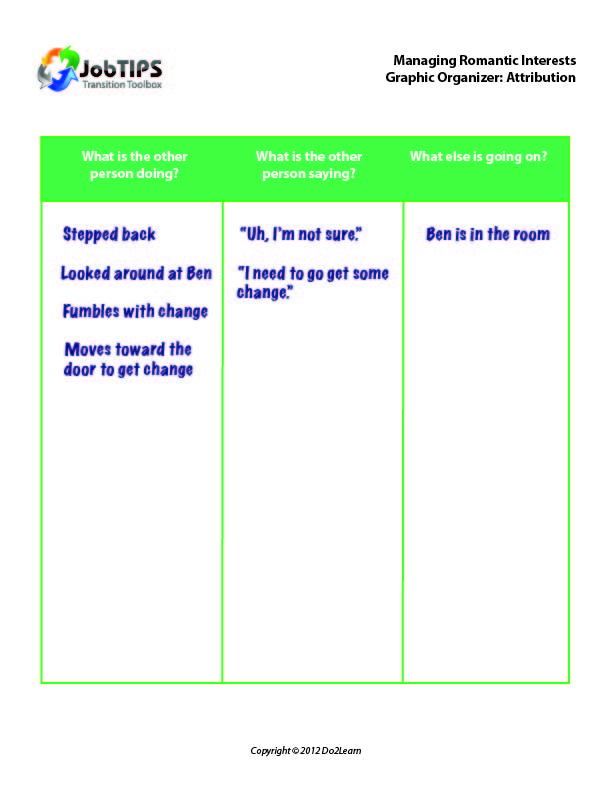
While making a request for social activity outside of work, the student may need practice in using a graphic organizer to help him attend to key details that support attribution. The organizer may be used in practice to help him think about the verbal and non-verbal behaviors of his conversation partner and to the environmental details that are relevant.
Filling in the columns on this organizer in varying role-plays or practice situations can help build the student’s ability to recognize specific signals, phrases, and circumstances and build increasing sophistication in interaction for social purposes:
Again, note that individuals tend to be visual learners. When they see the key details on paper, does it help them find the intent, the perspective, the meaning of a person’s response?
Is there a way to visually or thematically incorporate the student’s interests into this graphic organizer to increase motivation and engagement?
What additional visual clarity cues (e.g. icons, bolding, highlighting, color-coding) might you add to the graphic organizer to clarify concepts and to direct attention to key details?
For instance, with the Attribution Graphic Organizer above, consider whether icons on each column assist thinking as the individual picks out the important details.
In order to align this intervention topic area with the unique needs of the student, do you need to create a graphic organizer in the View2do program?