
In what contexts does the student need to display this skill, now and in the future?
Advocating for oneself is a skill that is used throughout life and in all environments. A student may need to advocate for himself in school to ask for supports or accommodations, to defend his opinions and choices, explain his needs, and seek a solution. An employee may need to share satisfaction or frustrations with his job and advocate for changes. If an employee seeks accommodations in the workplace under the Americans with Disabilities Act, he will need to request those accommodations. Similarly, if a student seeks accommodations in a post-secondary setting, he will need to request those supports. Self-advocacy is also important in the student’s adult life as he makes choices and decisions about where he wants to live and who he wants to spend time with. Self-advocacy is one of the “building blocks” of self-determination.
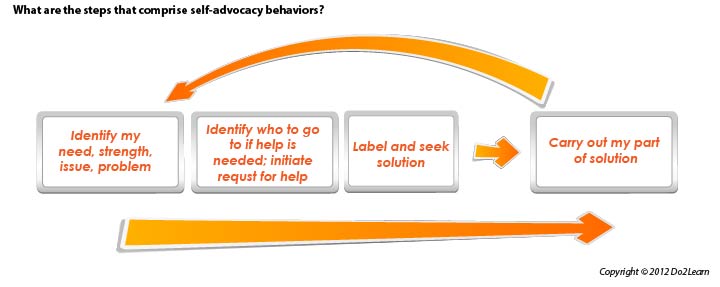
The way this step “looks” can come in many forms and levels of complexity:
The priming process is crucial here, as many students do not accurately perceive their strengths and needs. It is equally important to emphasize when the student does things well or when things are easy for them, so the student can learn to recognize and appreciate their strengths. The way to cultivate accurate self-awareness is by providing actual opportunities that allow the student to explore their interests, strengths, and needs. Following such experiences, self-assessment tools, instructor assessments (e.g., assessments that match the self-assessments, vocational assessments, results from informal classroom assessments delivered in terms the student can understand, data on IEP objectives delivered in terms the student can understand, formal evaluation information delivered appropriately and in terms the student can understand, etc.), graphic organizers, and social narratives can be used more effectively to shift perspective and promote self-awareness.
Define who to go to if help is needed, and then initiate the request for help.
In many cases, once the student identifies a need, he must then identify who can help and initiate the request for help. For example, after the student recognizes that the noise in the room is making him very anxious (step 1), what can he do to address that need? If a proactive plan is not in place to address this need (e.g., get out headphones and put them on), does he need to indicate to the instructor or supervisor that he is having a hard time? Again, priming will be crucial here as many students may challenge the idea that it is okay to ask for help and accept help. If initiating requests for help is a major challenge for the student, refer to Asking for Help in conjunction with this topic.
Label the solution.
In cases where the student seeks assistance to address the need, he will have to come to an agreement with that person on how to address the issue. Support the student in identifying and labeling an appropriate solution, rather than immediately identifying it for him. In this way, he takes more ownership over the solution. Use graphic organizers and other visual tools to help the student map out and select options when necessary. Priming here is crucial as well, because if the student does not “buy in” on the way to address the need, the other person alone will end up taking action to pursue the solution. Use visual supports including graphic organizers, instructions, and social narratives to support negotiation of the solution and to clarify what steps the student will take to achieve that solution.
Participate in the solution to take care of the need.
At this point, the student takes agreed-upon steps to achieve a solution. As described in more detail within the Shaping section, the ultimate goal is that the student can take over more of those steps to pursue a solution that addresses the need.
As the student develops competence advocating within one area of need or issue (e.g. asking for information when instructions are not clear or seeking classroom accommodations), then move to a different subset for instruction and practice. Over time, the instructor may support the student in connecting these varied circumstances (e.g., asking for missing materials, asking for a break, seeking classroom accommodations, getting help when bullied, pursuing a job that is a good fit, disclosing a disability to the supervisor in order to obtain workplace accommodations after the individual has carefully weighed the pros and cons, etc.) so that the student develops a working concept of what it means to be a “self-advocate.” Developing that concept of self-advocacy can support the student in correctly identifying when he might need to self-advocate in new situations.
What sub-skill should you target first for the student to initiate? Given what the student can do presently, how will you present the task so that the student can perform steps within his capacity while learning a new step?