
What type of schedule does the student need (a written schedule, a picture-written schedule, a picture schedule) to independently determine where to go for each event of the day and in what order?
The schedule shows the student the sequence of places to go within a workday. It clarifies the physical transitions to different spaces during the day. When one is working in a garage or automotive maintenance center, the worker is in the garage area throughout the day except during breaks and lunch. While he is in the garage area, he is moving from task to task but he stays in the same space: the garage. Each task, as noted earlier, requires movement to complete the task. Thus the to-do list or the visual instructions for a task are more significant in some ways than the schedule. Literally, in automotive maintenance or detailing, one drives the car in, reviews the manifest or order, completes testing and maintenance, completes the manifest, and drives the car out, repeatedly. In construction, generally the worker is at one building site all day. The sequence of tasks may be in a to-do list and in visual instructions, not necessarily the student’s daily schedule.
The point of this discussion is to alert you to how to use the tools differentially depending on the setting and the tasks. Mobility within tasks is a major part of these types of jobs. Determine if the student will need a schedule to let him know where to be at what times: he will need a break and lunch schedule inevitably. However, are other visual tools more critical to organized activity and to proper job performance? The amount of movement, lifting, and carrying of equipment and tools to different areas within a task make the visual cues, visual instructions and/or the to-do list very important.
How will the student interact with his schedule to ensure that he is consistently using and referencing it? Will he check items off, delete items, place completed events in a folder, place items in a bin to represent completion of an activity, etc.?
Is the schedule available to the student at all times? If not, what adjustments should you make to ensure its accessibility?
Regardless of whether the student is using a schedule or to-do list to see the progression of work tasks, he should still have access to a general schedule. Many individuals are challenged by the abstract concept of time management or mentally tracking duration. Consider if after you clocked-in to work, you were unsure of how much longer you had to work before clocking-out; this concern may bother you all day, contributing to a lack of focus and an increase in anxiety. This can be a daily challenge easily addressed by a simple schedule of the day’s events. Here is a schedule for a worker who will be painting several rooms of a new home:
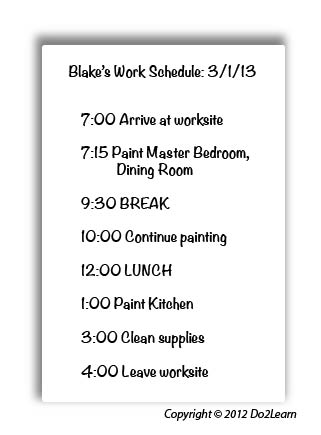
Each task on the schedule indicates where Blake should go at certain times, then each task may involve a to-do list or system (e.g. drop cloths and tape placed at the entrance to each room for Blake to set-up before starting painting; a checklist of tools requiring cleaning at the end of the day, etc.).
What additional cues (e.g. time durations, highlighting, reminders) might you add to the schedule to clarify expectations and activities?
In order to align this intervention topic area with the unique needs of the student, do you need to create a schedule in the View2do program?