
What type of to-do list is most appropriate for the student: A written to-do list or a to-do list that combines words and pictures?
The to-do list presents the sequence of tasks to be done. Often the schedule and to-do list may be combined in this type of work. Presenting a to-do list that sequences a series of tasks before a break or before contacting the supervisor can lead to independent movement between tasks, a very desirable skill in the work place.
Because the schedule itself may be remarkably consistent, embedding the to-do list within it may work for many. For instance, in an auto detailing position, the supervisor or a co-worker may fill in a template schedule with the specific jobs prior to each break so that the student can be totally independent and on task for extended periods. In this case, the student may have a ‘detailing list’ (or several for different levels of cleaning and detailing) that serves as an additional cue to assure that all steps of the detailing task are completed:
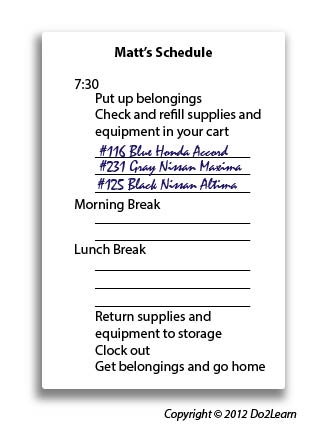
Does the student’s to-do list answer these four questions: “What do I have to do?”
“How much do I have to do?” “When am I finished?” “What next?”
The student should see in the to-do list the number and the type of jobs. Again, the to-do list helps the student move from task to task efficiently with a sense of what is being accomplished.
How will the student interact with his to-do list to ensure that he is consistently using and referencing it? Will he check items off or delete items?
Consider where the list can be housed or kept so that the student can refer to it and thus use it to stay focused and on task. The to-do list be placed on a clipboard at eye level over a work table in the garage. Or it can be stored by hanging the clipboard on the side of a work cart that holds the student’s equipment and supplies. Will the to-do list be on a portable clipboard attached to the student’s belt for ease of reference? If the student is wearing a nail apron, can the schedule/to-do list be on a card in the apron?
What additional cues (e.g. time durations, highlighting, instructions, reminders) might you add to the to-do list to clarify expectations and promote attention to key elements?
In order to align this intervention topic area with the unique needs of the student, do you need to create a to-do list in the View2do program?
