
What type of graphic organizer(s) might the student require in order to visually represent and organize the concepts, feelings, or behaviors that relate to this particular topic?
A graphic organizer is likely to be useful in the process of priming the student for a job. The organizer may assist in ‘mapping’ the various elements of the job or in ‘mapping’ the jobs that the student prefers vs. the ones that are less desirable. It can support the student in seeing the ‘big picture’ and may help overcome resistance associated with a certain task that is not interesting or seems too difficult to the student. The organizer may show all the key elements of a job at once.
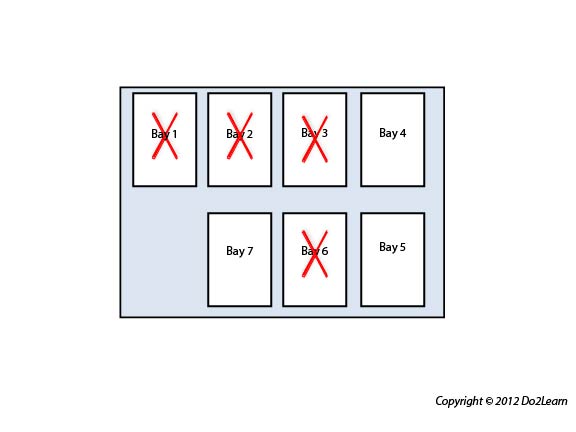
Graphic organizers may also help depict the layout of a workspace such as the floor plan of the garage, the location of all tools on a construction truck, etc. One graphic organizer for a car garage may be a map of the bays. This organizer could actually be used for several purposes, even as a creative to-do list. For example, if the garage map is printed and laminated, a supervisor or co-worker may use a marker to indicate with an ‘X’ the bays where the student should work. As the student completes the tasks for each indicated bay (e.g. draining oil, running diagnostics, etc.), he then erases the ‘X’ and moves to the next indicated bay:
Is there a way to visually or thematically incorporate the student’s interests into this graphic organizer to increase motivation and engagement?
Continuing with the garage-based job discussed above, how might the student’s interests be used to encourage his use of an organizer? In the floor map example, perhaps instead of drawn X’s, the bays requiring work are indicated by attaching icons of sports cars, photos of the Avengers, or tokens that can be collected as part of a reward system.
What additional visual clarity cues (e.g. icons, bolding, highlighting, color-coding) might you add to the graphic organizer to clarify concepts and to direct attention to key details?
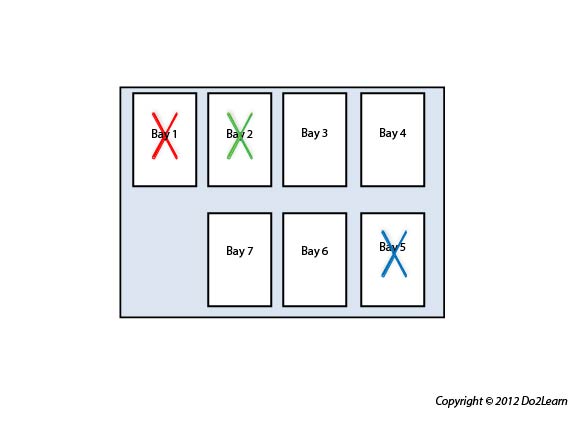
Sometimes, the work in trade and industrial settings is less about the physical order of presented tasks and more about priority. For example, the worker in a garage may not be able to just move through the bays in a left-to-right order, tackling tasks in order from Bay 1 to Bay 2 to Bay 3, etc. Cars will be pulled into open bays, most likely not in order of prioritized service. Perhaps the car in Bay 1 requires oil drainage so other employees can begin servicing it; Bay 2 needs to be vacuumed, and Bay 5 has a scheduled appointment for a battery-change. In what order should the student move? It may be that Bay 1 is handled first so that the other services on that vehicle can get started; then Bay 5 since they have an appointment; and finally Bay 2 because pick-up has been scheduled for later in the evening. In this case, the garage map may be marked by color-coded markers indicated priority of service with red (HIGH), blue (MEDIUM), and green (LOW). The worker would report to the bays in order of priority to complete tasks: red first, blue next, green last:
In order to align this intervention topic area with the unique needs of the student, do you need to create a graphic organizer in the View2do program?