
What visual instructions or reminder cues should be present in each space to support sequenced and organized performance? Where should these be placed?
The schedule, the to-do list, and the set of sequenced instructions for complex tasks are the visual supports that are most frequently used in assuring independent performance of trade skills.
Often multi-step jobs or tasks require a set of sequenced instructions, readily accessible to the student to keep him organized and independent. The student can use a laminated set of instructions that are kept in a consistent drawer or designated work space for his instructions. It is important to find a place to keep these so that others do not disturb or move the instructions. The student’s visual instructions can be kept in one ‘manual’ or notebook or contained space so that he can always find them. They can also be kept in a file box with tabs in alphabetical order to assist access.
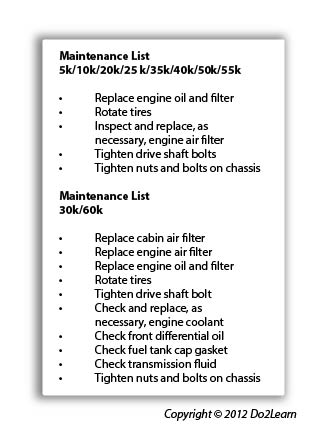
You may use an instruction book or portfolio in which instructions are housed. For instance, the student may work in a garage and assists with routine maintenance on vehicles. A set of structured lists have been created so that he can do either all of routine maintenance checks (at 5k, 10k or 40k miles) or part of the maintenance check at complex maintenance checks (for instance, 60k miles where several computer tests and significant repairs are required). These lists are titled so that he automatically checks the manifest or invoice, finds the appropriate list, and completes his portion of the maintenance that he will complete.
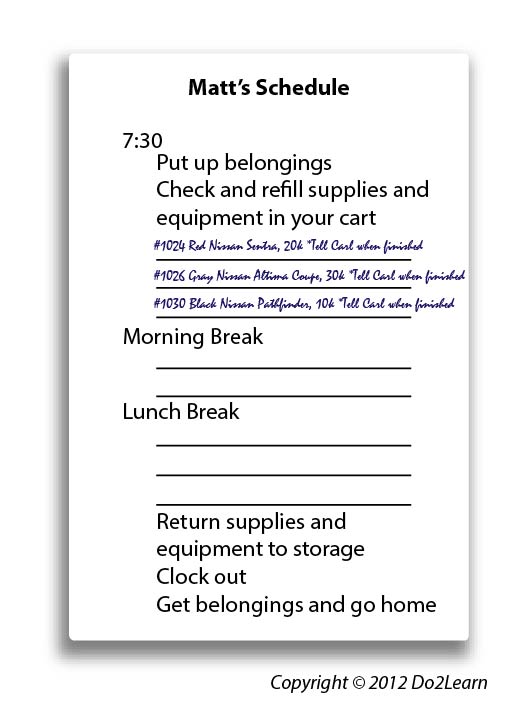
Visual cues may also include general reminders for specific issues or details with which the student has difficulty. For instance, the student may work in a garage using lists as noted above. Does he need an additional reminder added to his schedule, to-do list or to each set of instructions to remind him to tell his co-worker when he is finished with each task? The reminder may be added to the schedule or to-do list because the student always checks it when he is finished with a checklist or car. In this way the reminder is clearly and immediately evident.
How can I organize the materials (or help the student organize) to support independent performance? Where do materials go when they are finished?
For the last instruction on the visual instruction sequence, write “Put this instruction sheet back in your file box” to help the student keep up with all his instructions. The student should place finished jobs in one set location or return the finished job to a specific person.
In my design of each visual support, have I considered whether the student may need visual clarity cues (added to the environmental design, communication script, schedule, to-do list, or social narrative) to highlight (label) or emphasize key features or concepts?
In order to align this intervention topic area with the unique needs of the student, do you need to create visual instructions and reminder cues in the View2do program?