
When teaching new skills, we first identify the target skill to be taught in the assessment process. We then break it down so that the student can comprehend what is expected, and so that he can achieve success within a short period of instruction (task analysis). We identify how to set up and enhance motivation to assure investment and get agreement, as necessary, through the priming process.
Our next step in the teaching process involves modeling, practice, and role-playing – designing the instruction so that the student repeatedly experiences positive performance of the target skill. The instructor must determine how to use modeling or demonstration within a practice routine that gives the student confidence in performing the target skill in a series of environments. Will the student benefit from practice that involves role-playing in a more controlled environment to support learning? The instructor must determine how to design the environment to support student success (environmental design). Will the student practice the skill in a ‘safe’ environment with fewer peers, in a 1:1 teaching setting initially, OR can the student practice the skill within the full class or work site? Of equal importance is the choice of visual supports that will be used to support the development of the target skill. In this section the elements of modeling, practice, and role-play will be defined and illustrated to help the user determine a plan for instruction of the target skill.
What is modeling?
Modeling involves demonstrating or showing how a task is performed. Specifically, it often involves demonstration of what to say, of how to say it, and the use of body, gestures and facial expressions. For many individuals , it is also necessary to label in concrete terms what is being modeled. The instructor may serve as a ‘social interpreter’ by clearly defining the expected behavior that is modeled. Precise labeling of expected behavior can be crucial with individuals . However, care must be taken to label expressions, body position, and environmental details in ways that the student can comprehend. Labeling is useful in modeling and in social reinforcement of the skill as the student practices it. The instructor’s labeling should precisely identify what is being done well.
Please note that video modeling is one form of modeling that has proven effective with students . Within the Transition Toolbox curriculum units, you will find a number of video modeling samples that might be used to support your instruction.
Video modeling involves a student watching a video of the appropriate performance of a task (expected behavior) prior to practicing or potentially using the skill in natural settingsHowever, the instructor may instead decide to use simple live modeling in the introduction or demonstration of the target skill.
When to use modeling?
- Modeling is often used to introduce and define the desired behavior or skill.
- Modeling can also be used as a prompt to help an individual practice a skill. When used as a prompt, modeling should be faded over time to avoid prompt-dependency.
Prompt:
Temporary support that you provide which must be systematically faded in order to ensure independent performance across a variety of contexts.The instructor must fade modeling prompts gradually and systematically to prevent prompt dependency. Often individuals will become prompt dependent and not use a behavior except when someone else initiates the behavior through modeling.
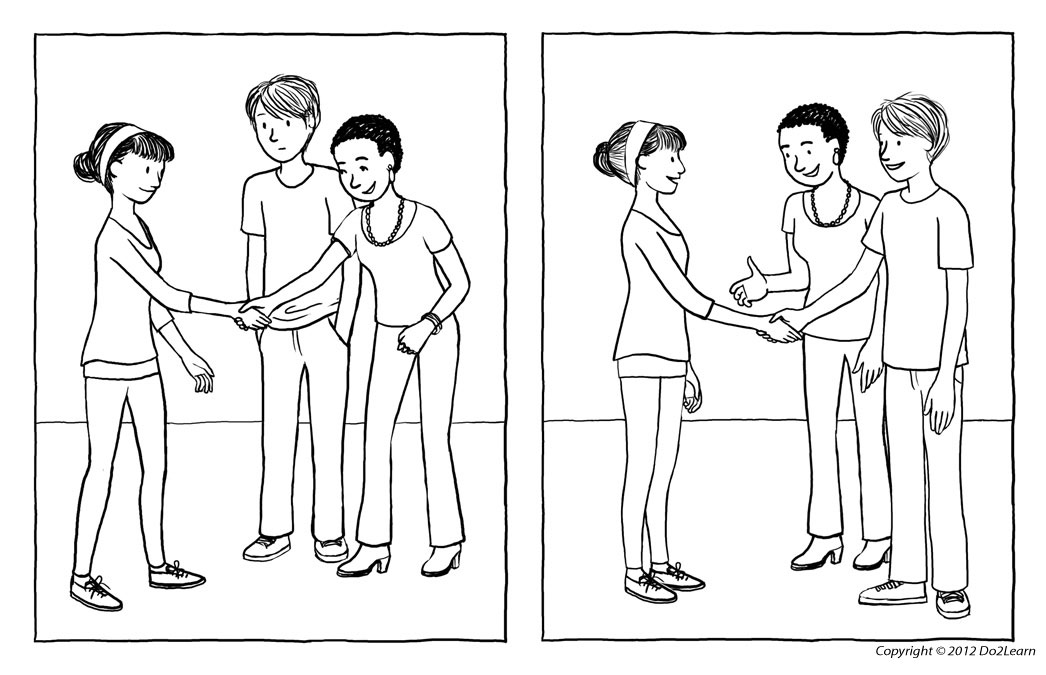
- This is a strategy to use sparingly! The instructor must focus on supporting the initiation of the new skill by the student. Initially, one may use multiple modeling prompts to help the person see all aspects of the skill, labeling elements of the skill as needed. Thereafter, one intentionally avoids using modeling prompts or delays and minimizes the model so that the individual initiates the behavior without attention to the instructor. One minimizes a prompt by doing less and less of the expected behavior when modeling.
Why use modeling?
Modeling provides a clear example of what to do. It may work in combination with discussion, written examples, social stories, and other visual supports during the teaching process. Think of the skills you possess that would have been very difficult to learn without having witnessed someone else perform them, such as dance steps or navigating an employer’s new software.
Practice & Role-Playing
 The goal of the teaching process is to assure that the student can apply the target skill with confidence in various settings independently (without prompts). Repeated successful practice to build confidence is essential. As noted in priming, the instructor must define what is preventing the student from performing the skill. Does he know how he is presently behaving? Does he know that his present behavior requires some change? Does he know that there is a better way of acting? Is it important to him to do this differently?
Once the instructor and student define the target skill in terms that the student can understand, the instructor determines the environment and the strategies for repeated successful practice of the target skill.
Role-playing is a great way to practice skills through enactment and re-enactment of various situations. In a role-play, actors are allowed to try their hand at practicing newly-taught skills. Individuals can work on specific skill details such as perfecting their business smiles or finding just the right volume when speaking in an office. During role-plays, the instructor can offer support, provide prompts and modeling, and visual scripts may be necessary.
Elements of Practice & Role-Playing
There are a number of key considerations as you engage students in practice and role-play opportunities:
Practice the skill in a setting designed to support the student.
After modeling and defining the expected behavior, repeated successful practice is crucial for individuals.
Central coherence:It is theorized that individuals over-focus on parts and details, rather than perceive the meaningful whole. Thus, they display weak central coherence. One with weak central coherence might struggle to see “the forest from the trees,” the “big picture,” or to discern the greater pattern from an array of smaller details. They might struggle to hold various concepts in mind and apply those concepts as they encounter new situations where such concepts are relevant. They might struggle to recognize how a concept targeted in one condition is applicable in another condition as well.
Determine the visual supports that you will use while practicing the new skill.
Scripts show a concrete set of written (and potentially picture) cues that provide the student with directions and words that he will use in a specific situation. The script provides visual cues for the dialogue, the interaction, and the expected behaviors in performance of a target skill. The script should be individualized to assure that it fits the needs of the student. Does he need every word of the dialogue written on the script card to support his successful performance? Does the student need additional picture or word cues to define his body position, facial expression, gestures, etc. during the use of the script?
Provide practice opportunities in which the student can identify examples of the incorrect (or unexpected) behavior in others to support understanding and build confidence.
Then the instructor says that she wants to practice the behavior. She moves away from the practice setting and approaches the student with her head down. She stands 8 feet away from the student and mumbles the greeting without looking at the student. After this occurs, the instructor asks the student to tell her what she did wrong. As the student notes different mistakes (head down, too far away, mumbling, not looking at the face, etc.), the teacher writes these on a board or paper for the student. Maybe the teacher practices again and the student has to correct the instructor during the greeting and the instructor then completes the behavior with the student’s prompts. Such opportunities can help a student more clearly distinguish between appropriate versus less appropriate responses.
Systematically fade modeling and prompting as quickly as possible during practice sessions so that the student will initiate and independently perform the expected behavior.
In this way, the student focuses on the visual support to guide his behavior. The instructor uses waiting and minimizes gestural prompts over time to promote independent performance.
As a result of role-playing and practice, the student shows success and fluency in performing the expected behavior with visual support (coping card, script, etc.).
Waiting, or time-delay procedures are used to fade out prompting and promote independent responding. As the student is expected to perform a particular skill, the instructor briefly pauses (waits) before issuing any prompt, in an effort to provide the opportunity for the student to independently display the skill. As the student displays increasing independence with the skill, the instructor gradually increases the amount of wait time before issuing any prompt.
In general, the gradual release model provides a framework for approaching practice and role-playing of new skills. It is important to methodically move from modeling by the teacher to independent performance by the student. Maintaining a high level of student success with the skill while preventing prompt dependency is one challenge for the teacher.
|
I Perform – You Watch I Perform – You Help You Perform – I HelpYou Perform – I Watch |
At this point, the focus of practice shifts to fluent use in a variety of situations (generalization).
When the student is ready to perform the skill in natural environments, sometimes the visual supports from practice sessions must be adjusted to fit the new setting and the student’s needs. For instance, a student initially in practice needed a very simple script for shaking hands when greeting. This script defined the exact words to say, as well as provided picture cues to cue him to orient his body, look at the face, and smile. Over time, he showed such skill in the dialogue that he did not need the concrete script of that dialogue. However, he was still inconsistent in orienting his body, smiling and making eye contact on every introduction. A modified script was developed for him that had three picture-written cues on a card (picture of two people face to face, picture of a smile, and picture representing ‘look at face’). The student then kept a copy of this card in his pocket for quick reference. In practice in natural settings, his job coach or assistant instructor cued him to look at the card prior to entering each of several sites (the office at school, the cafeteria at school, and a new job training site). By cuing the student to look at the card just prior to entering a site, the instructor has engaged in priming.
|
When building a new skill via modeling and practice:
|
