
What is a prompt? A prompt is something that you add to the teaching situation to assist the student in performing the skill. Prompts should be viewed as temporary supports that are faded as quickly as possible to prevent prompt dependency. Prompts can be used to help a student more accurately learn / perform nearly any skill.
The concept of instructional scaffolding is similar to prompting. With instructional scaffolding, a teacher provides a student with assistance but then that assistance is withdrawn gradually.
When to use a prompt? Prompting is often used when a student is learning a new concept or task. In other words, prompting is most often used in the skill acquisition phase. Again, your goal is independence, not prompt-dependence and thus all prompts should be faded out as the individual displays increasing independence with this skill.
Why use prompts? Prompts are used to keep the student successful during the teaching and learning process. If a student continues to make errors with no outside assistance, they will likely become frustrated and will quit.
Guiding questions to consider: |
|
Prompting
|

 |
 |
 |
|
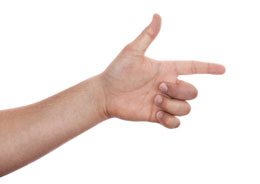
Gestural prompts: Use nonverbal signals (pointing, waving hand, reaching out arm, changing body position) to direct the student to the correct item or location. Example: A student is learning to transition from one classroom to the next in a large school. As you follow the student, he stops and is not sure whether to turn left or right. You point to the sign on the wall that shows which classrooms are located in which direction. In this way, your prompt is to a naturally occurring visual cue (the sign) that the student can use in future practice. |
Modeling prompts: Use demonstration (showing the student how to do something) to provide an observed example of the appropriate response. Modeling prompts can be in nonverbal or verbal form and can be used to generate a nonverbal or verbal response. Example: A student is learning how to install a radiator hose in his auto shop class. You demonstrate how to do this so the student can observe the correct placement and insertion. |
Positional prompts: Physically position one item closer to the student than another item, so they are more likely to select the correct item. Example: A student is sorting a pile of supplies into two work bins, but she is struggling to accurately discriminate between the supplies in order to put them in the correct bin. As she picks up one item to sort, you could place the correct bin closer to her. |
 |
 |
 |
|
Verbal prompts: Use spoken language to direct the student to respond correctly. Verbal prompts can be short (e.g. “Trays”) or long (“First get the trays, then scoop the ice…”). Example: A student is counting and sorting change in the school cafeteria as part of their on-campus work requirements. He incorrectly labels a quarter as a nickel. You verbally prompt him by saying, “That’s a quarter.”
|
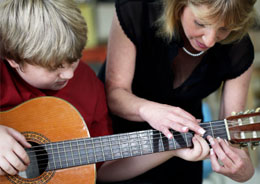
Physical prompts: Touch, reposition, or move the student in order to direct them to the correct response or area. Physical prompts can be partial (e.g. helping a student adjust their pencil grip) or they can be more extensive (e.g. hand-over-hand prompts to help a student write their name). Example: A student is assembling materials in the workshop area, but is struggling to fit two pieces together. You provide a slight physical prompt by turning the object in his hand so that they items then fit together correctly. |
Accidental prompts: Accidental prompts are exactly what they sound like – prompts or subtle hints that you did not intentionally provide. It is important to be aware of the potential for accidental prompts. Examples: Look at the correct answer from an array of choices, nodding, subtle gestures, body positioning, facial expressions (a look of expectancy as the student gets close to the right answer or a grimace as the student gets close to the wrong answer), etc. |
Are visual supports and prompts the same thing?
No.
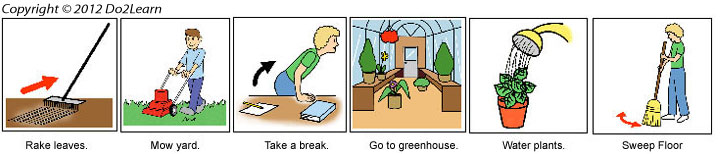
Visual supports such as schedules and to-do lists are not prompts. The distinction is that visual supports are long-term strategies that often remain in place to sustain independence and autonomy. You might use prompts to teach a student how to access and interpret that visual support, and then fade those prompts out so that the student is independently accessing, manipulating, and following that visual support to get their tasks done.
Visual supports are effective in making materials and environments more meaningful and allowing individuals to live and work more productively and independently. Visual supports might include schedules, to-do lists, graphic organizers, social narratives, video models, scripts, and visual cues.
Example 1: A student might require a visual schedule in order to move from one place to the next at his work site. When the student is first learning how to use this visual schedule, you might need to provide prompts (gestural, modeling, and / or verbal) to teach that student how to move from top to bottom and to check items off his schedule.
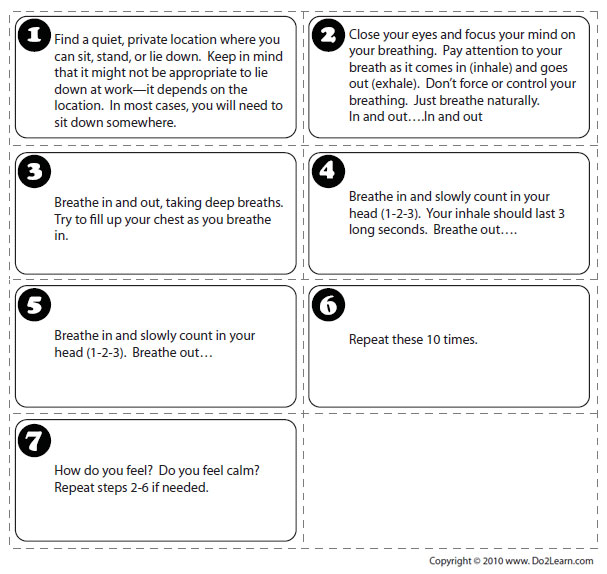
Example 2: A student might keep a small index card in her pocket containing a list of relaxation exercises to use when she is feeling overwhelmed or agitated. However, when the student is first learning how to perform those relaxation exercises, she might need modeling prompts to accurately perform the relaxation exercises and gestural prompts to retrieve the card.
Can you fade out visual supports? At times, it may be appropriate to fade out certain aspects of a visual support. For example, if a student is primarily reading the written text on their written / picture visual schedule, it may be appropriate to reduce the picture size until the pictures are ultimately removed altogether.
As another example, a student may require cue cards that contain various scripts for initiating and sustaining conversations. Over time, those scripts might be faded down to just a few key words to remind the student how to initiate or sustain a conversation.
In most cases, visual supports will not be faded out entirely, but rather some form of visual support will still be necessary. Most of us tend to rely on calendars, written lists, and cell phones to organize ourselves, right? Visual supports serve the same purpose for individuals . They may become less intrusive or obvious, but generally some level of visual cue remains necessary.
Important guidelines related to prompting:
When you are teaching any skill, it is necessary to achieve independent performance under multiple conditions.
You achieve this goal when you carefully consider what prompts you will use and when you systematically fade your prompts. Fading is the systematic removal of a prompt from the learning situation.
A critical component of prompt-fading is the time-delay procedure. As the student is expected to perform a particular skill, the instructor briefly pauses (waits) before issuing any prompt, in an effort to provide the opportunity for the student to independently display the skill. As the student displays increasing independence with the skill, the instructor gradually increases the amount of wait time before issuing any prompt.
|
All prompts can be faded, but what types of prompts are easiest to fade? |
What types of prompts are usually more difficult to fade? |
|
Gestural prompts |
Verbal prompts |
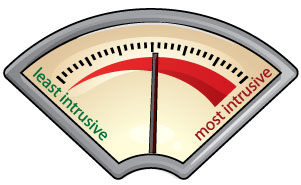 Gestural and positional prompts are easier to fade because they primarily direct the student’s attention to the task and the natural environment, rather than towards you.
Use the least intrusive prompt necessary.
Some prompts are generally more intrusive than others. The level of “intrusiveness” refers to two main things:
- How much the prompt directs the student’s attention towards you (rather than to the natural cues on the environment).
- How difficult the prompt is to fade out from the learning situation.
Physical prompts Verbal prompts Modeling prompts Positional prompts Gestural prompts
Apply a prompt that matches the targeted skill and the individual’s learning needs.
In other words, use the prompt that makes sense given the targeted response mode and situation. This means that if you are teaching a verbal communication skill (saying “hello” to co-workers), then your prompt might need to be verbal (verbal modeling). Be careful because a verbal prompt here may lead the individual to think that he says ‘hello’ only when you say hello. Will this set up prompt dependency? Or, if you are teaching a student to accurately arrange furniture in a room, your prompts might be gestural (pointing to parts of the room) or visual (picture of furnished room).
Appropriate prompts direct the student’s attention to the natural aspects within the task, rather than shifting the attention to you and the prompt that you add.
 For example, your student cannot locate a certain area in a building, and so you point to the map on the wall that identifies the best route. Thus, you are providing a gesture prompt to direct his attention to the natural cue (the map) that exists within that environment.
 Here’s another (less ideal) version of that example: Your student cannot locate a certain area in a building, and so you say to the student “Go upstairs and make a left turn.” You have shifted the student’s focus to you and away from any relevant cues in the natural environment.
Avoid prompts that become part of the task.
For example, let’s say you issue a two-step instruction (“Sort these books and then file the magazines”). The student completes the first part of the task (sorting books), but then stops and looks towards you. You then verbally prompt him by saying, “Now file the magazines.” Your verbal prompt is becoming a part of this task, and it will be very difficult to fade this out. A more appropriate strategy in this situation would be to provide the student with a written list of tasks that he checks off after each step.
Long term over-prompting can lead to prompt-dependence and learned helplessness.
- Prompt-dependence: When a student relies on a particular prompt in order to successfully perform the skill.
- Learned helplessness: When a student refuses or avoids independently engaging in a task because they assume that they will fail.
Key Points |
|
Prompting
|