
When our students’ academic, social communication, organization, or self-regulation behaviors are correct and appropriate, we would like to see more of those behaviors across many different contexts. Other behaviors are not so appropriate, and we might like to see less of those behaviors. How do we work to ensure that our students display more of the behaviors we want to see in school and vocational contexts? How do we increase these desirable behaviors? The primary way to increase a certain behavior is to use a process called reinforcement.

What is a reinforcer? A specific event (consequence) that follows a behavior which increases the future frequency of that behavior under similar circumstances. We call this event a “consequence” because it comes immediately following a behavior. We call it a “reinforcer” only if it increases the future frequency of that behavior under similar circumstances.
Guideline #1
Keep in mind that it is only reinforcement if it increases the future frequency of that behavior. If the rate, duration, and / or quality of the behavior does not increase, it is not reinforcement.
For example, let’s say that an employee needs help, and he asks someone to help him. The co-worker tries to help him.
 But the next time the employee needs help, he does not ask that co-worker, and he rarely or never asks him for help again. In this case, the behavior of asking for help was not actually reinforced – the future behavior did not increase as a result of that consequence (the co-worker helping him). Maybe it is because the co-worker did not help him in the way he had hoped, maybe he wanted a different co-worker to help him, or maybe the co-worker was rude to him. No matter what the reason, this consequence was not reinforcing.
As another example, let’s say that you give your student an instruction, and he immediately responds and does as you have asked. As a consequence, you give him an extra five minutes on the computer. But in subsequent situations like this, he does not respond as you have asked. The behavior of following the instruction was not actually reinforced – the future behavior did not increase as a result of that consequence (five extra minutes on the computer). Maybe it’s because the student is bored with that computer, maybe the student prefers other activities, or maybe the computer did not operate as intended. No matter what the reason, this consequence was not reinforcing. You intended for that extra five minutes on the computer to serve as a reinforcer, but it did not have that intended effect.
Why is this important? If the intended “reinforcer” is not actually increasing the behavior, then you will need to arrange a reinforcing consequence that is motivating and meaningful to the individual.
Guideline #2
|
Praise, smiles |
Anime, graphic novels |
But are these always reinforcers? No.
- Reinforcers are individually determined. What is reinforcing to one person might not be reinforcing to another person. Does everyone like pizza? Does everyone like public praise? Does everyone like receiving more responsibility at work because they are reliable and hard-working? Does every person enjoy video games?
In fact, someone may be reinforced by something very different than their typically developing peers, and these preferences should be respected. For example, if your student/employee really enjoys metro systems, allow them to look at a brochure or book about metro systems as a reinforcer.
Preference Survey
- The effectiveness of a reinforcer changes from moment to moment. It changes depending on what the individual student is most motivated by in that given moment. If your student has been playing computer games all weekend, will access to that computer game at school be as reinforcing in that moment? If your class just had a break 5 minutes ago, will another break right now be as reinforcing in that moment? If you have just eaten a big piece of chocolate cake, is a piece of chocolate candy as reinforcing in that moment?
Guideline #3
Intrinsic consequences refer to consequences that are more natural and likely to occur in real life. When the consequence is one that is naturally connected to the behavior, it is more likely that this behavior will generalize to other contexts because those same contingencies between behavior and consequence naturally exist in those other contexts.
When the consequence is one that is artificially connected to the behavior (extrinsic in nature), this behavior may be less likely to generalize to other contexts. That artificial or extrinsic consequence may not operate in those contexts. It might not operate in other contexts because you are not there to deliver it, or the environment simply is not conducive to that artificial reinforcer.
There may be times when extrinsic consequences are absolutely necessary in the initial stages of skill acquisition. However, we encourage you to arrange and deliver more naturalistic consequences whenever possible.
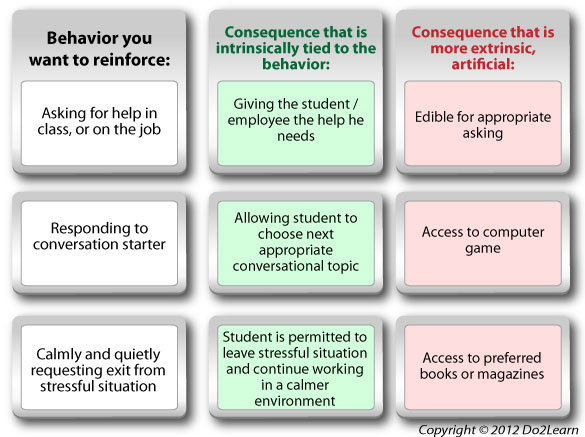
The above are examples to help clarify the difference between intrinsic versus extrinsic reinforcers.
Guideline #4
When you are teaching a new behavior / skill, it is important to deliver a reinforcing consequence immediately following the behavior (i.e. within 2-3 seconds). Otherwise, your student might not recognize the contingency (relationship or connection) between the behavior and the reinforcing consequence. The effectiveness of that reinforcement will be compromised if the contingency is not clear to the student.
For example, let’s say that you have been working with your student on appropriately requesting breaks in school, and on the job. The desired response is for him to calmly approach you and ask, “Can I take a five minute break please?”
The first time he displays this response without prompting, you say, “Hold on, I will be with you in a minute.” In this situation, you missed the opportunity to immediately reinforce that newly acquired behavior. The relationship between his response and the reinforcing consequence may not be clear to the student. As a result, this behavior of appropriately asking for a break might not strengthen. A better way to respond would have been to immediately say, “Yes! That was the perfect way to ask, go take a five minute break now!”
Guideline #5
However, once the target behavior is consistently displayed at an 80% or more success rate, you work to delay the delivery of reinforcement and also fade out any reinforcing consequence that is extrinsic / artificial in nature. This systematic fading of artificial reinforcement is a vital component to generalization. It is sometimes referred to as “thinning” the schedule of reinforcement.
Generalization: When a targeted behavior or skill is consistently performed in multiple natural environments, using varied instructions /materials / stimuli, and with a variety of familiar and novel people. Just because a target behavior is stable under one controlled condition certainly does not mean that we will see this behavior in other untrained conditions. For students , it is critical that we carefully and comprehensively program for generalization.
Think about it, in “real life,” or in a current or future job, will this student always get to experience immediate and continuous reinforcement? Will you always be in that environment to arrange for the consistent delivery of these artificial reinforcers? In many cases, the answer to both questions is no.
In generalized settings and conditions, it is more likely that the individual will experience reinforcement on an intermittent basis. Furthermore, it is likely that he might not always be able to predict when certain responses will be reinforced. This intermittent schedule of reinforcement is what sustains behavior in the long run. Intermittent intrinsic reinforcement is what most of us naturally experience in a wide variety of contexts. Therefore, in order to set your student up for success across all school and vocational environments, it is important to:
- Arrange and deliver reinforcing consequences that are intrinsically / naturally tied to the behavior you want to see because these types of reinforcers, as well as the frequency of their occurrence, match what happens in naturalistic, generalized settings.
- Devise a plan for how you will systematically fade out reinforcing consequences that are artificial / extrinsic to the current and future contexts and targeted behavior.
Intermittent: Not continuous, often variable and unpredictable in frequency. When a student raises his hand to answer a question, sometimes he is called on and sometimes he is not called on. He cannot predict when the teacher will call on him to respond. His hand-raising behavior is reinforced on an intermittent basis.
Guideline #6
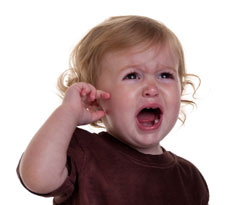 |
Here is a classic example of this: A child is in the grocery store check-out line with his mother and he is screaming for candy. His mother then gives him the candy that he was screaming for. In subsequent situations when he wants candy, he screams again. His screaming behavior has been reinforced. What is the reinforcer in this situation? |
 |
Your student engages in repetitive question-asking. Each time he asks you that question, you respond with some form of the same answer. His repetitive question-asking increases in future frequency. His question-asking behavior has been reinforced. What is the reinforcer in this situation? |
 |
A student uses threatening gestures when directed to complete school-based vocational work in the media center. In response to these gestures, the demand is withdrawn and the student is permitted to complete alternative tasks. In subsequent situations where he is presented with tasks in the media center, he uses threatening gestures again. His threatening behavior has been reinforced. What is the reinforcer in this situation? |
 |
A student/employee yells at his job coach whenever he is asked to correct a mistake at work. In response to this, the job coach argues back and this goes on for 5-10 minutes. In subsequent situations where the employee is corrected, he yells even more. His yelling behavior has been reinforced. What is the reinforcer in this situation? |
 Remember that if a consequence follows a behavior and that behavior increases in future frequency, then reinforcement has occurred (even if that was not your intention)!
Guideline #7
More appropriate behaviors can often replace less appropriate behaviors. When you want to reduce a specific behavior, it is important to identify a more appropriate behavior that might serve to replace the less appropriate behavior.
Let’s return to some of the examples from above to clarify this idea:
|
What is the behavior you want to reduce? What is an alternative behavior that you can reinforce in its place? How can you reinforce this alternative behavior? |
|
What is the behavior you want to reduce? What is an alternative behavior that you can reinforce in its place? How can you reinforce this alternative behavior? |
|
What is the behavior you want to reduce? What is an alternative behavior that you can reinforce in its place? How can you reinforce this alternative behavior? |
Guiding questions to consider: |
|
Reinforcement
|
