
 Graphic organizers are another form of visual support that can provide a student or employee with a way to represent and organize concepts, thoughts, feelings, behaviors, and potential outcomes. Examples of graphic organizers could include charts, simple tables or lists, sorting tasks, or visual illustrations.
From an academic standpoint, many educators distribute graphic organizers to their students to help them visualize and understand connections between key concepts, a chain of events, hierarchical relationships, and more. Educators also present graphic organizers to students to assist them with brainstorming ideas for projects or papers, evaluating their thought processes, and devising a plan to complete a particular assignment.
In many classroom contexts, graphic organizers are used for the following reasons:
- To help students see the “big picture” by illustrating connections and relationships between objects, classes of objects, events, people, etc.
- To ensure that students pay attention to the key concepts
- To ensure that students understand and use the key concepts
- To reduce the demands placed on working memory by providing an external, visual representation of important concepts and relationships
- To help students brainstorm, to generate ideas
At times, graphic organizers can be implemented as classroom accommodations to support the needs of a student with learning differences. For example, a set of guided notes may be an appropriate accommodation to provide to a student who struggles to efficiently process and write down verbally delivered lecture material. This set of guided notes may also serve to direct the student’s attention to the most relevant, key concepts when they might otherwise attend to less relevant information because of their learning differences. Well-designed graphic organizers incorporate elements described in the section on visual cues to organize and highlight learning material so that the individual can perform a new task or skill.
Beyond the many ways that graphic organizers might benefit one’s acquisition of academic content, they can also serve as yet another tool in your arsenal to address the organization and self-direction, social communication, and self-regulation issues that many individuals experience in school and vocational contexts. The graphic organizer may prove particularly helpful in the priming process to help the individual visually conceptualize how pieces of information fit together within a situation or problem.
Priming for some students involves getting agreement that there is a problem, getting agreement on the solution, and creating the motivation for change.
Like most other strategies, the graphic organizer does not stand alone in improving learning. It is just one link within a chain of important strategies designed to instruct the individual . The correctly sequenced combination of the forms of visual support, along with building upon interests, direct instruction and repeated practice opportunities, reinforcement, shaping, and prompt-fading, are all necessary to effectively intervene in the areas of organization, social communication, and self-regulation.
Example of a graphic organizer to support organization and self-direction:
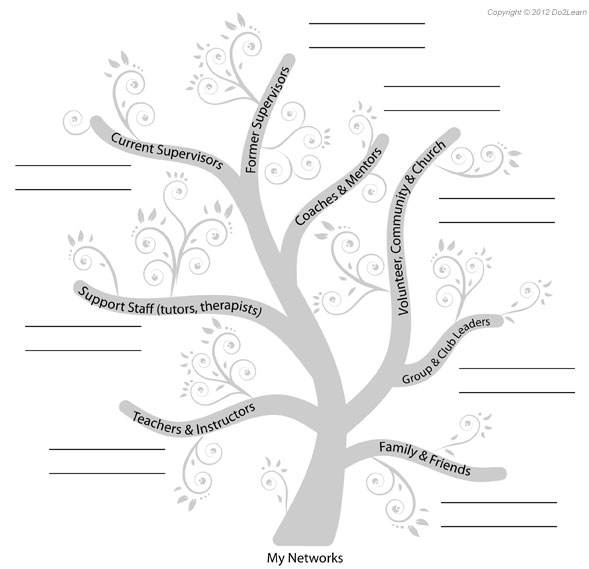
Your student needs to obtain a part-time job or volunteer opportunity, and he is struggling to identify potential networking contacts. One strategy is to visually represent networking channels to this student so that he can more independently and comprehensively identify people in his network.
A next step within the intervention process: You might then use the information he records on this organizer to develop a “to do list” that prioritizes who to contact, when, and in what format (face to face, via email, etc.), and next steps.
Example of a graphic organizer to support social communication:
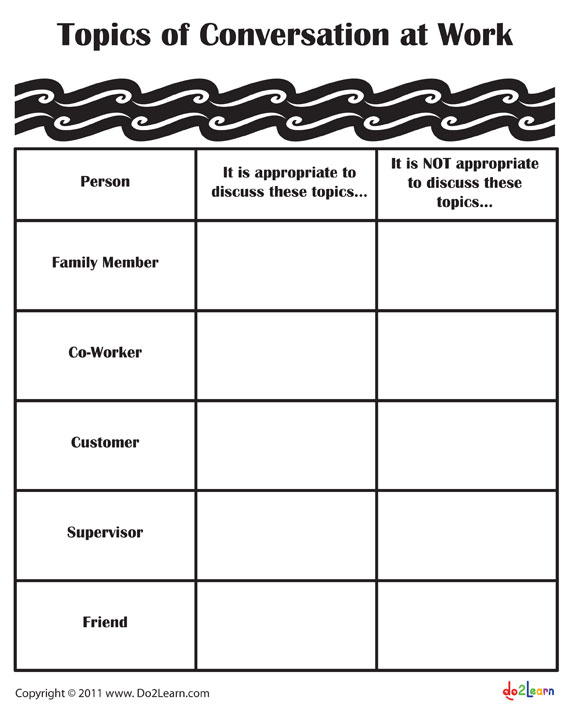
You are working with your student to help her discriminate between appropriate versus inappropriate topics of conversation in the work environment. This visual representation allows the student to make concrete comparisons about topics of conversation that are off-limits with certain types of conversational partners.
A next step within the intervention process: You might then use the information on this organizer to draft an individually tailored social narrative on “Topics of conversation at work,” in order to elaborate on the rationale behind these social communication rules.
Social narrative: A social narrative connects the important details of a setting or social situation to support the person in understanding the social context and in developing a new social skill. A social narrative might come in the form of a situational story, coping comic, thought story, or coping card.
Example of a graphic organizer to support social communication:
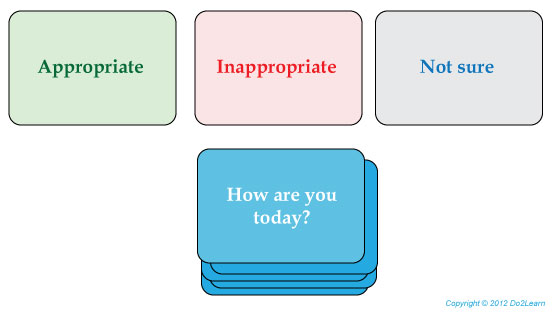
You are working with your student to help him accurately discriminate between appropriate versus inappropriate greetings at school and work. These JobTIPS Concept Sorting Cards are a different form of graphic organizer that allows the student to physically manipulate items in order to categorize them. The student examines each greeting and then determines whether it should be placed in the “appropriate,” “inappropriate,” or “not sure” stack.
A next step within the intervention process: You might engage the student in repeated and varied role-play opportunities to practice appropriate greetings that are depicted within this sorting activity.
Example of a graphic organizer to support self-regulation of emotions:
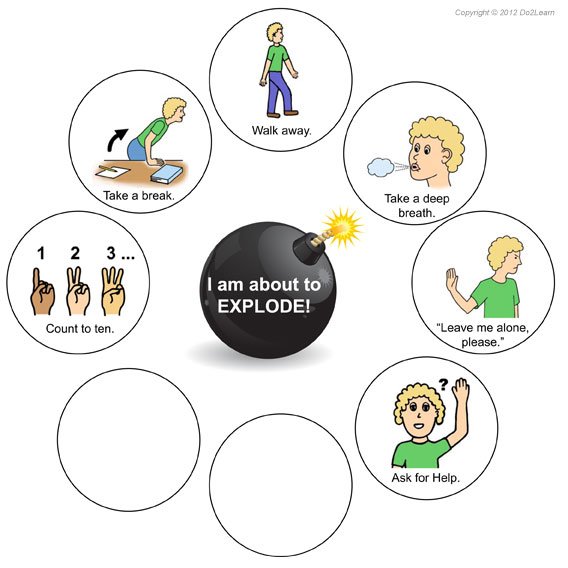
You are working with your student to help him identify potential responses when he is beginning to escalate. This graphic organizer provides a visual representation of those options, and it serves as a reminder to which the student can repeatedly refer as needed. This organizer could be a small cue card located on his desk, in his pocket, or posted nearby.
A next step within the intervention process: You might engage the student in repeated and varied role-play opportunities to practice each particular response that is depicted within this visual organizer.
Example of a graphic organizer to support self-regulation of emotions:
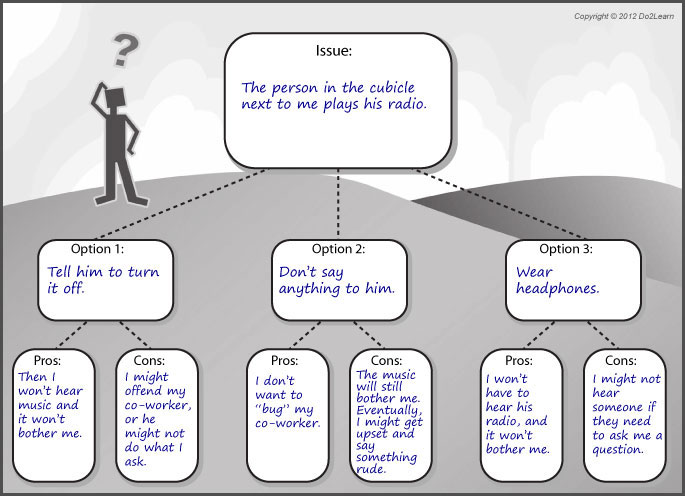
Your student is faced with a real or hypothetical situation where it would be important to evaluate potential options in order to make the best choice. This graphic organizer provides a visual representation of different choices of response and their associated outcomes.
A next step within the intervention process: You might use the selected option in order to draft a social narrative on “Dealing with noise at work” which elaborates further on why a particular response is most appropriate (from the perspective of the responding student, but also from the perspective of others).
Example of a graphic organizer to support self-regulation of emotions:
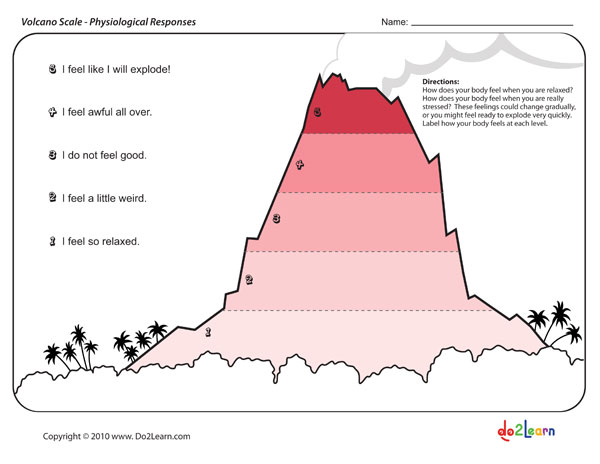
You are working with a student to help her detect some early signs of stress in order to prevent escalation. This graphic organizer offers a visual framework in which the student can identify the physiological (bodily) responses she experiences at each level of stress / frustration. In future situations where she is feeling stressed, she can then refer to a level (“I’m a 4 right now,” or hold up four fingers), rather than having to fully articulate her status.
A next step within the intervention process: Once the student can accurately discern how she feels when she is stressed, you might design a second organizer to help her identify the specific environmental or social demands in the classroom or work context that are triggering these stress responses.
Example of a graphic organizer to support self-regulation of emotions:
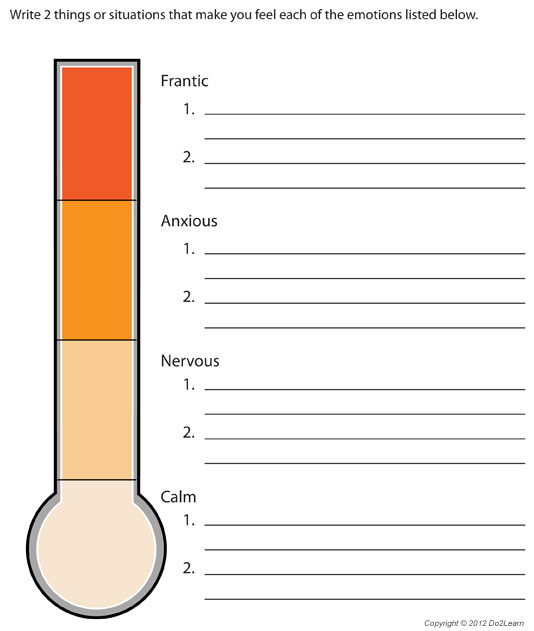
You are working with your student to help him identify coping strategies that align with increasing levels of emotional intensity. This graphic organizer provides a visual framework in which he can identify appropriate responses in order to prevent a meltdown.
A next step within the intervention process: You might concretely illustrate one coping strategy (e.g. deep breathing exercises) through video modeling. This will allow the student to observe and then repeatedly practice that depicted sequence.
Guidelines for developing and using graphic organizers:
- It is important to ensure that the graphic organizer is designed so that it works to clarify targeted concepts, rather than to confuse the individual . The complexity of the organizer needs to align with the conceptual level at which the student is generally operating.
- Consider how to use a graphic organizer within the priming process. The graphic organizer can support the process of ‘getting agreement’ from the individual that there is a social communication, organization, or self-regulation problem and that new behavior is necessary.
Priming: The graphic organizer is often part of the priming process because it visually presents information that adjusts the student’s perspective in a way that is meaningful to him. Priming involves getting agreement that there is a social communication or self-regulation problem, getting agreement on the solution, and creating the motivation for change.
- Sometimes the graphic organizer is used ‘after the fact’ to help the student comprehend a previous social situation. Ideally, this ‘after the fact’ presentation can lead to developing behaviors, strategies, or coping skills that can be used in the future. Remember that if we only provide triage (repair), we are not necessarily providing a skill for future use.
Guiding questions to consider: |
|
Graphic Organizers
|
