
Objects are used to communicate information about what an individual is going to do on a concrete level. The object schedule is the most concrete level of schedule in comparison to picture and written schedules. Thus, an object schedule is most appropriate for very young children and individuals with more significant cognitive challenges. Click here for more information on choosing the appropriate schedule modality.
Creating and using an object schedule:
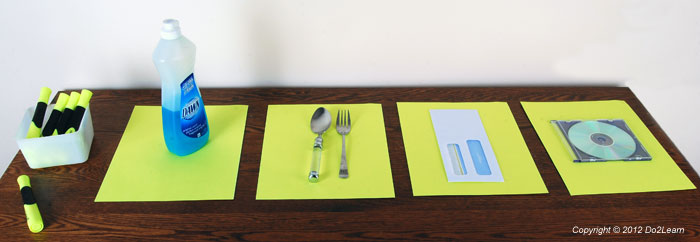
- An object schedule is used during transitions from one activity to the next activity.
- The objects should be as concrete and meaningful as possible so that they individual understands where to go next.
- One object represents just one activity. That same object should consistently represent that same activity.
- When one activity is finished, the individual is presented with or accesses the object that represents what activity they will engage in next. The individual then takes the object and carries it to the next activity.
- When arriving at the location of the next activity, there should be a designated place for the individual to put the object. Sometimes, it makes the most sense to have a clear container into which the individual places the object. In some cases, the individual may use that object to start the activity.
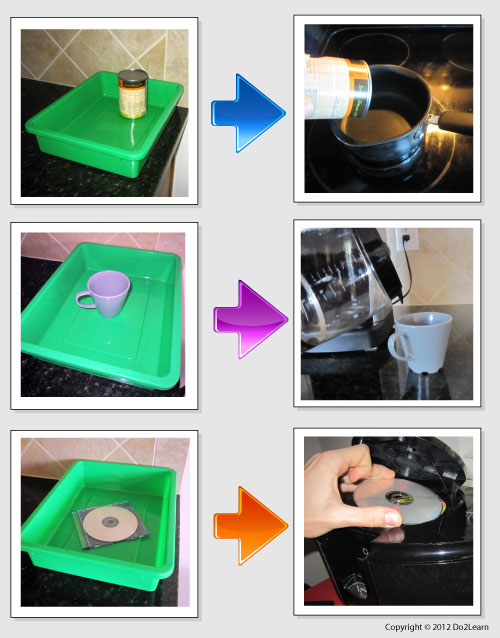
- Objects may be presented one at a time or within a “First-Then” schedule of two or even three objects. Objects answer the question, “What’s next?” for an individual. In some situations, an object schedule may represent a longer sequence of places or events. For instance, the individual is handed his backpack which signifies ‘time to get on the van.’ When he is in the van, he finds a prepared top-to-bottom object schedule kept in the glove box that shows a sequence of ‘a can of food’ signifying ‘go to Food Bank,’ followed by a ‘coffee mug’ (representing a specific coffee shop), followed by a specific ‘CD’ that represents personal time in his room back at home.
- Objects should be presented to the individual in whatever area they are working in to let them know where to go next.
Tips for teaching the individual to use the schedule:
- As the objects become more familiar, and the individual begins to understand their meaning, transitions should become easier. In order for the individual to learn how to use an object schedule, you will need to provide repeated and frequent instruction with systematic prompt-fading. Do not give up if the individual does not respond immediately. It will take time for the individual to learn to associate the object with the place. Choose objects that are concretely associated with the place or event that will follow.
- Be sure to fade your prompts (e.g. verbal, gestural, physical) so that the individual is taking the object and using that visual cue alone to independently transition.
- If the individual continues to show poor understanding of the object, consider a ‘less symbolic’ object that is more concretely related to the space.
- When using an object for a work session, consider using a piece of the first task as the transition object (i.e., a puzzle piece, hammer, stapler, etc,). You will need to start the work session with the same task each time so that the transition object remains the same. Because the task is familiar, the individual will know to begin the task using the object in their hand, which immediately engages them in the work session.
|
Example of using an object schedule at school:
|
Example of using an object schedule at home:
|
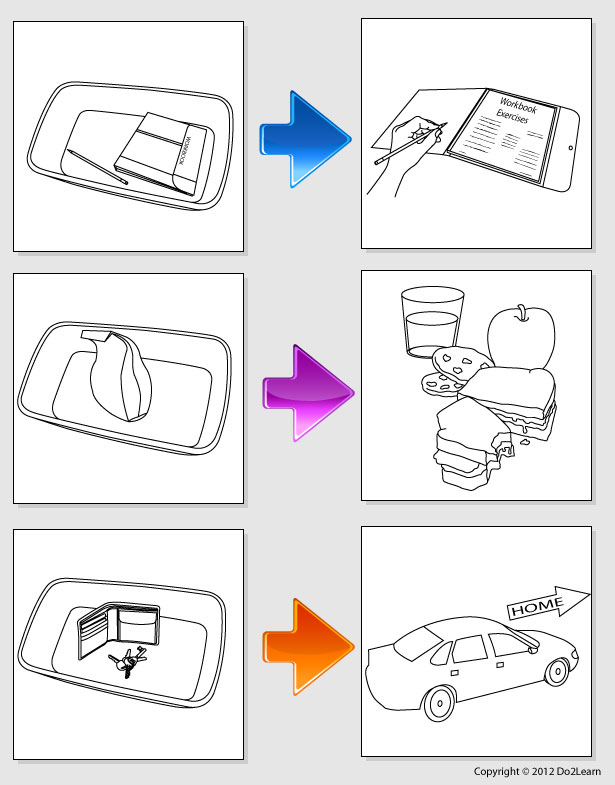
| In this example, the student’s object schedule consists of a stationary bin at his desk in which the object to be used for the next task is placed. This sequence includes 1) doing a workbook assignment, 2) snack, and 3) leaving for a community outing. Where will the student put objects when a task is complete? The workbook assignment may go to a designated, pre-determined location on the teacher’s desk, in a folder for “work to turn-in” on the student’s desk, or in a “Finished” bin or container centralized in the room. The decisions for such details ultimately are determined by factors such as what works best for the student and instructor, as well as the classroom layout. | In this example, the individual uses an object schedule with a stationary bin. Items in the green bin help the individual identify the next activity by providing the object necessary for the activity. Here, the schedule includes: 1) preparing soup, 2) having coffee, and 3) listening to a CD. Using a stationary bin or designated area for checking the object schedule allows the individual to learn and confidently check his schedule with a bit more independence as opposed to relying on a parent or instructor to just hand him the objects. With this method, the parent or instructor can put the next object in the designated bin while the individual is completing the current task. There are many variables to consider, even within this brief example: Does the individual place objects in a specific “Finished Bin” when the task is complete or has he learned where the individual objects go (the empty soup can in the trash, the pot and coffee mug in the dishwasher, etc.)? These details will differ greatly between individuals, so you must adjust accordingly. |
| Examples of three-dimensional transition objects: | |||
| Toilet paper roll, hand sanitizer bottle, or pull up if appropriate | = Toileting | Paper towel | = Wash hands |
| Cup | = Get water break | Paintbrush | = Art area |
| Cafeteria debit card | = Cafeteria | Headphones | = Preferred break activity of listening to music |
| Plate | = Snack, meal | Magazine | = Preferred break activity of reviewing magazine |
| Library book | = Media center | DVD | = Preferred break activity of watching movie segment |
| Backpack | = School | Plastic bottle | = Recycling station |
| Ball | = Physical education class | Car keys or Photo ID | = Car/Outing |
| Material or piece of a task | = Work session | Backpack | = Going home |
Guiding questions to consider: |
|
Object Schedules
|
