
What type of graphic organizer(s) might the student require in order to visually represent and organize the concepts, feelings, or behaviors that relate to this particular topic?
It is critical that you and the student develop a response plan that organizes the steps in a clear, concrete manner. This tool can be used to outline what to do, what to say, where to go, how to relax, and who to tell. It is great for structuring role-play demonstrations, determining options based on location, and as a guide for the student when he is at work:
"Responding To and Coping with Bullying - Bullying Response Plan"
Below is a modified response plan that the student may use to plan their responses in school or work contexts:
Consider how a graphic organizer might also serve as the “report form” on which the student describes a bullying event. These can be important for the student who struggles to verbalize what has happened, particularly when the event is very stressful and upsetting:
Consider the utility of graphic organizers that might be housed within other topics such as Self-Identify Anxiety and Self-Identify Anger. Below is one form that may help the student identify relaxation strategies to apply in response to bullying:
The following graphic organizers show options for coping strategies (with and without visual picture cues):
Is there a way to visually or thematically incorporate the student’s interests into this graphic organizer to increase motivation and engagement?
What additional visual clarity cues (e.g. icons, bolding, highlighting, color-coding) might you add to the graphic organizer to clarify concepts and to direct attention to key details?
A floor map may be used to show a student where to go when he needs to relax or to escape a threatening situation. Much like the fire escape routes posted in businesses and schools, a map of the student’s worksite can include arrows to indicate where to go in case of a fire, a designated safe space, or how to get to a supervisor’s office.
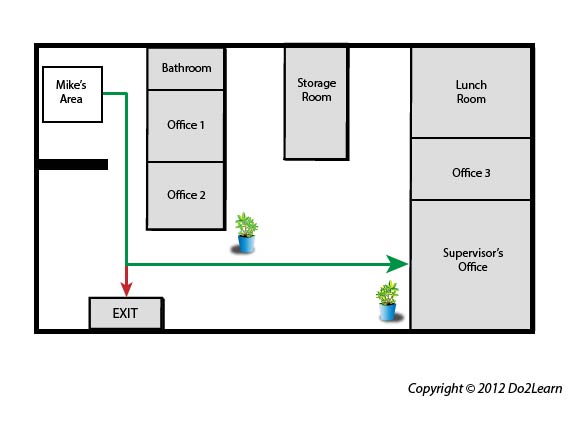
Certain graphics can be confusing and overwhelming based on layout and the amount of information included; this is an issue that if left unaddressed completely voids the purpose of the graphic organizer. If using a floor map, incorporate color-coded arrows with colored areas (e.g. a green arrow leads to the bathroom which is highlighted green), or add icons or photos to represent the designated spaces (e.g. a photo of the student for her work area, icon of “relax” in the break room). However, another student may benefit from the same concept, but a more concrete version, such as an actual photograph of where to go.
In order to align this intervention topic area with the unique needs of the student, do you need to create a graphic organizer in the View2do program?