
How can you connect this new skill to the student’s priorities? How can you assure ownership by making the development of this skill the student’s goal rather than just the goal for the student?
Explain to the student that change is inevitable and unavoidable, and that you are going to help them cope with it. This explanation would be best conveyed through a social narrative, and specifically, a situational story:
Explaining to the student why you are teaching the skill and that it benefits them, should hopefully increase their “buy-in.”
As you introduce this skill, how will you incorporate (visually, thematically) the student’s unique interests?
Can the use of visual supports and self-assessments help get agreement that there is a problem (i.e. student is struggling to respond to and cope with change), get agreement on the solution, and create the motivation to learn and apply new strategies?
Priming is a form of negotiation that can reframe and sharpen a student’s assessment of self. Below are the self-assessment tools that align with this intervention topic:
"Organization and Self Direction - Task Completion 3"
Before the student encounters a situation where he will need to tolerate change, how do you help the student prepare?
As mentioned above, preparation will be extremely important for most students. Letting the student know in advance that there is a change will give them time to adjust to the new idea. Prepare the student by visually letting them know that a change is to occur by indicating the change on a visual reminder, schedule, to-do list, monthly calendar, or weekly calendar.
For example, use a weekly or monthly calendar to show the student’s upcoming events and activities. If there is a change of plans, indicate that change, for example, by writing “No school- Teacher workday.” Or “Leave work at 4pm for appointment with Dr. Lawrence.”
If the change is of a different nature (new supervisor, for example), write them a situational story to inform them of the change, how the change will affect them, and what they can do to cope with the change.
Here is an example of a situational story for a supervisor who is going out on maternity leave.
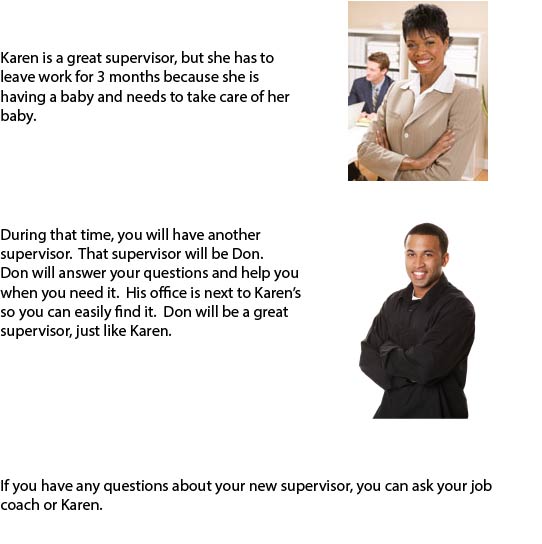
In this particular example, in addition to the situational story, it would be helpful for the student to familiarize himself with the new supervisor if possible. Have the student meet Don and if possible, begin the supervisory transition one week before Karen leaves in case any issues arise. This preparation should make for a smoother transition.
For some students, a calendar that shows supervisors (or co-workers, job coaches, etc.) on different days may provide a vehicle for preparing the student for personnel changes in a predictable fashion.