Arriving On Time
As students move from the carefully scheduled world of high school into college or the workplace, they may be unsure how to organize their time to reliably meet their school, work, and social commitments. Being prompt requires organizational skills, the ability to judge how much time activities will take, and the ability to handle unforeseen schedule changes or delays. A student must know where they must be when, how to get there, and be able to successfully transition from one activity to another. It can be helpful for instructors to work through cause-and-effect scenarios to help the student understand the consequences of running late for work or missing an appointment. Calendars and graphic planners can aid the student as they learn to be more independent in organizing their time. These time management skills will be a lifelong benefit to the student.

Teaching Ideas
Click on the icons below for detailed information on how to teach this skill.





 Guiding Questions
- Is the student able to tell time? Can the student accurately estimate how long an activity/transition will take in order to plan and coordinate his schedule?
- Does the student understand why it is important to be on time, and does he recognize the potential consequences for being late? Is the student motivated to arrive on time when it is required?
- Is the student able to stop a favored activity before finishing if it is time to leave for work, a class, or an appointment?
- What time management strategies does the student currently use? What other strategies might be needed for the student to independently arrive on time?
- Does the student struggle to arrive on time during particular periods in the day (early morning classes/appointments/jobs versus late afternoon or second shift job/appointments)?
- Can the student accurately discriminate between situations where it is important to arrive on time or even early (interviews, tests, medical appointments), versus situations where it might be acceptable to arrive slightly late (certain social events)?
Visual Supports
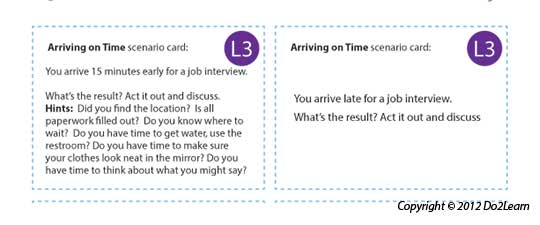
Communication systems and scripts provide the student with a means to initiate communication. Use these cards to practice different scenarios with your students.
|
Schedules are visual supports that organize the school or work day and tell the student where he will go that day. Schedules help focus attention on the sequence of places and events.
|
|
The to-do list (also referred to as a "work system"or "activity system") visually clarifies a series of activities that a student is to do.
|
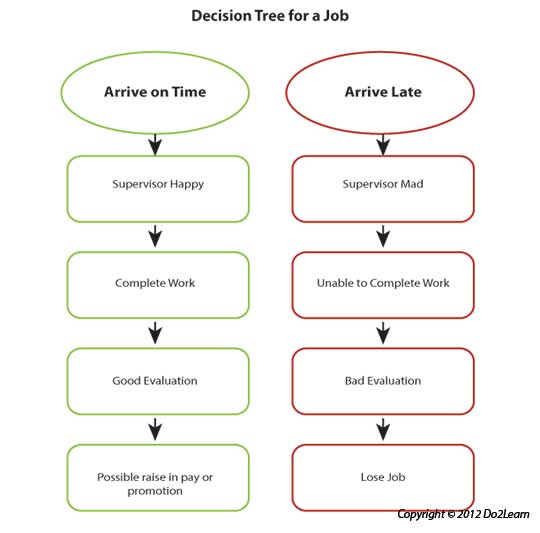
Graphic organizers can provide a student with a way to represent and organize concepts, thoughts, feelings, behaviors, and potential outcomes.
|
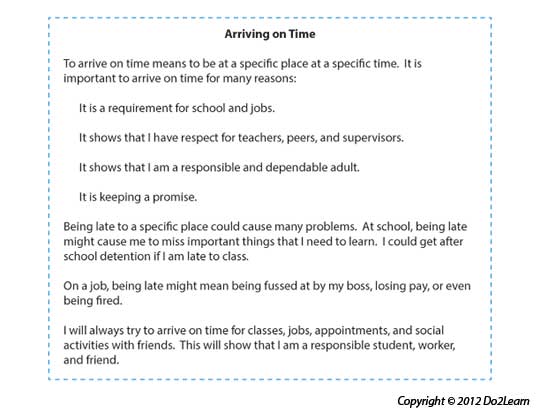
Social narratives are a set of tools that visually represent social situations and appropriate social behaviors. The social narrative connects the important details of a setting or social situation to support the student in understanding the social context and in developing a new social skill.
|
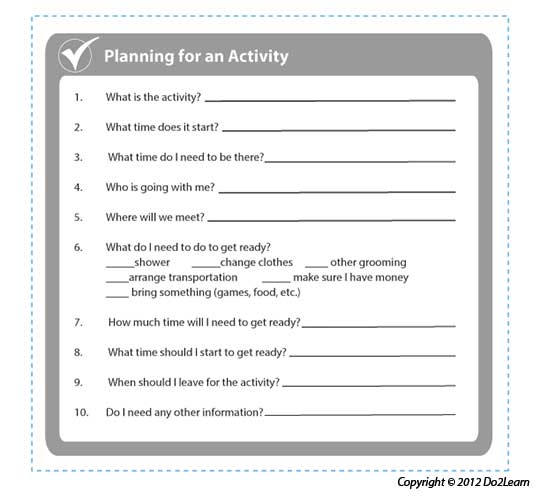
Visual Cues are learning materials that students can keep with them to help guide them through real life situations.
|
|
Video modeling involves the use of video recording as a teaching tool. It involves a student watching a video of the appropriate performance of a task (expected behavior) prior to practicing or potentially using the skill in natural settings.
|

Does the design of space and furniture help the student focus on the tasks and behaviors expected in the setting?
Often, if the student agrees, review of how the home environment is designed to assist student efficiency is critical. If work clothes are organized in one section of the closet this may assist efficient dressing. If all school or work materials are in one area or bag, this may also assist focus. There may be a designated area where a cell phone can be placed, to prevent frantic searching in the morning.
In general, if my materials and space are organized as I make a transition, I have a better chance of being on time. Assess the organization of materials and space at any point in the day where the student tends to be late.
Is the space designed to support independent movement both within and between tasks?
The caregiver/instructor may keep all materials necessary for one routine within a limited space to assist speed and transition during the routine. Consider whether direct instruction and repeated practice can lead to the student arranging his own materials in this way.
|