Downtime On the Job
At school or work, there is often downtime between tasks or busy periods. This unstructured time can be anxiety provoking for someone who prefers a highly structured schedule. Usually downtime requires quiet activities that do not disturb the work of others. There may also be productive tasks to be done once the “official” work has been completed, such as beginning that night’s homework or tidying the workspace. Students should develop tools to help them choose appropriate downtime activities for each setting, including checklists of tasks to be done and graphics depicting allowed activities. They can then look forward to downtime as a brief time to recharge and regroup before the next activity.
Teaching Ideas
Click on the icons below for detailed information on how to teach this skill.





 Guiding Questions
- What does the student typically do during downtime in specific environments?
- How does the student handle unexpected events?
- For school environments, what leisure skills and/or ‘filler activities’ are available to the student?
- For work environments, what secondary work activities should the student seek out to assure that he keeps busy on the job?
- Does the student understand appropriate versus inappropriate activities at school or work? Can he gauge social norms to know if he is bothering others?
- Does the student initiate appropriate downtime activities on his own, or is he typically prompted in some way?
Visual Supports
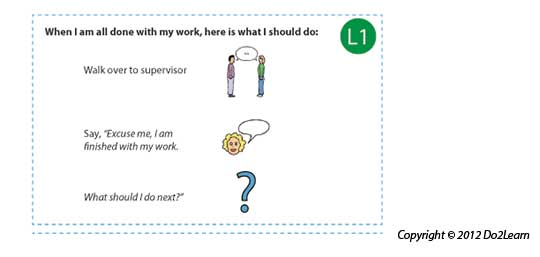
Communication systems and scripts provide the student with a means to initiate communication. Use these cards to practice different scenarios with your students.
|
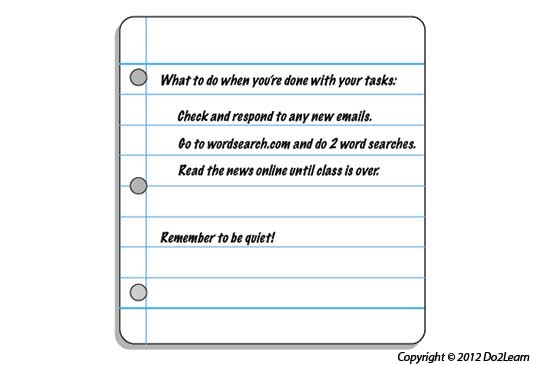
The to-do list (also referred to as a "work system"or "activity system") visually clarifies a series of activities that a student is to do.
|
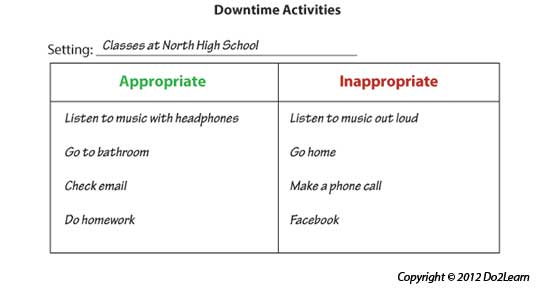
Graphic organizers can provide a student with a way to represent and organize concepts, thoughts, feelings, behaviors, and potential outcomes.
|
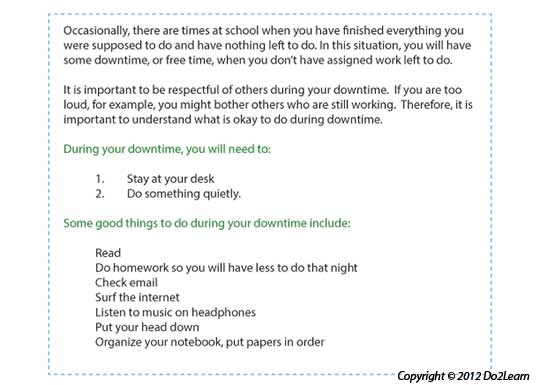
Social narratives are a set of tools that visually represent social situations and appropriate social behaviors. The social narrative connects the important details of a setting or social situation to support the student in understanding the social context and in developing a new social skill.
|
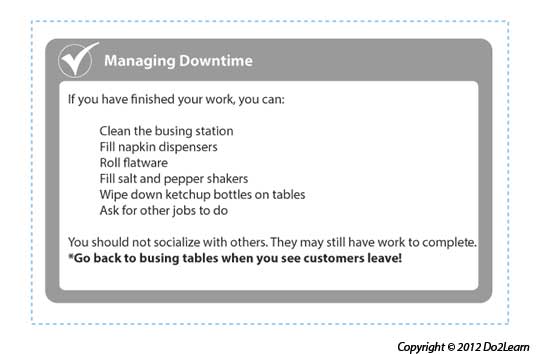
Visual Cues are learning materials that students can keep with them to help guide them through real life situations.
|

Are there clear separate spaces for different contexts or sets of activities (i.e., place to take a break vs. work spaces, etc.)
The design of the space depends on the secondary tasks or jobs that are available for the student in a work site and the student’s needs for organization around these tasks. For instance, downtime in a restaurant can be filled with rolling flatware at a busing station, cleaning and organizing the busing station, or filling napkin dispensers. All of these tasks would be completed in one space – the busing station.
Ask yourself if the student can handle a list or set of downtime jobs that are in multiple work areas or if she needs a list in one station to which she goes when there is downtime. How will you design the space so that the student can easily transition into and out of a downtime activity? In other words, the student’s downtime activities may need to be in a space where he can see when primary work is available again. Consider avoiding downtime tasks that are in a distant corner of the workplace where he cannot see when primary work is available.
|