Self-Monitoring Work
Turning in a report that is missing pages will likely lead to a frustrated supervisor; delivering a sandwich that is missing the tomatoes and mustard will result in an unhappy customer. Employees must be able to self-monitor the quality of their work to ensure it is completed accurately and thoroughly. Some students may rush through tasks, making errors, while others may spend too much time focusing on a task and missing deadlines. Students may also fail to turn in completed work or to notify a supervisor that a task is complete. All of these will lead to a lowered quality of work and may put the student’s job in jeopardy. Instructing students in how thoroughly they must check their work and how quickly they must work will help them understand when a task is truly finished. This will lead to tasks that are completed accurately and on time.

Teaching Ideas
Click on the icons below for detailed information on how to teach this skill.





 Guiding Questions
- Does the student pay attention to details or are they more impulsive or eager to get the job done?
- Does the student check his work after he has completed it?
- Can the student tell the difference between a job well done and a mediocre (or poor) completion of a task?
- Does the student consistently ‘hand off’ the completed task in school and work environments? Does the student sometimes forget to turn in homework? What type of system is in place for turning in homework?
Visual Supports
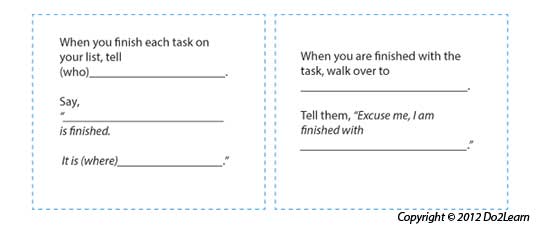
Communication systems and scripts provide the student with a means to initiate communication. Use these cards to practice different scenarios with your students.
|
|
Schedules are visual supports that organize the school or work day and tell the student where he will go that day. Schedules help focus attention on the sequence of places and events.
|
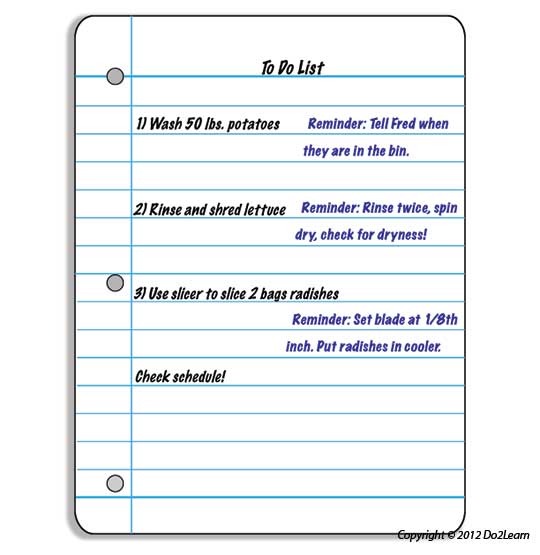
The to-do list (also referred to as a "work system"or "activity system") visually clarifies a series of activities that a student is to do.
|
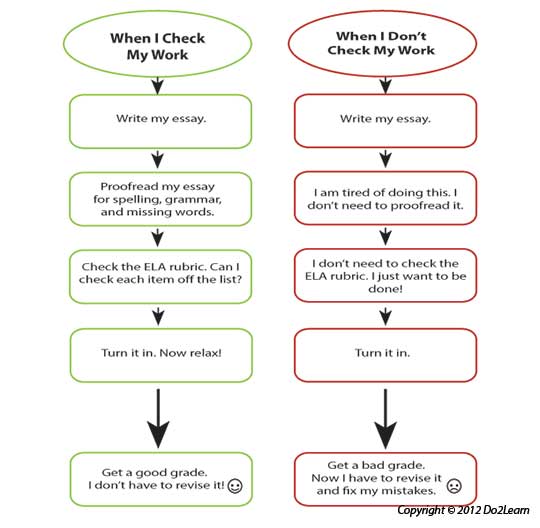
Graphic organizers can provide a student with a way to represent and organize concepts, thoughts, feelings, behaviors, and potential outcomes.
|
|
Social narratives are a set of tools that visually represent social situations and appropriate social behaviors. The social narrative connects the important details of a setting or social situation to support the student in understanding the social context and in developing a new social skill.
|
|
Visual Cues are learning materials that students can keep with them to help guide them through real life situations.
|

Does the design of space and furniture help the student focus on the tasks and behaviors expected in the setting and minimize distractions?
Quality of work, and the ability to check for the quality of work, will improve if distractions are reduced. Make sure the student has a quiet work area, preferably away from others, to minimize distractions. Using large bookshelves or room dividers to minimize the view of distracting stimuli can also be helpful. If noise is an issue, have the student wear headphones to eliminate auditory distractions. Your goal is to reduce other forms of stimulation so that the student can focus on the behaviors that are supported by the defined quality markers (e.g., the to-do list, instructions, rubrics, visual clarity cues, etc.).
Are there clear separate spaces for different contexts or sets of activities (i.e., place to take a break vs. work spaces vs. place for belongings, etc.)?
A clear place for finished work will be extremely important in aiding the student in turning in completed tasks. Depending on the type of work, the finished place will vary based on what makes the most sense. For example, documents on a computer may be put in a separate folder labeled “Finished Work.” Paper work may be put in a finished tray on the student’s desk. The tray should be labeled clearly, as a visual reminder to put their work where it belongs when it’s done. Is there a clear space in the job training site where work goes when finished? Maybe an ‘outbox’ should be set up where paper work always goes. Is there a designated space where completed merchandise racks are placed when all clothes have been processed? Consider whether that designated space is within close proximity to a supervisor or experienced co-worker who will then route or use the work accordingly. That close proximity may help the student communicate that he is finished and successfully ‘hand it off.’
|