Private Behaviors
There are some behaviors that are only appropriate in private. Social norms and legal regulations restrict activities such as personal grooming or sexual behaviors to private settings in the home. An employee who does not recognize that some behaviors are inappropriate in public, or who is unable to regulate this type of behavior, may face social rejection, termination of employment, or disciplinary or legal consequences. Some students may be unaware of these social norms, or may use these activities as a way to mitigate stress. In these cases, the instructor must work carefully with the student to help identify problem behaviors and set clear limits for when and where the behavior may be performed. Keeping these private behaviors private will ensure continued success in the workplace.
Teaching Ideas
Click on the icons below for detailed information on how to teach this skill.





 Guiding Questions
- Does this student display any private behaviors in locations other than his/her home or bedroom? These behaviors might include: Nose-picking, scab-picking, passing gas, burping loudly, viewing pornography, etc.
- Do you suspect that this student engages in masturbation (or partial masturbation, touching outside of clothing) in any school, community, or employment setting (including bathrooms in those environments)?
- Is this student unaware of the social norms that govern when and where to engage in private behaviors?
- Is this student generally aware of the social norms that govern private behaviors, but struggles to refrain from these behaviors when he experiences stress, overstimulation, etc.?
- Under what specific conditions does the behavior occur? How frequently does the behavior occur?
Visual Supports
|
Schedules are visual supports that organize the school or work day and tell the student where he will go that day. Schedules help focus attention on the sequence of places and events.
|
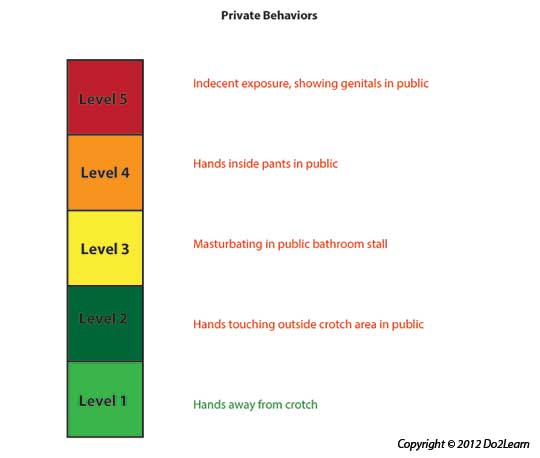
Graphic organizers can provide a student with a way to represent and organize concepts, thoughts, feelings, behaviors, and potential outcomes.
|
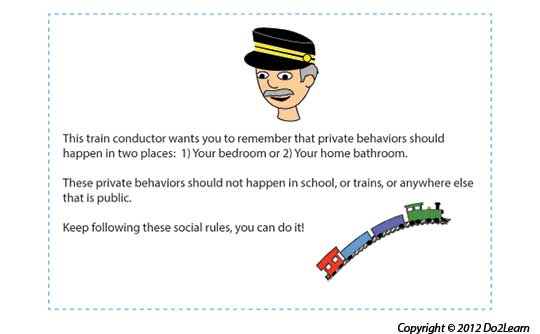
Social narratives are a set of tools that visually represent social situations and appropriate social behaviors. The social narrative connects the important details of a setting or social situation to support the student in understanding the social context and in developing a new social skill.
|
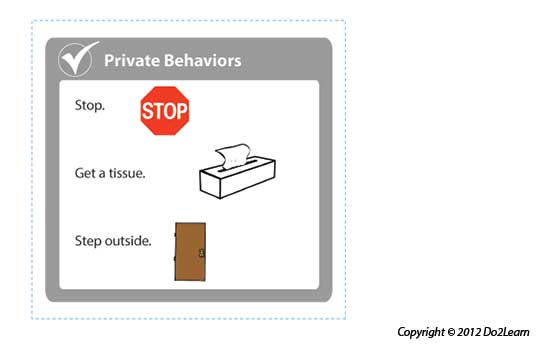
Visual Cues are learning materials that students can keep with them to help guide them through real life situations.
|
|
Video modeling involves the use of video recording as a teaching tool. It involves a student watching a video of the appropriate performance of a task (expected behavior) prior to practicing or potentially using the skill in natural settings.
|