Over-Questioning
People who ask the same question over and over may not realize that their questions are disruptive to those around them. Perseverative questioning, the asking of the same question repeatedly, may be related to stress, anxiety, or intense focus on a certain topic. A student may also repeat questions because they are unsure how to communicate with co-workers, or to seek assurance from others. Students who frequently engage in perseverative questioning may be at a disadvantage in the workplace, as their questioning may interfere with the productivity of themselves and others. Practicing conversational skills, self-soothing techniques, and social modeling can help students recognize perseverative questioning and hopefully reduce their need to ask questions repeatedly.

Teaching Ideas
Click on the icons below for detailed information on how to teach this skill.





 Guiding Questions
- Does the student ask questions over and over to others?
- What may be driving this behavior? Is it a narrow interest, a way of interacting with others, or anxiety?
- Have you systematically evaluated the events that precede this behavior (antecedents) and the consequences that follow this behavior in order to determine what is driving the behavior?
Visual Supports
|
Communication systems and scripts provide the student with a means to initiate communication. Use these cards to practice different scenarios with your students.
|
|
Schedules are visual supports that organize the school or work day and tell the student where he will go that day. Schedules help focus attention on the sequence of places and events.
|
|
The to-do list (also referred to as a "work system"or "activity system") visually clarifies a series of activities that a student is to do.
|
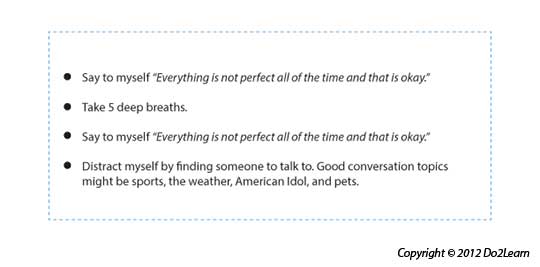
Social narratives are a set of tools that visually represent social situations and appropriate social behaviors. The social narrative connects the important details of a setting or social situation to support the student in understanding the social context and in developing a new social skill.
|
|
Visual Cues are learning materials that students can keep with them to help guide them through real life situations.
|
|
Video modeling involves the use of video recording as a teaching tool. It involves a student watching a video of the appropriate performance of a task (expected behavior) prior to practicing or potentially using the skill in natural settings.
|