Interrupting Others
Interruptions occur frequently, often for good reason. It can be challenging to know when and where it is appropriate to interrupt someone, Barging into the boss’s office to notify him that his car is being towed may be appropriate; barging into the bathroom stall occupied by the boss to tell him the same thing is probably not. co-workers and employers may become annoyed if an employee interrupts too frequently or is rude with their words or body language. A good employee knows when it is okay or even important to interrupt someone, and how to do so politely. This requires attention to context and an understanding of the person’s priorities, both of which are advanced social skills. Students will benefit from concrete guidelines about when it is okay to interrupt someone, and scripts to help them make interruptions tactfully.

Teaching Ideas
Click on the icons below for detailed information on how to teach this skill.





 Guiding Questions
- Does the student tend to interrupt people in a manner that would be perceived as inappropriate?
- Can the student identify situations that would necessitate immediate interruptions (e.g. smoke is coming from the copy machine) versus those that should wait?
- Can the student evaluate the situation and the other person’s behavior in order to determine when it is the right time to interrupt versus when he should wait versus when he should come back later?
- Does the student tend to not interrupt, even under circumstances in which it is necessary and appropriate to do so?
- Does the student require instruction to interrupt using appropriate verbal behaviors (Normal volume and tone, “Excuse me…”) and appropriate non-verbal behaviors (e.g. knock on door first; stand in doorway; slight raise of hand to signal interjection/question; maintain appropriate physical distance, etc.)?
- Does the student accurately decipher and respond to verbal signals (e.g. “Hang on a second…”) and non-verbal signals (e.g. finger up to signal “wait”) used by others to indicate that he should not interrupt at that moment?
Visual Supports
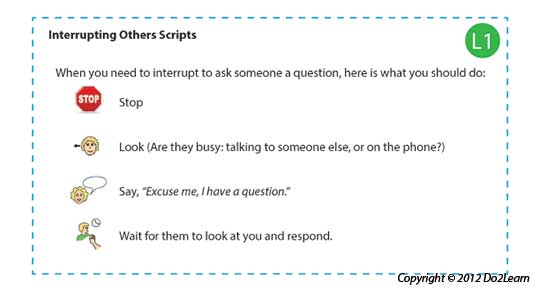
Communication systems and scripts provide the student with a means to initiate communication. Use these cards to practice different scenarios with your students.
|
|
The to-do list (also referred to as a "work system"or "activity system") visually clarifies a series of activities that a student is to do.
|
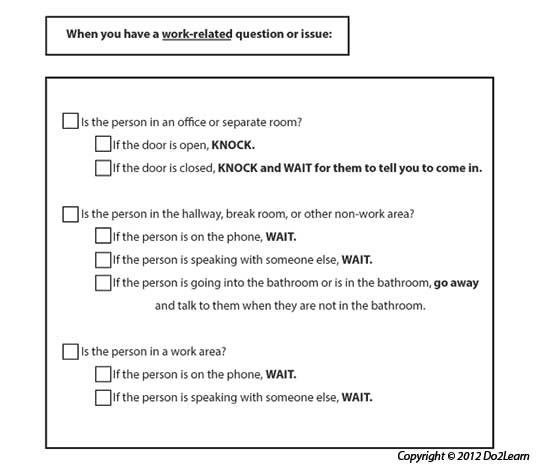
Graphic organizers can provide a student with a way to represent and organize concepts, thoughts, feelings, behaviors, and potential outcomes.
|
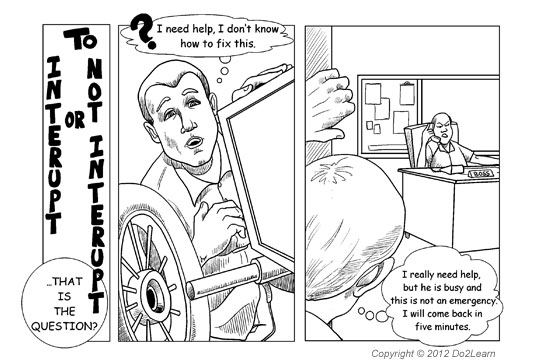
Social narratives are a set of tools that visually represent social situations and appropriate social behaviors. The social narrative connects the important details of a setting or social situation to support the student in understanding the social context and in developing a new social skill.
|
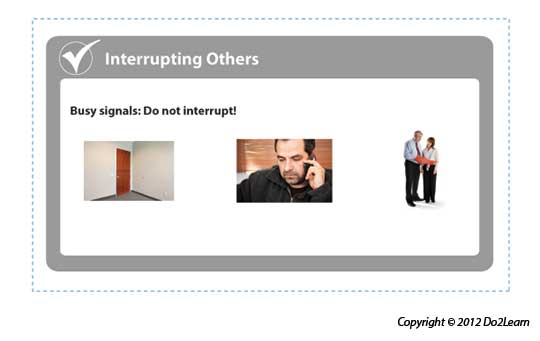
Visual Cues are learning materials that students can keep with them to help guide them through real life situations.
|
|
Video modeling involves the use of video recording as a teaching tool. It involves a student watching a video of the appropriate performance of a task (expected behavior) prior to practicing or potentially using the skill in natural settings.
|
Does the environmental design address student issues with proximity to others or even distractibility that may reduce performance?
If the student is inclined to interrupt others to socialize, consider whether it may be necessary to adjust seating arrangements. Consider how you might reposition his work station or desk to decrease opportunities to interrupt others as they walk by.
|