Door-to-Door Searches
Visiting potential employers’ businesses can be an effective strategy for networking and applying for jobs, but it can also be anxiety provoking for the applicant. They may wonder who they should ask for information, when it is an appropriate time to approach someone, what to say, or how to answer questions. In some cases, this is the applicant’s first opportunity to make an impression on the supervisor who makes hiring decisions, so these skills should be thoroughly practiced ahead of time. Rehearsing these social exchanges will ensure that their interactions with employees and supervisors during this process are positive and appropriate.

Teaching Ideas
Click on the icons below for detailed information on how to teach this skill.





 Guiding Questions
- Is it likely that the student might need to obtain any job applications through the door to door search process (as opposed to online)?
- Will the student struggle to identify where to go within a store and who to approach in order to obtain an application?
- Can the student decipher when it is appropriate to approach an employee/supervisor versus when he should wait to approach?
- Will the student struggle to verbalize an appropriate introduction and request?
- Will the student struggle to demonstrate appropriate non-verbal behaviors (e.g. smiling, looking towards employee, appropriate physical proximity) as he makes the introduction and request?
- Does the student need to rehearse responses to basic questions that might arise during this interaction (e.g. “What is your availability?”; “When are you interested in starting?”)
-
Visual Supports

Communication systems and scripts provide the student with a means to initiate communication. Use these cards to practice different scenarios with your students.
|
|
The to-do list (also referred to as a "work system"or "activity system") visually clarifies a series of activities that a student is to do.
|

Graphic organizers can provide a student with a way to represent and organize concepts, thoughts, feelings, behaviors, and potential outcomes.
|

Social narratives are a set of tools that visually represent social situations and appropriate social behaviors. The social narrative connects the important details of a setting or social situation to support the student in understanding the social context and in developing a new social skill.
|
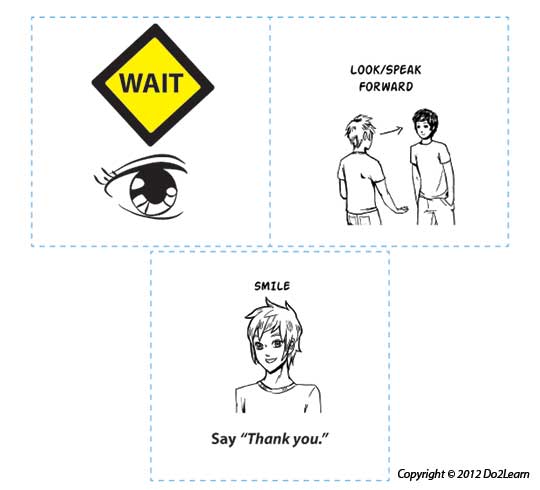
Visual Cues are learning materials that students can keep with them to help guide them through real life situations.
|

Video modeling involves the use of video recording as a teaching tool. It involves a student watching a video of the appropriate performance of a task (expected behavior) prior to practicing or potentially using the skill in natural settings.
|
Does the design of space and furniture help the student focus on the tasks and behaviors expected in the setting?
Carefully consider how you arrange the environment in role-play simulations to most closely approximate what the student would encounter when he is out in the community seeking an application. One of the main components is recognizing where to go within a store to request an application, a detail that changes between nearly every location. Use props to represent hostess stands, receptionist desks, check-out counters, receiving areas, or customer service counters to help the student practice identifying these locations. Familiarize the student with visual cues that naturally exist in the workplace environment (e.g., signs that indicate customer service areas, “employee only” areas that he should not enter, signs that indicate where lines begin, etc.).
|