|
Strategies
It is important to implement strategies that address the needs of the individual. We recommend that you apply these strategies across home, school, and community contexts.
| Language |
 Focus on interactive communication. Focus on interactive communication.- Use active listening.
- Incorporate the student’s interests into speech.
- Ensure that the student has a way to appropriately express their wants and needs.
- Reinforce communication attempts (e.g. their gestures, partial verbalizations) when the student is non-verbal or emerging verbal.
- Paraphrase back what the student has said or indicated.
- Use storybook sharing in which a story is read to student and responses are elicited (praise is given for appropriate comments about the content).
- Ask open-ended appropriate questions.
- Use linguistic scaffolding techniques that involve a series of questions.
- Use language for social interaction and to resolve conflicts.
- Emphasize goals and tasks that are easy for the student to accomplish.
- Work at the student's pace.
- Present only one concept at a time.
- Have speech therapist present language units to the entire class.
- Use computers in the classroom for language enhancement.
- Encourage reading and writing daily.
- Use tactile and visual cues (e.g., pictures, 3-D objects).
- Incorporate vocabulary with unit being taught.
- Provide fun activities that are functional and practical.
- Be aware of the student's functioning level in auditory skills, semantics, word recall, syntax, phonology, and pragmatics (and how they affect academic performance).
|
| Speech |
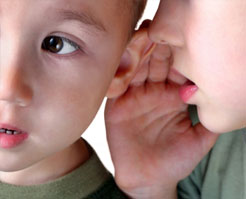 Develop a procedure for the student to ask for help. Develop a procedure for the student to ask for help. - Speak directly to the student.
- Be a good speech model.
- Have easy and good interactive communication in classroom.
- Consult a speech language pathologist concerning your assignments and activities.Be aware that students may require another form of communication.
- Encourage participation in classroom activities and discussions.
- Model acceptance and understanding in classroom.
- Anticipate areas of difficulty and involve the student in problem-solving.
- Provide assistance and provide positive reinforcement when the student shows the ability to do something unaided.
- Use a peer-buddy system when appropriate.
- Devise alternate procedures for an activity with student.
- Use gestures that support understanding.
- Model correct speech patterns and avoid correcting speech difficulties.
- Be patient when student is speaking, since rushing may result in frustration.
|
| Academics & Behavior |
 Reduce unnecessary classroom noise as much as possible. Reduce unnecessary classroom noise as much as possible.- Be near the student when giving instructions and ask the student to repeat the instructions and prompt when necessary.
- Provide verbal clues often.
- Provide a quiet spot for the student to work if possible.
- Speak clearly and deliberately.
- Provide visual cues - on the board or chart paper.
- Redirect the student frequently and provide step by step directions - repeating when necessary.
- Allow students to tape lectures.
- Allow more time for the student to complete activities.
- Modify classroom activities so they may be less difficult, but have the same learning objectives.
- Allow more time for the student to complete assignments and tests.
- Design tests and presentations that are appropriate for the student (written instead of oral).
- Divide academic goals into small units, utilizing the same theme.
- Provide social and tangible reinforcers.
- Focus on the student's strengths as much as possible.
- Have the student sit in an accessible location to frequently monitor their understanding.
- Allow extra time to complete work because of distractions, slow handwriting, or problems in decoding text.
- Have routines that students can follow.
- Use a visual reminder of the day's events to help with organization.
- Establish communication goals related to student work experiences and plan strategies for the transition from school to employment and adult life.
|
| Physical |
 Be aware that because of the way the brain develops, it is easier to acquire language and communication skills before the age of five. Be aware that because of the way the brain develops, it is easier to acquire language and communication skills before the age of five.- Be aware that if children have muscular disorders, hearing problems, or developmental delays, their acquisition of speech, language, and related skills may be affected.
- Use augmentative communication systems to ensure that nonverbal students and students with severe physical disabilities have effective ways to communicate.
- Ensure that the student has access to their (portable) communication system across all contexts, all of the time.
|
|