Environmental Stressors
Everyone has specific things that increase their stress level. Noises, smells, feeling too hot or cold, or uncomfortable clothing are just some of the environmental causes of stress. If a student is stressed, they might feel angry, impatient, or unable to focus on the task at hand. It is useful for a student to know ahead of time what kinds of things make them feel stressed. This allows them to choose work and social environments where they will feel more serene, and to cope with their stressors when they cannot be avoided. Students can learn to make changes in their environment, perhaps by turning on a fan or wearing clothing in layers. They will also be able to ask for specific accommodations, such as a desk away from noisy areas. A student can then feel prepared to handle stressful triggers in any work or social situation.

Teaching Ideas
Click on the icons below for detailed information on how to teach this skill.





 Guiding Questions
- What are the known environmental stressors for this student?
- How can the instructional team assure reduction in environmental stress as a first step in this process? (Do not expect the student to make all the accommodations! Provide accommodation first and then teach self-advocacy around environmental stress signals.)
- Is the student aware of his preferences for and responses to particular noise levels, smells, lighting, temperature, textures, physical activity, and degree of social interaction?
- Can the student identify the kinds of environments that are a good match for him? What strategies does he need to develop in order to thrive within these environments?
- What accommodations are necessary to promote success in these environments?
- Can the student identify the kinds of environments that are not a good match for him? Can he advocate for himself to avoid these settings when appropriate?
Visual Supports
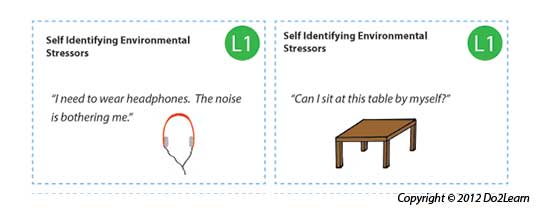
Communication systems and scripts provide the student with a means to initiate communication. Use these cards to practice different scenarios with your students.
|
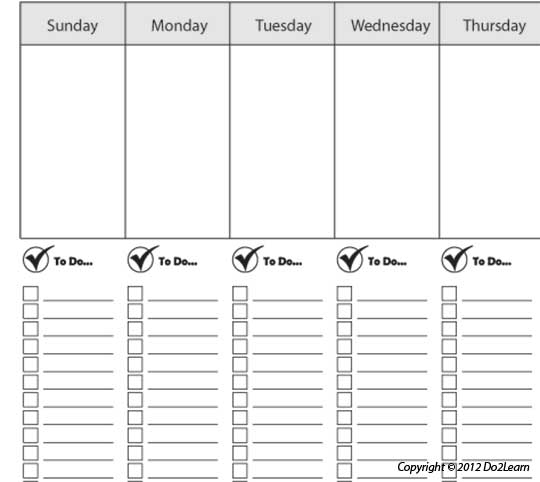
Schedules are visual supports that organize the school or work day and tell the student where he will go that day. Schedules help focus attention on the sequence of places and events.
|
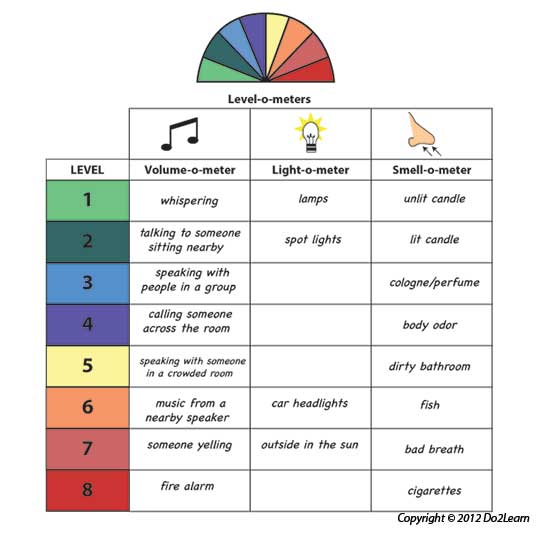
Graphic organizers can provide a student with a way to represent and organize concepts, thoughts, feelings, behaviors, and potential outcomes.
|
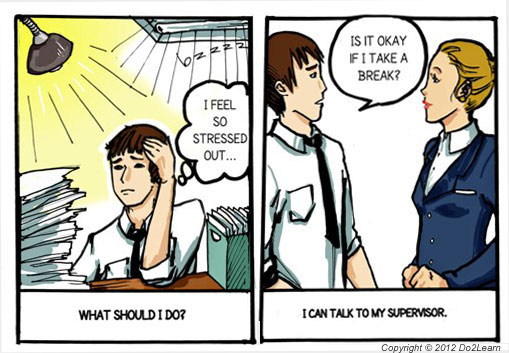
Social narratives are a set of tools that visually represent social situations and appropriate social behaviors. The social narrative connects the important details of a setting or social situation to support the student in understanding the social context and in developing a new social skill.
|
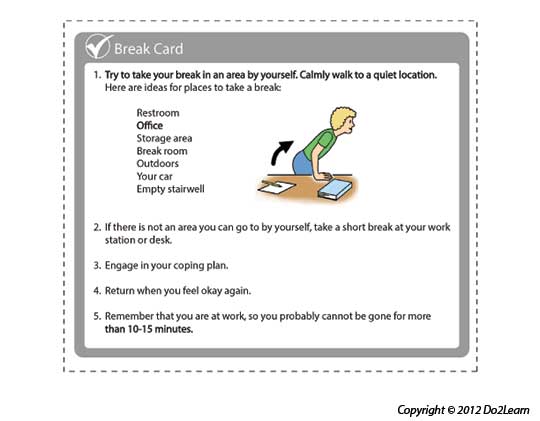
Visual Cues are learning materials that students can keep with them to help guide them through real life situations.
|
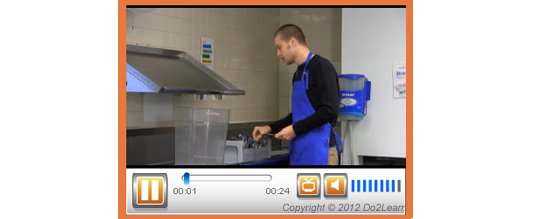
Video modeling involves the use of video recording as a teaching tool. It involves a student watching a video of the appropriate performance of a task (expected behavior) prior to practicing or potentially using the skill in natural settings.
|

How can the instructional team assure reduction in environmental stress? Does the design of space and furniture help the student focus on the tasks and behaviors expected in the setting?
Remember, do not expect the student to make all the accommodations. Provide accommodation first and then teach self-advocacy around environmental stress signals.
Does the environmental design address student issues with proximity to others or even distractibility that may reduce performance (working close to others may set up too much interaction)?
Below are a few strategies related to preferential seating (in school or on the job) that might support the student’s success:
- At the front of the room, near the instructor
- In the back of the room if social anxiety is an issue, if social “visibility” is the student’s concern
- In a seat with an empty seat next to it if the student needs more “space”
- Away from the door if there is a lot of traffic
- Near an exit door if breaks should be readily accessible
- Placed near a conscientious peer/co-worker, and away from more distracting peers
- Placed in a lower traffic area, out of a direct path in the work or classroom setting
- Placed in a grouping arrangement with fewer students/co-workers
- Placed at a work area alone
- Placed in a separate work or testing setting
Is the space designed to support independent movement both within and between tasks?
Be sure the student’s location allows for unobstructed access for task completion when possible. For example, if the student is required to move many boxes from one side of the room to the other, adjust the environment such that there are no barriers (low-desks, other boxes, chairs).
Are there clear separate spaces for different contexts or sets of activities (i.e., place to take a break vs. work spaces vs. place for belongings, etc.)?
|