Personal Information
The workplace is generally not the place to share some types of personal information, from political views to financial status to details about health. Some people may have a hard time knowing what kind of personal information is best kept private, and what things should only be shared in specific situations. It may be appropriate to ask a supervisor for formal accommodations for a disability, for instance, but inappropriate to share the details of that condition with co-workers or acquaintances. In order to avoid potentially embarrassing, inflammatory, or even legally compromising situations, students should be helped to develop a set of guidelines for sharing personal information. Whether these guidelines are strictly black-and-white or are more complex, using them will help the student make good choices about sharing personal information in the workplace.

Teaching Ideas
Click on the icons below for detailed information on how to teach this skill.





 Guiding Questions
- Can the student distinguish between personal and conversational information?
- Can the student identify the contexts (related to both setting and communication partner) in which personal information should not be shared or sought?
- Can the student apply this knowledge and these rules about personal information when he is interacting with others? In other words, can he withhold or filter what he shares or asks?
- For the more advanced student who does not need strict rules presented in only “black and white” terms, can he determine when it might be okay to share personal information (e.g. with a “true” friend outside of the workplace)?
Visual Supports
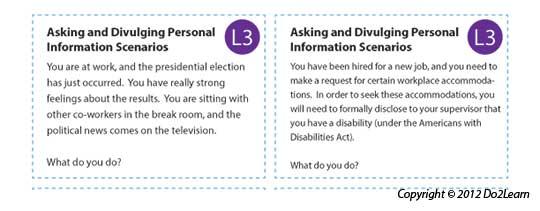
Communication systems and scripts provide the student with a means to initiate communication. Use these cards to practice different scenarios with your students.
|
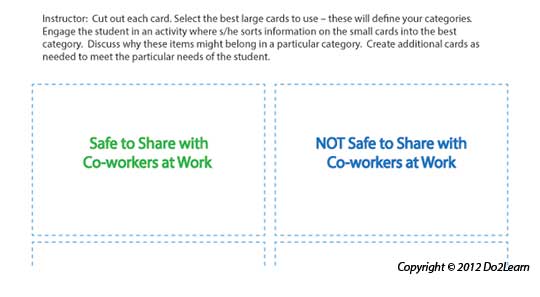
Graphic organizers can provide a student with a way to represent and organize concepts, thoughts, feelings, behaviors, and potential outcomes.
|
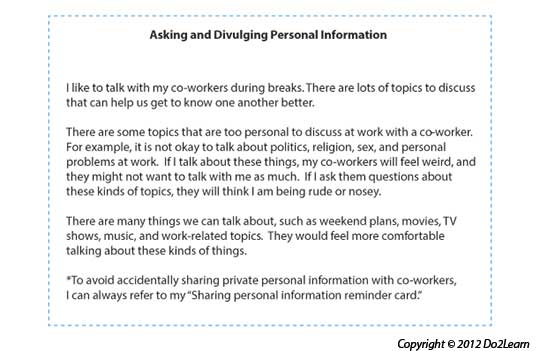
Social narratives are a set of tools that visually represent social situations and appropriate social behaviors. The social narrative connects the important details of a setting or social situation to support the student in understanding the social context and in developing a new social skill.
|
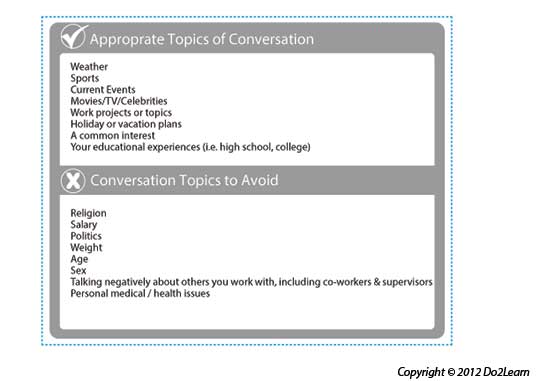
Visual Cues are learning materials that students can keep with them to help guide them through real life situations.
|
|
Video modeling involves the use of video recording as a teaching tool. It involves a student watching a video of the appropriate performance of a task (expected behavior) prior to practicing or potentially using the skill in natural settings.
|