Exiting Conversations
Conversations have a natural arc, and it is important to know when and how to end a conversation. If someone keeps talking when the other person is bored, or leaves a conversation abruptly, it is likely that others will not enjoy conversations with them. Instructors can help students to identify the verbal and nonverbal cues people give when they are ready for a conversation to be over. Scripts can be useful for bringing a conversation to a smooth end. Wrapping up a conversation with style will mean many more conversations in the future.

Teaching Ideas
Click on the icons below for detailed information on how to teach this skill.





 Guiding Questions
- How does the student end the conversation with someone?
- How does the student excuse himself from ongoing conversations within a group?
- Does the student know what to say and how to time that exit?
- Does the student ever initiate ending a conversation, or does he always wait for someone else to end the conversation?
- Does the student struggle to recognize and respond to the cues that indicate that his conversation partner is trying to end the exchange?
Visual Supports
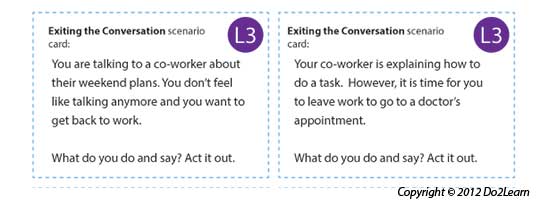
Communication systems and scripts provide the student with a means to initiate communication. Use these cards to practice different scenarios with your students.
|
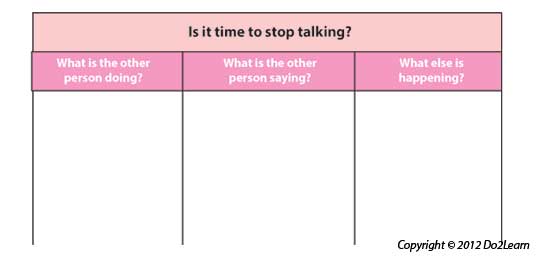
Graphic organizers can provide a student with a way to represent and organize concepts, thoughts, feelings, behaviors, and potential outcomes.
|
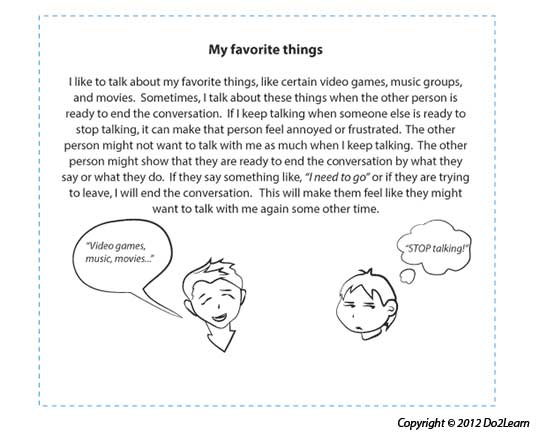
Social narratives are a set of tools that visually represent social situations and appropriate social behaviors. The social narrative connects the important details of a setting or social situation to support the student in understanding the social context and in developing a new social skill.
|
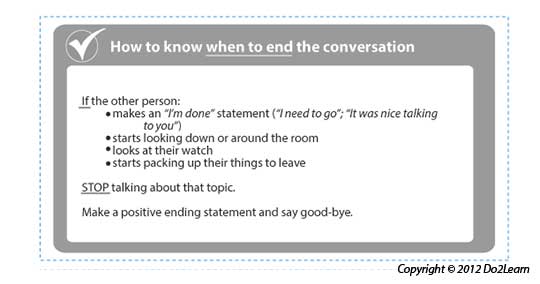
Visual Cues are learning materials that students can keep with them to help guide them through real life situations.
|
|
Video modeling involves the use of video recording as a teaching tool. It involves a student watching a video of the appropriate performance of a task (expected behavior) prior to practicing or potentially using the skill in natural settings.
|