Following Instructions
Following instructions from supervisors, co-workers, and customers is a necessary part of any job. A worker must listen to a request, respond appropriately, transition from their current activity to the new activity, and independently implement the instructions into the new task. Some students may struggle at any step of this process, but there are strategies that a student can use to make following instructions easier. Instructions given in written or picture format, for instance, can help a worker organize multiple-step tasks. Teachers and job coaches should work with a student to find out what kind of strategies help them complete their work with the most independence possible.

Teaching Ideas
Click on the icons below for detailed information on how to teach this skill.





 Guiding Questions
- Is the student able to process verbal instructions consistently or some of the time?
- What type of visual instructions are most effective for the student? Will written instructions, pictures, or a combination words and pictures support consistent and independent performance?
- Does having a jig or visual model help the student?
- How much information can the student process at one time? That is, how many steps can the student follow at one time consistently (one step, two steps, multiple steps; steps in perfect sequence versus those presented out of sequence)? Think about this both verbally and visually.
Visual Supports
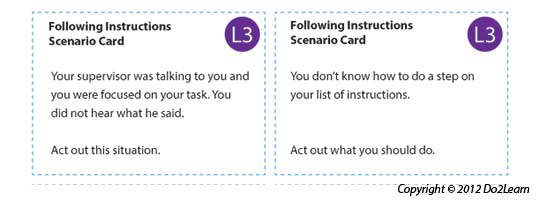
Communication systems and scripts provide the student with a means to initiate communication. Use these cards to practice different scenarios with your students.
|
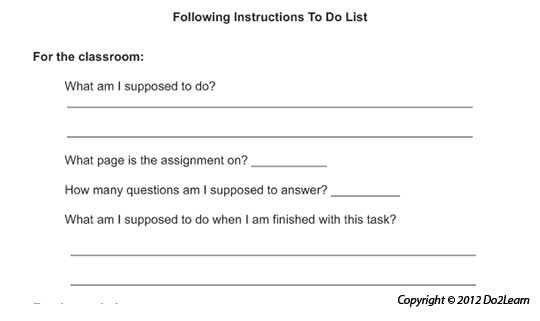
The to-do list (also referred to as a "work system"or "activity system") visually clarifies a series of activities that a student is to do.
|
|
Social narratives are a set of tools that visually represent social situations and appropriate social behaviors. The social narrative connects the important details of a setting or social situation to support the student in understanding the social context and in developing a new social skill.
|
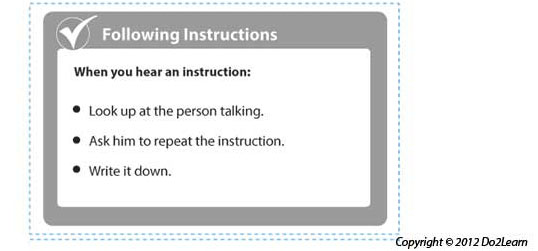
Visual Cues are learning materials that students can keep with them to help guide them through real life situations.
|